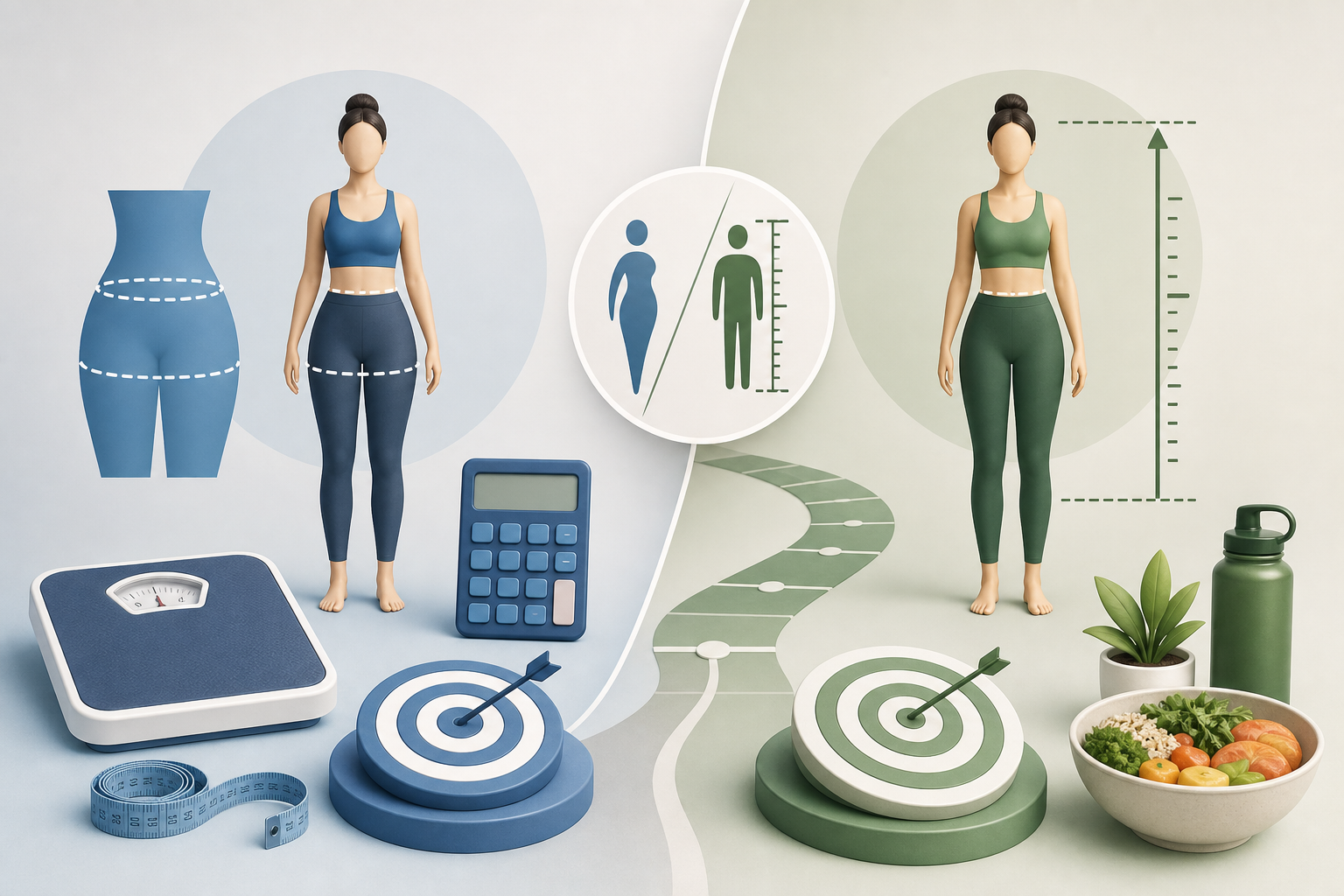
In the comparison of waist to hip ratio vs waist to height ratio, the main difference is the denominator: waist-to-hip ratio divides waist circumference by hip circumference, while waist-to-height ratio divides waist circumference by height. Both are unitless estimates based on body measurements, but they answer different questions and their results are not interchangeable.
Waist to hip ratio vs waist to height ratio: the key differences
Waist-to-hip ratio describes the size of the waist in relation to the hips. It is commonly used as a simple indicator of body fat distribution, particularly whether more body size is carried around the waist than around the hips.
Waist-to-height ratio compares the waist with overall stature. It indicates how large the waist is relative to a person’s height, without considering hip circumference.
| Feature | Waist-to-hip ratio | Waist-to-height ratio |
|---|---|---|
| Measurements used | Waist and hips | Waist and height |
| Formula | Waist ÷ hips | Waist ÷ height |
| Main focus | Waist size relative to hip size | Waist size relative to stature |
| Reflects hip circumference | Yes | No |
| Reflects height | No | Yes |
| Directly measures body fat | No | No |
Neither ratio is a direct measurement of body-fat mass, internal fat, fitness or health. Each is a calculated screening measure that may contribute to a broader assessment.
How each ratio is calculated
Waist-to-hip ratio
The formula is:
Waist-to-hip ratio = waist circumference ÷ hip circumference
For example, a waist of 90 cm and hips of 100 cm produce a waist-to-hip ratio of 0.90:
90 ÷ 100 = 0.90
The same unit must be used for both measurements. Because the units cancel during division, the result has no unit. Measurements of 90 cm and 100 cm give the same ratio as their correctly converted equivalents in inches.
Waist-to-height ratio
The formula is:
Waist-to-height ratio = waist circumference ÷ height
A person with a 90 cm waist and a height of 180 cm would have a waist-to-height ratio of 0.50:
90 ÷ 180 = 0.50
Again, waist and height must use the same unit. Mixing centimetres and inches would produce an invalid result.
Why the two results are not interchangeable
The ratios may look similar because each uses waist circumference as the numerator, but changing the denominator changes the meaning of the calculation. Hip circumference and height represent different physical characteristics.
Consider two people who both have a 90 cm waist. If one has 100 cm hips and the other has 110 cm hips, their waist-to-hip ratios are 0.90 and approximately 0.82. Their waist measurements are identical, but the larger hip circumference lowers the second person’s ratio.
If those two people have the same height, however, their waist-to-height ratios will be the same. Waist-to-height ratio does not respond to differences in hip size.
The reverse also applies. Two people can have the same waist and hip measurements, and therefore the same waist-to-hip ratio, while having different waist-to-height ratios because they are different heights.
This is why one result cannot be converted reliably into the other. To calculate both, you need all three measurements: waist circumference, hip circumference and height.
What each measure can add to a body-size assessment
Waist-to-hip ratio may be useful when the specific question is how waist circumference compares with hip circumference. It describes relative body shape, but it does not reveal why the circumferences differ or identify the tissues contributing to them.
Waist-to-height ratio may be useful when the question is whether a waist measurement is relatively large or small for a person’s stature. It adjusts the waist measurement for height, but it leaves hip size out of the calculation.
Neither ratio should be treated as a complete health profile. Body measurements can be considered alongside factors such as health history, age, physical function, laboratory findings and changes over time. The US National Institute of Diabetes and Digestive and Kidney Diseases provides broader information about weight management and body-size assessment.
Interpretation may also depend on the measurement protocol and the context in which a ratio is used. Avoid applying a cut-off from an unknown source without checking which ratio, measurement method and population it refers to.
What a waist hip ratio calculator can and cannot tell you
A waist hip ratio calculator performs one specific calculation: it divides the entered waist circumference by the entered hip circumference. This reduces manual arithmetic and can make it easier to record results consistently.
What it can tell you
- Your calculated waist-to-hip ratio from the values entered.
- How your waist circumference compares numerically with your hip circumference.
- Whether the ratio has changed when repeat measurements use the same technique.
- A simple description of body proportions based on two circumferences.
What it cannot tell you
- Your waist-to-height ratio unless height is collected and a separate calculation is performed.
- Your body-fat percentage or the precise location of internal fat.
- Your muscle mass, fitness, blood pressure, blood glucose or cholesterol levels.
- The cause of a particular body shape or change in circumference.
- Whether an entered measurement is accurate.
- Your overall health status or future health outcome.
The displayed ratio is a calculated estimate based on the inputs. The waist and hip circumferences themselves are measured values, and errors in either measurement will affect the result.
How to improve measurement consistency
Small differences in tape position, posture or tension can change a circumference reading. A repeat result is most meaningful when the same measurement method is used each time.
- Follow one defined protocol for locating the waist and hips. Measurement sites vary among protocols, so do not switch methods between readings.
- Use a flexible, non-stretch tape on a level line around the body.
- Keep the tape close to the body without compressing the skin.
- Stand in a consistent, relaxed position and avoid deliberately pulling in the abdomen.
- Measure under similar clothing conditions each time.
- Repeat an unexpected reading and check that the tape has not twisted or slipped.
- Record the measurement locations and units along with the result.
If you calculate both ratios, use the same waist measurement for each calculation when the chosen protocols permit it. Keep centimetres with centimetres or inches with inches.
Changes over a very short interval may reflect technique, posture, clothing, breathing or normal day-to-day variation rather than a meaningful change in body composition. Looking at measurements collected consistently over time is generally more informative than focusing on one isolated result.
Frequently asked questions
Is waist-to-hip ratio the same as waist-to-height ratio?
No. Waist-to-hip ratio divides waist circumference by hip circumference. Waist-to-height ratio divides waist circumference by height. They describe different proportions even though both include the waist.
Can I calculate waist-to-height ratio from my waist-to-hip ratio?
Not from the ratio alone. You would need the original waist measurement and the person’s height. Hip circumference does not provide enough information to determine height.
Does a waist-to-hip ratio measure body-fat percentage?
No. It describes waist size relative to hip size. It may provide information about body fat distribution, but it does not calculate the percentage of body weight that is fat.
Why did my ratio change when my waist stayed the same?
For waist-to-hip ratio, a change in hip circumference changes the result even if waist circumference remains stable. For waist-to-height ratio, the value would usually remain unchanged when waist and adult height stay the same. Measurement variation can also affect either result.
Can I compare a result in centimetres with one calculated in inches?
Yes, provided both measurements within each calculation use the same unit and the conversions are accurate. Ratios are unitless, so correctly measured and converted values produce the same result.
Which ratio should I use?
That depends on the question. Use waist-to-hip ratio to compare the waist with the hips, and waist-to-height ratio to compare the waist with stature. In the waist to hip ratio vs waist to height ratio comparison, neither measure replaces the other because each uses a different reference measurement.
Both ratios are simple ways to organise circumference data, not complete evaluations of health or body composition. Their usefulness depends on accurate measurements, consistent technique and interpretation alongside broader health information.