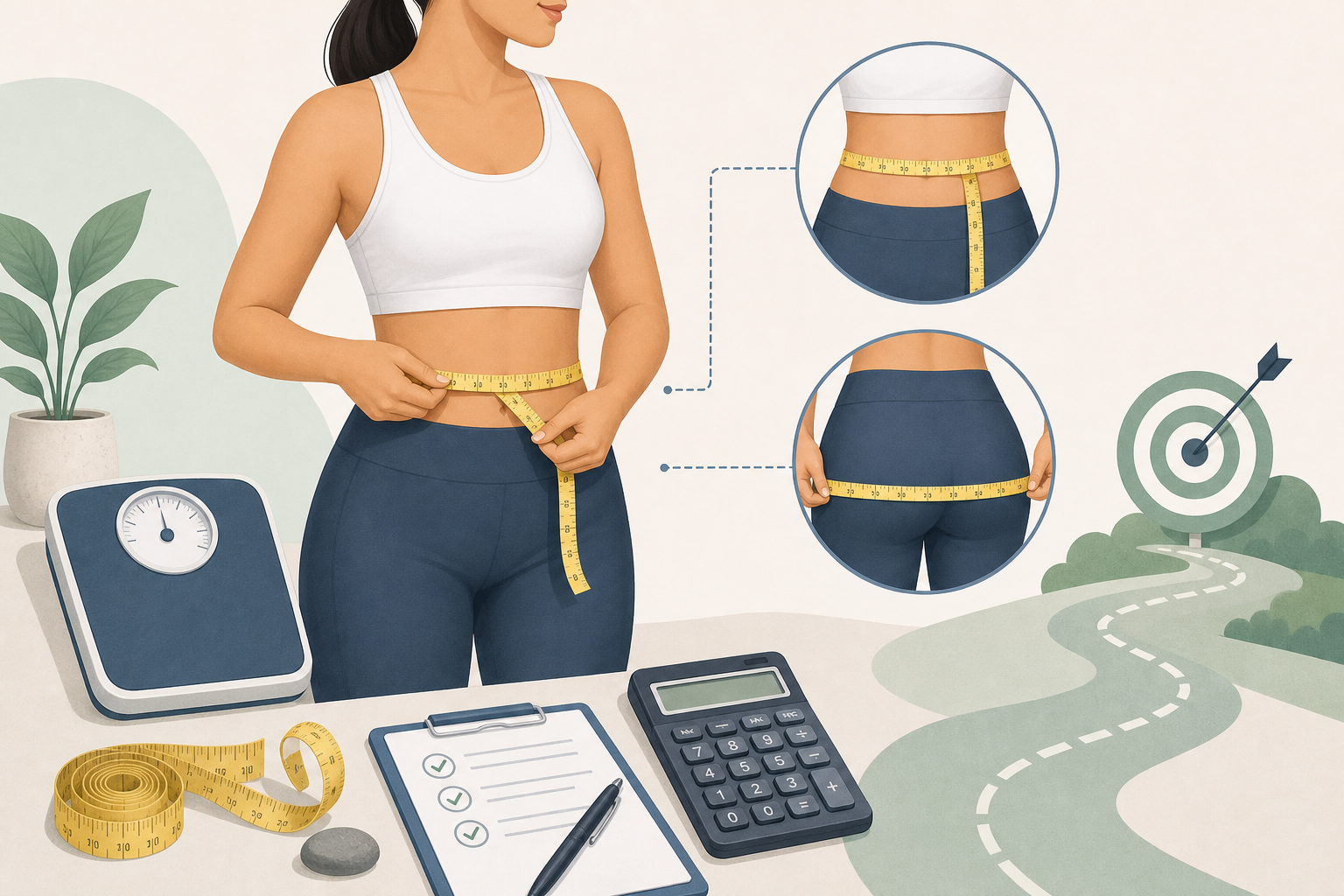
Learning how to measure waist and hips correctly comes down to three details: locating the same anatomical points each time, keeping the tape level, and applying gentle, consistent tension. Measure the waist at a defined point between the lowest rib and the top of the hip bone, and measure the hips around the widest part of the buttocks. Record both circumferences in the same unit.
- What you need before measuring
- How to measure waist and hips step by step
- Measuring your waist
- Measuring your hips
- How to make the measurements repeatable
- Common waist and hip measurement errors
- Measuring over bulky clothing
- Tilting or twisting the tape
- Pulling the tape too tightly
- Using the wrong waist or hip location
- Changing posture or breathing
- Mixing centimetres and inches
- Calculating waist-to-hip ratio
- What the calculator can and cannot tell you
- Frequently asked questions
- Should I measure my waist at the belly button?
- Should the tape be tight or loose?
- Can I measure over clothes?
- Why do I get a different result each time?
- Can I use inches for one measurement and centimetres for the other?
- How often should I measure?
Small changes in tape position, posture, clothing or breathing can alter the result. A repeatable technique is therefore more useful than trying to obtain a particular number.
What you need before measuring
- A flexible, non-stretch measuring tape
- A mirror, if measuring without assistance
- Light, close-fitting clothing or bare skin
- A place to record the measurement, unit and date
A fabric or fibreglass body-measuring tape is preferable to a rigid construction tape. Check that the tape is not stretched, twisted or damaged and that its zero mark is easy to identify.
Measure under similar conditions when comparing results over time. For example, use the same tape and measurement method, and measure at roughly the same time of day. Circumference can vary temporarily with meals, hydration, clothing and abdominal tension.
How to measure waist and hips step by step
Measuring your waist
- Stand upright with your feet together or comfortably close, your weight evenly distributed and your abdomen relaxed.
- Locate the bottom of your lowest palpable rib and the top of your hip bone on each side.
- Identify the midpoint between these two landmarks. Use this level consistently around your body.
- Wrap the tape horizontally around your waist at that point.
- Check in a mirror that the tape is parallel to the floor and has not risen or dropped at the back.
- Let the tape rest against the skin without compressing it.
- Breathe normally, then take the reading after a gentle, normal exhalation. Do not hold your breath or pull your abdomen inward.
- Record the circumference immediately, including whether you used centimetres or inches.
Waist-measurement protocols are not always identical. Some tools or health programmes may specify the narrowest part of the torso, the level of the navel or another anatomical point. These locations can produce different values, so follow the method specified by the calculator or programme and document the method you used.
If no method is specified, the midpoint between the lowest rib and the top of the hip bone provides a defined location that is easier to repeat than an estimated “natural waist.” The navel should not automatically be used because its position does not necessarily identify the required waist level.
Measuring your hips
- Remain standing upright with your feet together or close and your weight evenly balanced.
- Wrap the tape around the widest circumference of your buttocks.
- Move the tape slightly up or down if necessary to find the largest reading.
- Use a mirror to confirm that the tape is level all the way around.
- Keep the tape flat and snug without squeezing the skin or compressing clothing.
- Read and record the measurement in the same unit used for your waist.
The hip measurement refers to the largest horizontal circumference around the buttocks, not simply the level of the hip bones. From the side, the tape will often pass around the fullest projection of the buttocks.
How to make the measurements repeatable
Take each circumference at least twice. Remove and reposition the tape between readings rather than leaving it in place. If the results differ noticeably, take a third measurement and review the tape position, tension and posture.
Use one consistent approach to record repeated readings. For example, you might record the average of two close measurements or repeat the process until two measurements agree closely. Note the method so that you can use it again.
- Use the same anatomical location every time.
- Stand in the same posture without twisting or leaning.
- Keep your abdomen and buttocks relaxed.
- Use similar clothing, preferably thin and close-fitting.
- Apply enough tape tension to remove slack, but not enough to indent the skin.
- Read the tape at eye level rather than looking down at an angle.
- Record values with sensible precision for your tape, such as the nearest visible division.
If another person takes the measurements, use the same helper where practical. Different people may position or tighten the tape differently.
Common waist and hip measurement errors
Measuring over bulky clothing
Thick waistbands, belts, pockets and layered clothing add to the circumference and can prevent the tape from lying flat. Measure on bare skin or over one thin layer.
Tilting or twisting the tape
A tape that is lower at the front and higher at the back follows a longer or different path around the body. Check the full loop in a mirror, not just the section visible from the front.
Pulling the tape too tightly
The tape should touch the body without digging in. Compressing soft tissue can produce a smaller reading that is difficult to reproduce.
Using the wrong waist or hip location
The waist is not necessarily the trouser waistband, and the hip circumference is not measured only across the bony sides of the pelvis. Define the location before starting and keep that definition consistent.
Changing posture or breathing
Arching the back, spreading the feet, tightening the abdomen or taking a deep breath can change the waist reading. Stand naturally and take the measurement after a normal exhalation.
Mixing centimetres and inches
A waist-to-hip ratio is unitless because it divides one circumference by another. However, the entered measurements must use the same unit. Dividing a waist in centimetres by hips in inches gives an invalid result.
Calculating waist-to-hip ratio
Waist-to-hip ratio compares waist circumference with hip circumference. It is a simple numerical description of body fat distribution based on external measurements.
The formula is:
Waist-to-hip ratio = waist circumference ÷ hip circumference
For example, a person with a 90 cm waist and a 100 cm hip circumference has the following result:
90 ÷ 100 = 0.90
The result has no unit. The same correctly converted measurements in inches would produce the same ratio.
A waist hip ratio calculator performs this division after the two circumferences are entered. The quality of its result still depends on the accuracy and consistency of the measurements provided.
What the calculator can and cannot tell you
The calculator can provide your waist to hip ratio, show how the value was calculated and offer a consistent way to repeat the calculation after future measurements. It may also help document changes in the relative size of the waist and hips when the same measurement method is used.
The ratio can describe one aspect of body fat distribution, but it does not directly measure body fat mass, internal fat, muscle mass, fitness, blood pressure, blood glucose or overall health. Two people with the same ratio may have different body sizes, body compositions and health circumstances.
A result can also change because of measurement error rather than a meaningful physical change. A different waist location, tighter tape or altered posture may affect the numerator and therefore the ratio.
Interpretation should take account of broader information rather than relying on one calculated value. The National Institute of Diabetes and Digestive and Kidney Diseases provides wider context on weight management and body-size assessment.
Frequently asked questions
Should I measure my waist at the belly button?
Not unless the method you are following specifically requires that location. The navel is easy to find, but it may sit above or below the waist point defined by another protocol. For repeatability, use a clearly defined anatomical location and record it.
Should the tape be tight or loose?
It should be snug enough to lie flat and remove slack, but not tight enough to compress the skin. Consistent tape tension is important when comparing measurements.
Can I measure over clothes?
Thin, close-fitting clothing may be workable if it does not bunch under the tape. Bare skin is generally easier to measure consistently. Avoid thick clothing, belts and bulky waistbands.
Why do I get a different result each time?
Common causes include a tilted tape, changing the measurement location, different tape tension, altered posture or breathing. Remove and reposition the tape between readings, and use a mirror to check that it remains horizontal.
Can I use inches for one measurement and centimetres for the other?
No. Both measurements must use the same unit before they are divided. You may use either centimetres or inches, provided the unit is consistent.
How often should I measure?
There is no single schedule suitable for everyone. If you are tracking changes, allow enough time between measurements to avoid treating normal short-term variation as a trend. Use the same method and conditions each time.
The central principle in how to measure waist and hips is consistency: use defined landmarks, keep the tape horizontal and snug, relax your body, and record the method alongside the numbers. This makes the resulting ratio more repeatable and easier to interpret in context.