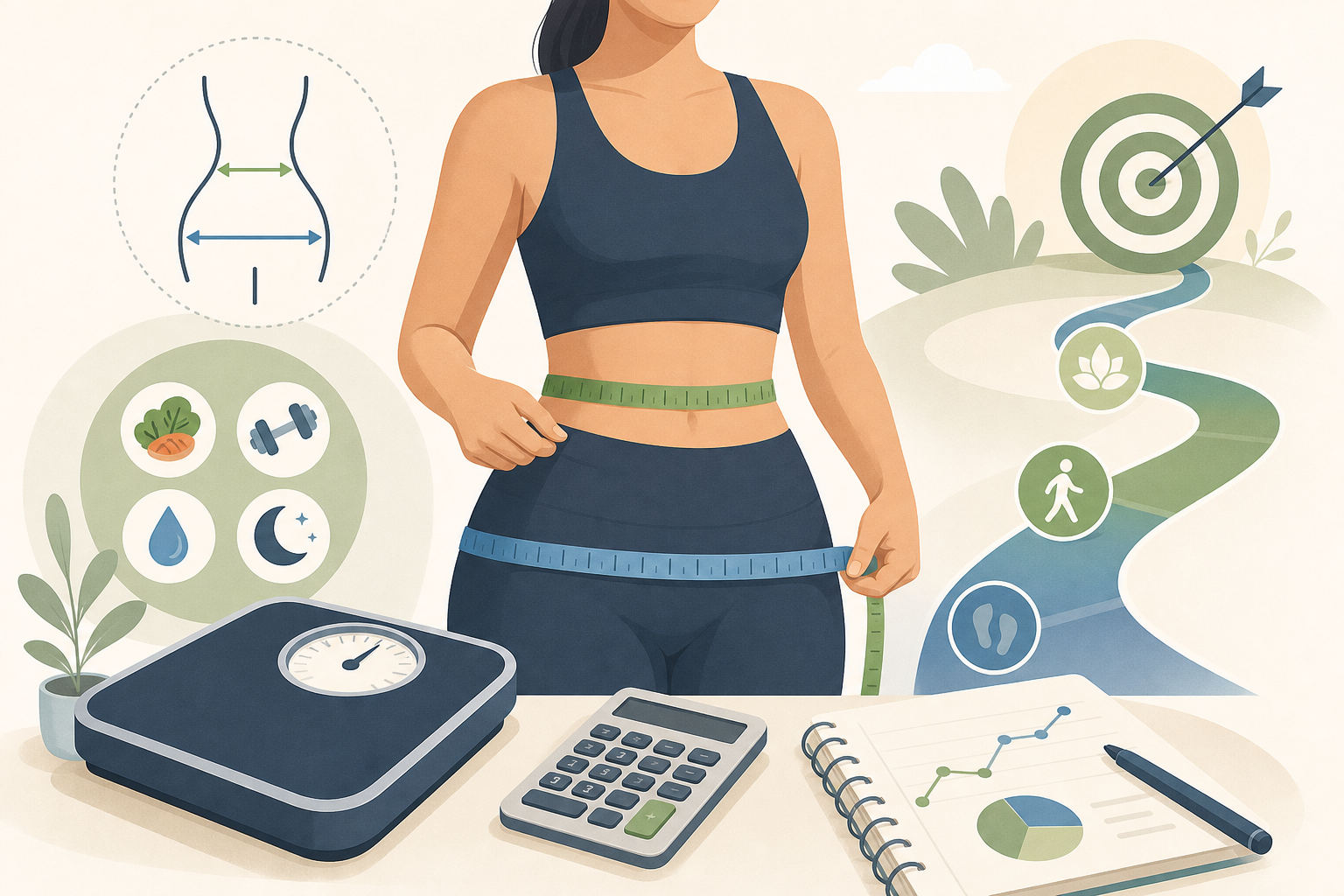
Your waist to hip ratio during weight loss can rise, fall, or remain almost unchanged because waist and hip circumferences do not always decrease at the same rate. The ratio may also shift because of measurement technique, posture, clothing, or normal short-term changes around the abdomen. For that reason, a series of consistently taken measurements is usually more informative than one result.
How waist to hip ratio during weight loss can change
Waist-to-hip ratio compares the circumference of your waist with the circumference of your hips. It is calculated with a simple formula:
Waist-to-hip ratio = waist circumference ÷ hip circumference
Because both measurements use the same unit, the result is unitless. A 90 cm waist and a 100 cm hip circumference, for example, give a ratio of 0.90. Using inches for both measurements would produce the same ratio.
During weight loss, three broad patterns are possible:
- The ratio decreases: the waist becomes smaller faster than the hips.
- The ratio increases: the hips become smaller faster than the waist.
- The ratio remains similar: both circumferences change at roughly the same proportional rate.
This means a higher ratio does not automatically mean that the waist has grown. It may simply mean that the hip measurement has decreased more quickly.
Why waist and hip measurements may change at different rates
Changes in body size are not always evenly distributed. A person may notice a clear difference around the waist while seeing little change at the hips, or the reverse. Individual body shape and body fat distribution influence where circumference changes become noticeable.
Waist circumference can reflect more than body fat
The waist measurement includes the tissues around the abdomen, but it can also be affected by factors such as posture, abdominal muscle tension, breathing, meals, and temporary digestive fullness. These influences can create small changes even when longer-term body composition has not changed substantially.
For example, measuring after a large meal may produce a different result from measuring before breakfast. Pulling the abdomen inward or measuring after a full exhalation can also change the tape reading.
Hip circumference includes several body tissues
Hip circumference reflects the size of the pelvis area, including fat, muscle, and other tissues. Changes in the muscles around the hips and buttocks may affect the measurement, particularly if someone changes their resistance-training or general activity routine while losing weight.
The underlying bone structure does not become narrower through ordinary weight loss. Therefore, hip circumference may eventually change more slowly in some people, even while other measurements continue to decrease.
Proportional change matters
A ratio responds to the relationship between two numbers, not just the direction of either number. A small waist reduction can be outweighed mathematically by a larger proportional reduction in hip circumference.
For instance, a waist changing from 90 cm to 88 cm is a reduction. However, if the hips change from 100 cm to 95 cm over the same period, the ratio rises from 0.90 to about 0.93. The higher ratio occurs even though both measurements became smaller.
Measurement technique can look like a change in the ratio
Waist-to-hip ratio is calculated from measured circumferences, so any inconsistency in either measurement affects the result. A difference of only a centimetre or two can be enough to shift the displayed ratio, especially when results are rounded.
For more comparable measurements:
- Use the same flexible, non-stretch tape each time.
- Measure the waist and hips at the same anatomical locations.
- Keep the tape level and parallel to the floor.
- Place the tape against the body without compressing the skin.
- Stand in a similar relaxed posture each time.
- Measure under similar conditions, such as at a consistent time of day.
- Record the unrounded circumferences as well as the calculated ratio.
Definitions of the waist measurement site can vary between tools and organisations. Whichever method is being used, changing the location from one session to another makes trend comparisons less reliable. The widest part of the hips should also be identified consistently rather than estimated differently each time.
If a reading seems unexpected, repeating each circumference two or three times can help identify tape-placement errors. Large differences between repeated measurements suggest that technique, rather than body change, may be affecting the result.
A practical example of changing waist-to-hip ratio
Consider a person who records waist and hip measurements once every four weeks under similar conditions:
| Measurement point | Waist | Hips | Waist-to-hip ratio |
|---|---|---|---|
| Starting measurement | 96 cm | 108 cm | 0.89 |
| After four weeks | 93 cm | 106 cm | 0.88 |
| After eight weeks | 91 cm | 102 cm | 0.89 |
| After twelve weeks | 88 cm | 100 cm | 0.88 |
The ratio moves between 0.88 and 0.89 even though both measurements trend downward. At eight weeks, the ratio returns to its starting value because hip circumference has decreased proportionally faster during that interval.
Looking only at the ratio might hide useful information. Recording the waist, hips, ratio, and measurement date shows what actually changed and makes the pattern easier to interpret.
What a waist hip ratio calculator can and cannot tell you
A waist hip ratio calculator divides the entered waist circumference by the entered hip circumference. It reduces arithmetic errors and can make repeated results easier to compare.
The calculator can tell you:
- Your calculated waist-to-hip ratio from the measurements entered.
- How the relationship between waist and hip circumference changes over time.
- Whether a ratio changed because of newly entered measurements.
It cannot tell you:
- Whether either circumference was measured at the correct location.
- Why your waist or hips changed.
- How much body fat or muscle you gained or lost.
- Where a change in body weight came from.
- Your overall health status or individual health risk.
The output is a calculation based on your inputs, not a direct measurement of body composition. It is one simple description of body fat distribution, but it does not separate fat from muscle or account for all factors relevant to health.
How to interpret the trend without overreacting to one result
Start by examining the original circumferences. If the ratio rises, check whether the waist increased, the hips decreased, or both changed. These patterns have different mathematical explanations even when they produce the same ratio.
Next, consider the size and consistency of the change. A single unexpected value may reflect tape placement or short-term abdominal variation. Several measurements taken in the same way provide a clearer trend.
It can also be useful to review waist-to-hip ratio alongside body weight, waist circumference, clothing fit, physical function, and other health information relevant to the individual. The National Institute of Diabetes and Digestive and Kidney Diseases presents body-size assessment within a broader weight-management context rather than as a complete picture on its own.
In summary, interpreting waist to hip ratio during weight loss requires attention to both underlying measurements. A stable or rising ratio does not necessarily mean that progress has stopped, just as a falling ratio does not describe every aspect of body composition or health.
Frequently asked questions
Can waist-to-hip ratio increase while I lose weight?
Yes. This can happen if hip circumference decreases proportionally faster than waist circumference. It may also result from differences in measurement location or technique.
Why did my ratio stay the same when both measurements decreased?
If the waist and hips decrease by similar proportions, their ratio can remain nearly unchanged. For example, 90 cm divided by 100 cm and 81 cm divided by 90 cm both equal 0.90.
How often should I measure my waist and hips?
There is no single interval that suits everyone. Measuring too frequently may emphasise ordinary short-term variation, while a consistent schedule spaced far enough apart to observe a trend can make comparisons easier. Use the same timing and technique whenever possible.
Should I round my measurements before using the calculator?
Enter the measured values as recorded rather than rounding them first. The calculator can round the final result for display. Keeping the original measurements also makes it easier to investigate small changes later.
Does a lower waist-to-hip ratio prove that I lost abdominal fat?
No. A lower ratio shows that the waist became smaller relative to the hips, based on the measurements entered. Circumference alone cannot identify the tissue responsible for the change or directly measure abdominal fat.
Can I compare results measured in centimetres and inches?
Yes, provided both the waist and hip measurements in each calculation use the same unit. Because one circumference is divided by the other, the unit cancels out. Do not divide a waist measurement in centimetres by a hip measurement in inches.