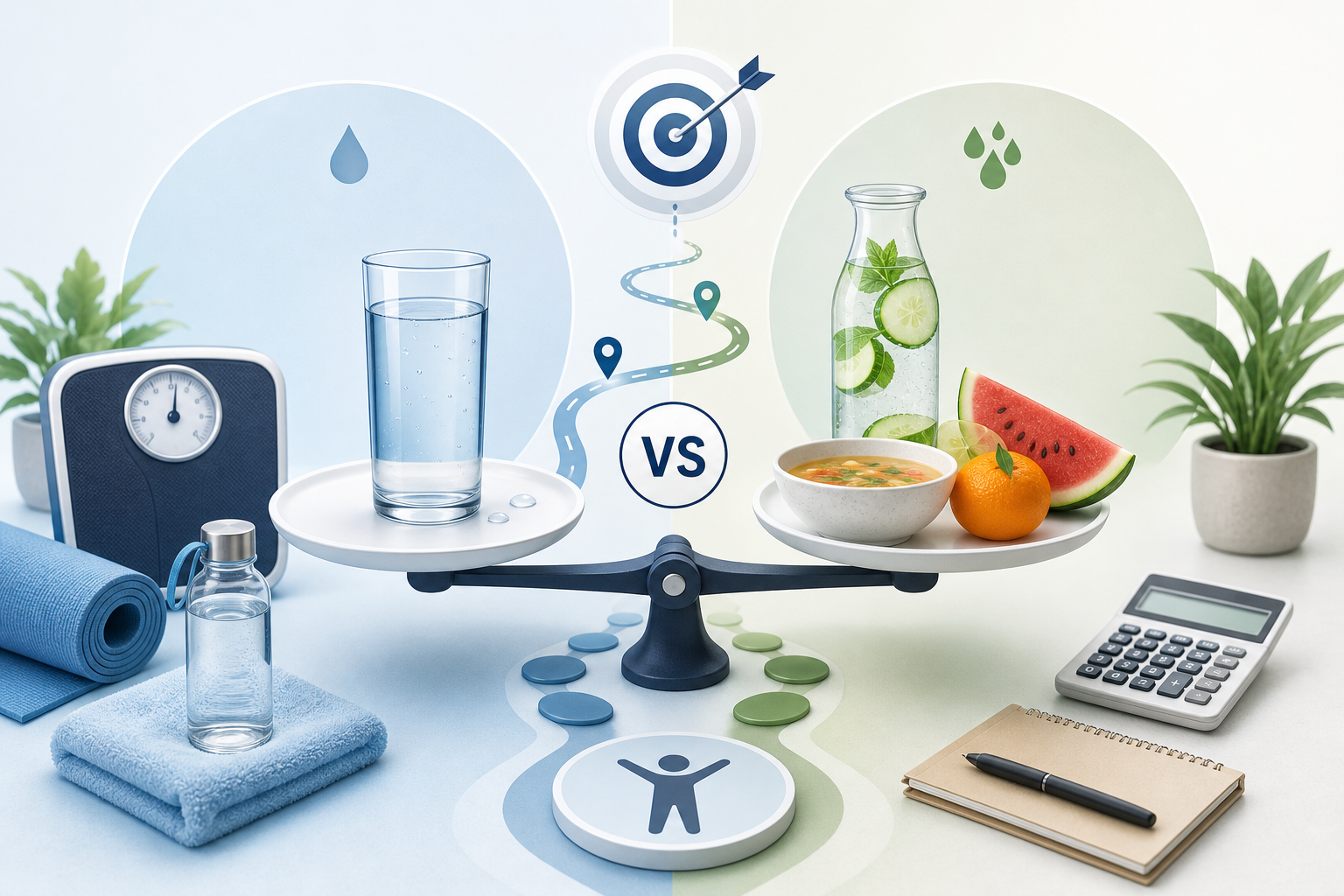
The question drinking water vs total water intake what counts has a straightforward answer: total water includes plain drinking water, water in other beverages, and moisture contained in food. Drinking water is therefore one part of daily water intake, not the whole amount. Adult reference values generally describe total water from all these sources rather than the number of litres of plain water a person must drink.
Drinking water vs total water intake what counts in each total?
Drinking water usually means plain water consumed from a glass, bottle, tap or fountain. Sparkling water and unsweetened flavoured water may also fit this category, depending on how an app or food diary labels them.
Total water intake is broader. It includes:
- Plain still or sparkling water
- Water in tea, coffee, milk and other beverages
- Water used in soups, broths and similar dishes
- Moisture naturally present in fruit, vegetables, yoghurt and other foods
The National Academies’ Dietary Reference Intakes give approximate adult adequate intakes of 3.7 litres per day for men and 2.7 litres per day for women. These figures include water from both food and beverages. They are population-level reference values, not individual drinking targets.
This distinction matters because interpreting 3.7 litres as a requirement for plain water would leave out the water already obtained from meals and other drinks. The reference value describes the combined total.
How beverages and foods contribute to daily water intake
Plain water is often a convenient source because it contains no sugar and can be consumed with meals or between them. However, it is not the only beverage that contributes water.
Tea, coffee, milk and other drinks contain substantial amounts of water. Caffeinated beverages still contribute to total water intake, although their caffeine, sugar and energy content may be relevant for other dietary reasons. Counting a beverage as a water source does not mean that every beverage has the same nutritional profile as plain water.
Food also makes a meaningful contribution. The exact amount depends on the foods chosen and how they are prepared. A diet containing soups, fruit, vegetables, yoghurt and cooked grains will generally provide more moisture than one based largely on dry foods.
Examples of food moisture
- Soup and broth contain water as a major ingredient.
- Fruit and vegetables often contain considerable natural moisture.
- Yoghurt, porridge and cooked rice contain water even though they are eaten rather than drunk.
- Bread, crackers, nuts and other relatively dry foods contribute less moisture by volume.
Food moisture does not need to be separately “replaced” with plain water when interpreting a total-water reference. It is already part of the total.
A practical total-water example
Consider an adult whose drinks over one day include 1.5 litres of plain water, two mugs of tea and a glass of milk. The person also eats porridge, vegetable soup, fruit and a cooked evening meal.
Looking only at the 1.5 litres of plain water would understate total water intake. The tea and milk add beverage water, while the porridge, soup, fruit and other foods add moisture. Estimating the exact food contribution would require detailed information about portions, ingredients and preparation.
This example also shows why a bottle count is not the same as a total-water count. Two people could drink the same amount of plain water but have different total intakes because their other beverages and meals differ.
For everyday planning, it may be more practical to recognise the main sources than to calculate every millilitre in food. Detailed tracking can create an impression of precision that the available food and portion information may not support.
What a water intake calculator can and cannot tell you
A water intake calculator can display the adult total-water reference associated with the selected sex category. It uses the Dietary Reference Intake values of approximately 3.7 litres per day for men and 2.7 litres per day for women, including water from food and beverages.
The result is a reference estimate rather than a measured personal requirement. A hydration calculator cannot determine the exact amount of water absorbed from a person’s meals, account fully for changing conditions, or confirm an individual’s hydration status.
What the calculator can provide
- An adult population-level total-water reference
- Equivalent units where supported by the tool
- Context about the approximate share commonly obtained from beverages
- A starting point for understanding total intake rather than plain water alone
What the calculator cannot determine
- An exact personal fluid requirement
- The measured moisture content of a particular day’s meals
- How much fluid is needed during a specific exercise session or hot day
- Whether symptoms are related to hydration
- How illness, medication, pregnancy or breastfeeding changes an individual plan
Calculator outputs should not be interpreted as instructions to consume the entire displayed amount as plain water. The estimate represents total water from beverages and food combined.
Why individual water needs may differ from the reference
Adequate Intake values are designed as broad reference points. They do not imply that every adult in a category needs exactly the same amount each day.
Climate can affect fluid losses, particularly in hot conditions. Physical activity may also increase losses through sweating, while the amount lost can vary with exercise intensity, duration, clothing and environment.
Diet changes the amount of moisture obtained from food. Someone eating soup, fruit and other water-rich foods may obtain more water from meals than someone eating mostly dry foods. This can change the amount that needs to come from drinks even when total intake is similar.
Pregnancy, breastfeeding, illness and some medications can also alter fluid considerations. In such circumstances, a general daily water intake estimate may not reflect personalised guidance.
Day-to-day needs are not necessarily fixed. A reference value is best understood as context for planning rather than a precise quota that must be reached identically every day.
Frequently asked questions
Does coffee count towards total water intake?
Yes. The water in coffee contributes to total water intake. Coffee may also contain caffeine and added ingredients, so counting its water contribution does not make it nutritionally identical to plain water.
Does tea count as drinking water?
Tea contributes to total water intake, but it is usually recorded as a beverage rather than plain drinking water. The distinction is mainly about labelling: its water still forms part of the daily total.
Do fruit and vegetables count towards hydration?
The moisture in fruit and vegetables counts towards total water intake. The amount varies by food and serving size, so it is usually an estimate unless the food and quantity are analysed in detail.
Should I drink 2.7 or 3.7 litres of plain water?
Those adult reference figures describe total water from food and beverages, not a required volume of plain water. How much comes from plain water depends partly on other drinks, food moisture and individual circumstances.
Is a water intake calculator giving an exact target?
No. It provides a population-level reference estimate based on the selected inputs. It does not directly measure fluid losses, food moisture or personal hydration status.
Putting the distinction into practice
For drinking water vs total water intake what counts, the essential distinction is that plain water is only one contributor. Other beverages and the moisture in food also form part of total daily water intake.
When reviewing a calculator result or reference value, first check whether it refers to plain water, beverages or total water. For the adult Dietary Reference Intake values discussed here, the total includes both food and drinks. This avoids treating a broad reference estimate as a fixed plain-water prescription.