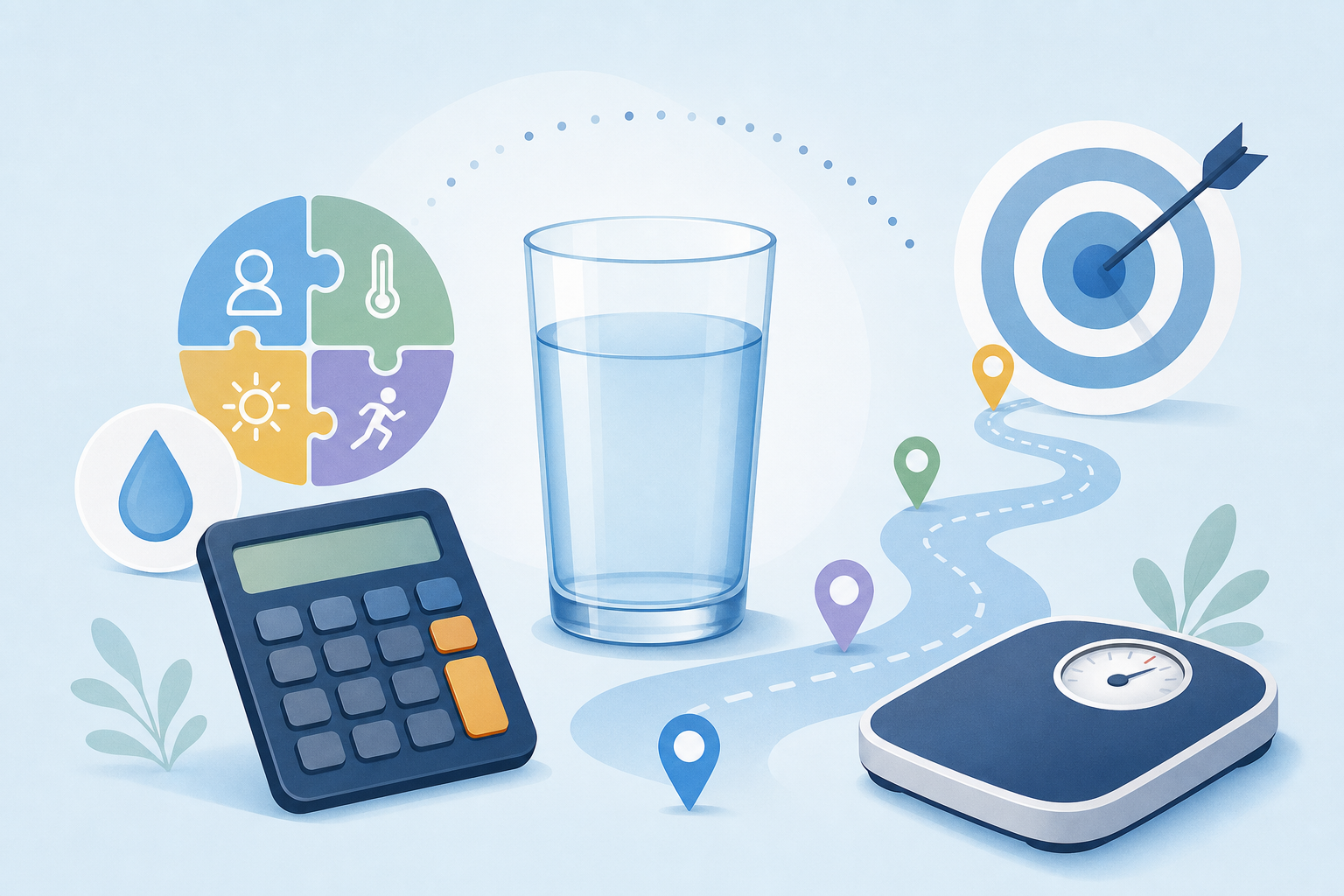
The main reason why water intake calculators give estimates not exact targets is that hydration needs change with climate, activity, diet, health status and individual fluid losses. A calculator can provide a useful adult reference value, but it cannot measure how much water a particular person needs on a particular day.
Most calculators begin with population-level reference values. These are suitable for general planning, not precise prescriptions or guarantees that a fixed amount will be appropriate in every situation.
Why water intake calculators give estimates not exact targets
A water intake calculator uses a defined formula or reference standard. The related calculator uses adult Dietary Reference Intake values of approximately 3.7 litres of total water per day for men and 2.7 litres for women.
These values include water from both drinks and food. They are Adequate Intake reference values for generally healthy populations, rather than minimum requirements or individually measured needs.
The calculation also depends on the information entered and the assumptions built into the tool. Even if the reference value is reliable at a population level, it cannot account fully for changing weather, sweat losses, food moisture, illness, medication use or differences between individuals.
Daily water intake includes more than drinking water
Daily water intake means total water from all sources. Plain water contributes, but so do other beverages and the moisture naturally present in foods.
Foods vary considerably in water content. Meals containing soups, fruit, vegetables, yoghurt or other moisture-rich foods may provide more water than meals based mainly on dry foods. As a result, two people can have similar total-water intake while drinking different amounts.
This distinction matters when reading a hydration calculator result. A reference value of 2.7 or 3.7 litres does not necessarily mean that the entire amount must be consumed as plain water. If the calculator shows an approximate beverage share, that figure provides context rather than an exact drinking target.
The National Academies’ Dietary Reference Intakes also distinguish total water from water consumed only through beverages. This is why calculator results should be interpreted according to the label shown, rather than treated automatically as a number of bottles or glasses.
Factors that can change hydration needs
Fluid needs can differ between people and can change from one day to the next. A general reference calculator cannot measure all the following influences.
Climate and environment
Hot conditions can increase sweating, while dry or windy environments may also affect fluid losses. Time spent indoors in a temperature-controlled setting is different from prolonged exposure to outdoor heat.
Altitude and travel to an unfamiliar climate may also change normal routines and fluid losses. A calculator that asks only for sex or age cannot identify these environmental differences.
Physical activity
Activity can increase fluid loss through sweat. The amount varies with exercise intensity, duration, clothing, weather, fitness and personal sweat rate.
A short, low-intensity activity session in a cool room is not equivalent to several hours of outdoor physical work. Without measured fluid losses and detailed activity information, a calculator cannot determine the exact additional amount needed.
Diet and beverage patterns
The amount of water supplied by food depends on what a person eats. Diet can therefore change how much fluid needs to come from beverages, even when total-water intake is similar.
Meal composition and drinking patterns may also vary from day to day. A calculator’s beverage estimate cannot analyse the moisture content of every meal unless detailed food data are provided.
Pregnancy and breastfeeding
Pregnancy and breastfeeding can change fluid requirements. A basic adult calculator based only on male and female reference values may not include the specific reference categories that apply during these stages.
Users should check whether a tool explicitly accounts for pregnancy or breastfeeding before relying on its displayed estimate.
Illness, medicines and health status
Illness can alter fluid intake or losses. Medicines and health conditions can also affect how the body handles water or whether fluid intake needs to be adjusted.
A general calculator cannot assess these clinical factors. When an individual has been given personalised instructions about fluid intake, those instructions are more relevant than a population-level calculator estimate.
Individual variation
People differ in body composition, daily movement, sweat rate, food intake and routines. Two adults placed in the same broad calculator category may therefore have different practical needs.
Needs also vary within the same person. A quiet day in mild weather may not require the same intake pattern as an active day in hot conditions.
A practical example of why one number may not fit
Consider two adult men who receive the same 3.7-litre total-water reference from a calculator. One works at a desk in a climate-controlled office and eats several moisture-rich foods. The other spends part of the day doing physical work outdoors in hot weather.
The calculator gives the same starting reference because both users fall into the same adult category. However, the outdoor worker may lose more fluid through sweat, while the office worker may obtain a larger share of total water from food.
The result is not necessarily wrong. It is simply answering a limited question: what is the general adult total-water reference for the selected category? It is not measuring either person’s actual daily fluid losses.
The same principle applies across seasons. A result calculated in winter does not become a precise summer target merely because the user’s basic details remain unchanged.
What the water intake calculator can and cannot tell you
The water intake calculator displays the appropriate adult total-water reference and an approximate beverage share for context. Its value is in translating reference information into a clear planning estimate.
What it can tell you
- The adult total-water reference associated with the selected sex category.
- An approximate daily amount expressed in the chosen unit system.
- That total water includes both beverages and moisture from food.
- An estimated beverage contribution, based on the assumptions explained by the tool.
- A general baseline that can be considered alongside daily circumstances.
What it cannot tell you
- Your exact fluid requirement on a specific day.
- How much water you are losing through sweat or other routes.
- The precise amount of water contained in your meals.
- Whether your current hydration status is adequate.
- How pregnancy, breastfeeding, illness, medicines or a health condition should change your intake.
- Whether a personalised fluid limit or clinical hydration plan is appropriate.
To use the result correctly, first confirm whether it refers to total water or beverages alone. Then review the tool’s assumptions and consider whether current activity, weather, diet or health circumstances differ substantially from the general adult conditions represented by the reference.
Frequently asked questions
Is the calculator result a minimum amount of water?
No. The result is an Adequate Intake reference for total water, not a universal minimum that every adult must reach exactly. Individual intake may differ because the reference is designed for population-level guidance.
Does the result mean I should drink that amount as plain water?
Not necessarily. Total-water values include water from beverages and food. The amount that needs to come from plain water depends partly on other drinks and the moisture content of meals.
Why does the calculator use different reference values for men and women?
The method uses sex-based adult Dietary Reference Intake categories. These categories provide broad reference values, but they do not account for every difference in body size, activity, environment or health status.
Should I recalculate my intake when the weather changes?
Your underlying adult reference category may remain the same, but weather can affect fluid losses. Recalculating with a basic tool may produce the same result unless climate is an input, so the displayed value should still be treated as a baseline rather than a weather-specific target.
Can a hydration calculator account for exercise?
Only if the tool specifically requests activity information and explains how it is used. Even then, exercise-related fluid loss differs by intensity, duration, conditions and individual sweat rate, so the result remains an estimate.
Why might another water calculator give a different answer?
Calculators may use different references, formulas, unit conversions or assumptions about the share supplied by food. Check whether each result represents total water, beverages only or plain water before comparing the numbers.
Understanding why water intake calculators give estimates not exact targets
Understanding why water intake calculators give estimates not exact targets helps prevent a general reference from being mistaken for a precise daily prescription. The calculator’s 3.7-litre and 2.7-litre adult values describe total water from food and beverages, based on broad population categories.
Climate, activity, diet, pregnancy, breastfeeding, illness, medications and individual variation can all change the practical amount of fluid a person consumes or loses. The most accurate interpretation is therefore to treat the result as a reference point, read its assumptions and recognise what the calculation does not measure.