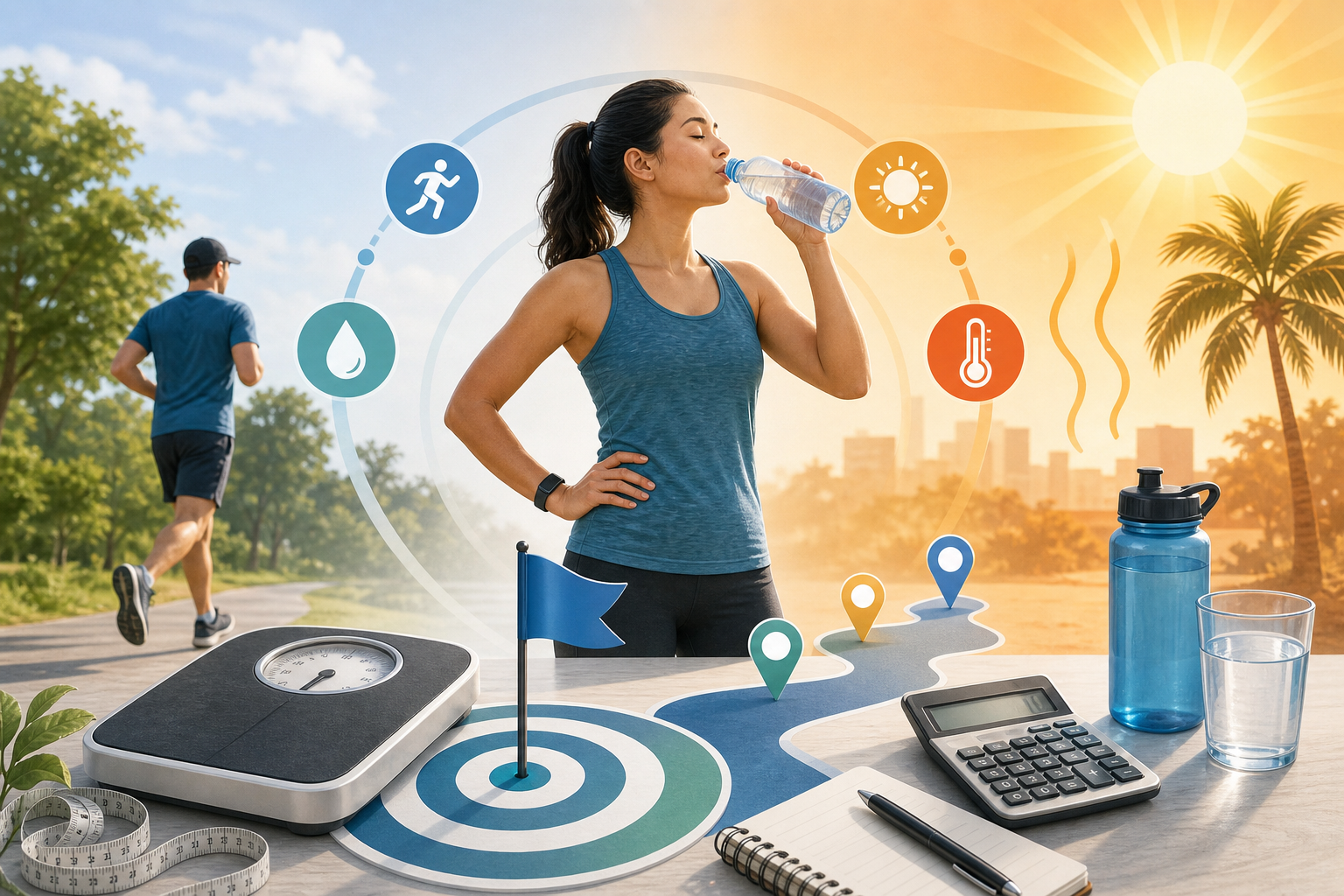
Understanding how exercise and hot weather can change water needs starts with sweating. Physical activity produces heat, and hot or humid conditions make it harder for the body to release that heat. Sweating helps with cooling, but the water lost through sweat usually increases the amount of fluid that must be replaced. The increase is not the same for everyone because activity level, climate, clothing, body size, diet and individual sweat rate all matter.
How exercise and hot weather can change water needs
Daily water needs include more than the water lost through sweat. The body also loses water through urine, breathing and bowel movements. Water is replaced through drinks and moisture in food.
Exercise can increase water loss in several ways. Working muscles produce heat, breathing may become faster, and sweating often rises as the body tries to control its temperature. Longer, harder or repeated exercise sessions generally create more opportunity for fluid loss than brief, light activity.
Hot weather can raise sweat loss even without formal exercise. Walking, gardening or working outdoors may require more fluid than the same activities in a mild environment. Direct sun, heavy clothing and limited airflow can increase heat strain further.
Humidity also matters. Sweat must evaporate from the skin to provide effective cooling. In humid air, evaporation is less efficient, so a person may continue sweating heavily without feeling as though the sweat is drying.
Why fluid replacement needs vary
There is no single exercise or hot-weather adjustment that works for every adult. Two people completing the same activity can lose different amounts of sweat, and the same person may sweat differently on separate days.
Activity duration and intensity
A short, easy session may add relatively little to a person’s usual daily water intake. A longer or more strenuous session can result in greater losses, especially if it takes place outdoors or includes limited rest.
Temperature, humidity and airflow
Temperature is only one part of the environment. High humidity, direct sunlight and still air can all affect cooling and sweating. Indoor exercise can also be hot when ventilation is poor or equipment and other people add heat to the room.
Clothing and equipment
Protective clothing, uniforms, helmets and layered garments may trap heat and reduce evaporation. This can increase sweating even when the recorded air temperature does not appear extreme.
Individual sweat response
Sweat rate varies with factors such as body size, exercise pace, heat adaptation and personal physiology. Visible sweat is not a precise measure because some evaporates and some remains in clothing.
Food, drinks and other circumstances
Meals can provide a meaningful share of total water, particularly when they include fruit, vegetables, soups or other moisture-rich foods. Pregnancy, breastfeeding, illness, medications and certain diets can also change fluid needs. These factors are not captured by a simple population reference value.
Practical ways to plan fluid intake
It is usually more useful to think about hydration across the whole day than to focus on one fixed volume of plain water. Total intake includes drinking water, other beverages and water contained in food.
- Begin with usual daily intake. Consider what you normally drink and eat on a mild, less-active day.
- Account for the activity and conditions. Longer sessions, harder effort, heat, humidity and heavy clothing can all increase expected losses.
- Make fluids accessible. Practical access matters during outdoor work, travel and extended exercise.
- Spread intake when possible. Drinking at intervals may be more comfortable than trying to replace a large amount at once after activity.
- Review what actually happened. A session that was hotter, longer or sweatier than expected may require a different approach next time.
Thirst can provide useful information, but it is not a precise measurement of fluid deficit. Urine colour may also offer general context, although it can be affected by food, supplements, medicines and the time of day. Neither sign can calculate an exact personal requirement.
Sweat contains water and electrolytes, including sodium. For ordinary daily activity, food and regular beverages may contribute to replacement. Longer periods of heavy sweating can create different replacement considerations, so the appropriate choice depends on the activity, conditions and the individual rather than on the word “exercise” alone.
More is not always better. Drinking very large amounts quickly can be inappropriate, just as failing to replace substantial losses can be. Anyone who has been given a fluid limit or an individual hydration plan should use that guidance rather than a general estimate.
A practical hot-weather exercise scenario
Consider an adult who normally takes a 30-minute walk in mild weather. On another day, the person completes a 90-minute walk in direct sun with high humidity and carries a backpack. The second walk is likely to produce more heat and sweat because it lasts longer and takes place under more demanding conditions.
A calculator’s standard daily reference would not automatically measure that extra loss. The person would need to consider the longer duration, weather, clothing, access to shade and how much sweating occurred. The extra requirement still cannot be determined exactly from the outdoor temperature alone.
For planned activities, change in body weight before and after exercise can provide context about short-term fluid balance when measurements are taken under comparable conditions. However, scale changes are not pure water measurements: clothing, food, drink and bathroom use can affect the result. It is therefore better treated as a practical estimate than a laboratory measurement.
What a water intake calculator can and cannot tell you
The water intake calculator provides an adult total-water reference estimate. It uses population-level Dietary Reference Intake values of approximately 3.7 litres per day for men and 2.7 litres per day for women. These amounts include water from both food and beverages; they are not targets for plain water alone.
The underlying values are adequate intakes developed from population evidence. They provide a reference for generally healthy adults rather than a measured requirement for a particular person. The calculator may also show an approximate beverage share to help distinguish beverages from total water.
What the estimate can do
- Provide a general adult reference for total daily water intake.
- Clarify that food moisture contributes to total water.
- Offer a starting point for thinking about usual intake.
- Present the reference in a convenient unit.
What the estimate cannot do
- Measure an individual’s sweat loss.
- Detect the temperature, humidity, sunlight or airflow around an activity.
- Calculate an exact exercise-related fluid adjustment.
- Account fully for pregnancy, breastfeeding, illness, medications or a clinician-directed fluid limit.
- Determine whether a particular beverage or electrolyte product is necessary.
A hydration calculator result should therefore be read as a reference estimate, not as an individualized prescription. Actual needs can be lower or higher depending on food moisture, activity, climate and other circumstances.
Frequently asked questions
Does every workout require extra water?
Not necessarily. The effect of a brief, light session may be small, especially in a cool environment. Longer, harder or hotter sessions are more likely to increase sweat loss and fluid requirements.
Does hot weather always mean the same increase in daily water intake?
No. Temperature alone does not reveal how much someone will sweat. Humidity, sun exposure, airflow, clothing, activity and individual sweat response all influence losses.
Should the 3.7-litre and 2.7-litre references be consumed entirely as drinks?
No. These are total-water values that include moisture from food as well as water and other beverages. The amount that must come from drinks varies with diet and circumstances.
Can thirst tell me exactly how much fluid I need?
Thirst is useful feedback, but it does not provide an exact volume. Its timing and intensity can vary, so it should be considered alongside activity, environmental conditions, usual intake and individual guidance.
Is an electrolyte drink required whenever someone sweats?
Not automatically. Sweat includes both water and electrolytes, but replacement needs differ according to the duration and intensity of activity, the amount of sweating, diet and personal circumstances. A short routine activity is different from prolonged heavy sweating in the heat.
Can a water intake calculator adjust for a heatwave or exercise session?
A basic calculator using adult reference values cannot measure those changing conditions. It can provide a baseline estimate, but any adjustment for exercise or heat remains individualized and uncertain unless fluid losses are assessed more directly.
Putting the estimate in context
The main point about how exercise and hot weather can change water needs is that both can increase water loss through sweating, while the size of the increase varies widely. Duration, intensity, humidity, clothing, food intake and individual sweat rate all affect the result.
Use a population reference as context rather than a rigid drinking target. A calculator can estimate standard adult total water intake, but it cannot measure real-time sweat loss or provide a precise replacement amount for every workout or hot day.