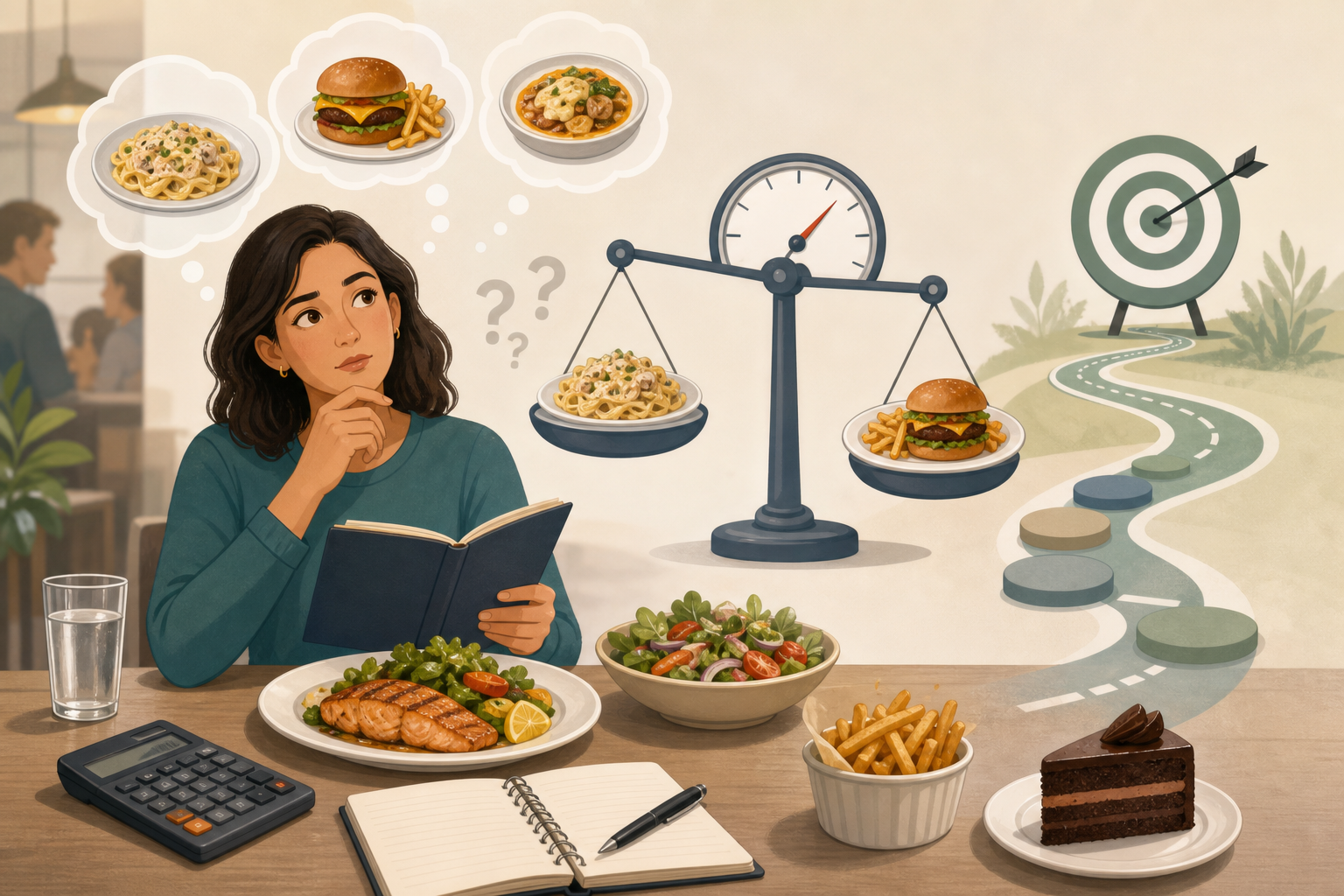
Why restaurant meal calories can be hard to estimate comes down to missing information: diners usually cannot see exact portions, ingredient quantities, cooking fats or recipe changes. Even when a menu provides a calorie value, the serving on the plate may differ from the standard recipe used to calculate it. A restaurant total is therefore best treated as an informed estimate rather than a precisely measured value.
- Why restaurant meal calories can be hard to estimate accurately
- The main sources of uncertainty
- Portion sizes are not always standard
- Cooking fats may not be visible
- Sauces, dressings and toppings add complexity
- Restaurant recipes can change
- Drinks and shared foods are easily missed
- How to interpret restaurant calorie information
- A practical restaurant meal example
- Ways to make an estimate more consistent
- What a meal calorie calculator can and cannot tell you
- Frequently asked questions
- Are menu calorie values exact?
- Should sauce served on the side be counted?
- How should I estimate a shared restaurant dish?
- Is it better to enter one number or a calorie range?
- What if I cannot find the exact dish in a food database?
- Do small extras need to be included?
- Putting restaurant estimates in context
Why restaurant meal calories can be hard to estimate accurately
At home, ingredients can be weighed and nutrition labels can be checked before a meal is prepared. In a restaurant, much of that information is unavailable. You may know the main ingredients but not their amounts or how they were cooked.
The final calorie estimate can be affected by several small uncertainties at once. A slightly larger portion, extra oil in the pan, a generous serving of sauce and an uncounted drink can all change the estimated total.
Calories describe the energy supplied by food and drinks. Carbohydrate, fat and protein contribute energy, but the amount in a restaurant dish depends on the actual recipe and serving size. The National Academies provides broader background on dietary energy and macronutrients, but it cannot identify the ingredients or portions in an individual restaurant meal.
The main sources of uncertainty
Portion sizes are not always standard
A menu item may be designed around a standard serving, but the portion received can vary. Hand-served foods such as rice, pasta, chips, noodles, dressings and grated cheese are especially difficult to reproduce exactly without weighing or fixed measuring tools.
Visual estimates also have limits. A deep bowl can hold more than it appears to, while meat or fish may be served with bones, skin or other inedible parts that complicate comparison with nutrition data.
Cooking fats may not be visible
Oil, butter, cream and other fats can be incorporated during frying, roasting, sautéing or finishing. Some remain in the pan, while some become part of the food. A diner generally cannot tell how much was used or absorbed by looking at the plate.
This matters when comparing dishes that appear similar. Grilled vegetables prepared with a light coating of oil and vegetables finished with butter may look almost identical but have different meal calories.
Sauces, dressings and toppings add complexity
Sauces may contain oil, cream, sugar, cheese, nuts or other energy-containing ingredients. Their recipes and serving amounts can vary widely. The same issue applies to salad dressings, mayonnaise, dips, syrups, glazes and flavoured spreads.
Toppings are easy to overlook because they may seem secondary to the meal. Cheese, seeds, fried garnishes, croutons and avocado are still part of the calorie total, as are sauces served on the side if they are eaten.
Restaurant recipes can change
A dish name does not define one fixed recipe. Two restaurants may prepare chicken curry, vegetable noodles or a cheeseburger with different ingredients and portions. Even within one restaurant, substitutions, seasonal ingredients and preparation by different kitchen staff may alter the result.
Customisation introduces further uncertainty. Extra cheese, a different side, removed ingredients or a replacement sauce can make the served dish different from the version described in published nutrition information.
Drinks and shared foods are easily missed
Caloric drinks count towards the energy total even though they may not feel like part of the meal. Sweetened coffee, soft drinks, juice, milk-based drinks and alcoholic beverages should be included when estimating calories in a meal.
Shared starters, bread, dips and desserts can be harder to record because the amount eaten is unclear. Dividing a dish equally among diners may be a reasonable starting assumption, but it remains an estimate unless individual portions were measured.
How to interpret restaurant calorie information
Where menu calories are available, they usually provide a more relevant starting point than an unrelated entry from a general food database. However, the number may represent a standard recipe and standard portion rather than a direct measurement of the plate served to you.
Check what the stated value covers. It may apply only to the main item, while sides, dressings, toppings, drinks or optional additions are listed separately. A range may be shown when customers can choose different ingredients or portion sizes.
If no restaurant-specific information is available, a comparable dish can provide a rough estimate. Choose an entry that matches the main ingredients, cooking method and apparent portion rather than selecting the lowest or highest result. Recording the source of the estimate can make later comparisons more consistent.
A practical restaurant meal example
Suppose a diner orders a main dish with a menu value of 650 kcal. The meal also includes a side estimated at 220 kcal, a caloric drink listed as 120 kcal and half of a shared dessert estimated at 250 kcal.
The illustrative total would be:
650 + 220 + 120 + 250 = 1,240 kcal
This does not mean the meal contained exactly 1,240 kcal. The main dish may have differed from its standard recipe, and the side and dessert portions were estimated. It is more accurate to record this as an estimated meal total based on the information available.
If sauces or cooking fats appear particularly uncertain, it may be useful to note that uncertainty rather than adding an arbitrary number. A range can also be more honest than a single value, provided the lower and upper estimates are based on plausible portions and comparable dishes.
Ways to make an estimate more consistent
- Start with restaurant-specific information: Use the restaurant’s published value when it clearly matches the item, size and options ordered.
- Count each component: Include the main dish, sides, sauces, toppings, drinks, starters and desserts that were consumed.
- Match the cooking method: A fried, breaded or cream-based version should not be logged as a plain grilled or steamed dish.
- Account for customisation: Add or remove ingredients when the order differs from the standard menu description.
- Estimate the portion actually eaten: If some food was left, avoid automatically recording the full serving. If food was shared, estimate your share.
- Use comparable entries consistently: When exact information is missing, repeatedly using a similar reference may be more useful for tracking than switching between very different database entries.
- Keep uncertainty visible: Label the result as an estimate and add a note when oil, sauce or portion size is particularly unclear.
Detailed estimation is not always necessary. The appropriate level of precision depends on the purpose of tracking. A broad comparison between meals requires less detail than reviewing why recorded daily totals vary.
What a meal calorie calculator can and cannot tell you
A meal calorie calculator adds the energy values entered for breakfast, lunch, dinner, snacks and caloric drinks. The method is straightforward:
Daily meal calories = breakfast + lunch + dinner + snacks and drinks
For example, daily entries of 400, 550, 650 and 250 kcal produce an estimated total of 1,850 kcal:
400 + 550 + 650 + 250 = 1,850 kcal/day
The calculator can help organise meal estimates and compare a planned or recorded day with an overall calorie target. It performs the addition consistently and can reduce arithmetic errors.
It cannot determine the true calorie content of a restaurant dish. If a restaurant meal is entered as 800 kcal but the actual ingredients and portions are unknown, the result remains dependent on that 800 kcal estimate. Adding uncertain inputs does not turn them into measured values.
The tool also does not assess nutrient quality, ingredient balance or portion-measurement error. Two days with the same estimated calorie total may contain different foods and nutrients. The output should therefore be read as a meal-energy estimate, not a complete assessment of dietary quality.
Frequently asked questions
Are menu calorie values exact?
They should generally be treated as estimates for a standard item or recipe. The portion served, ingredient substitutions and preparation method may differ from the assumptions behind the published value.
Should sauce served on the side be counted?
Count the amount you actually use as well as you reasonably can. If only part of the sauce is eaten, estimating a fraction of the full serving is more representative than automatically counting all or none of it.
How should I estimate a shared restaurant dish?
Begin with the calorie estimate for the complete dish and estimate your share. Equal division may work when portions were similar, but it may not reflect what each person ate. Treat the result as approximate.
Is it better to enter one number or a calorie range?
A single number is convenient for a meal calorie calculator, while a range can better communicate uncertainty. If the tool requires one value, a reasonable midpoint may be used for planning, with a separate note recording the possible range.
What if I cannot find the exact dish in a food database?
Look for a comparable meal with a similar portion, main ingredients and cooking method. Avoid assuming that dishes with the same name are nutritionally identical, particularly when sauces and preparation styles differ.
Do small extras need to be included?
Extras that contain energy are part of the meal total, including caloric drinks, bread, dips, dressings and toppings. Whether detailed tracking is useful depends on your purpose, but repeatedly omitting the same types of extras can make totals less representative.
Putting restaurant estimates in context
Ultimately, why restaurant meal calories can be hard to estimate is that the most important inputs are often hidden or variable. Diners rarely know the exact weight of each ingredient, how much cooking fat was retained or whether the plate matches a standard recipe.
A sensible estimate combines restaurant information, comparable food data and the portion actually eaten. Recording uncertainty is more accurate than presenting a calculated total as if the meal had been measured directly.