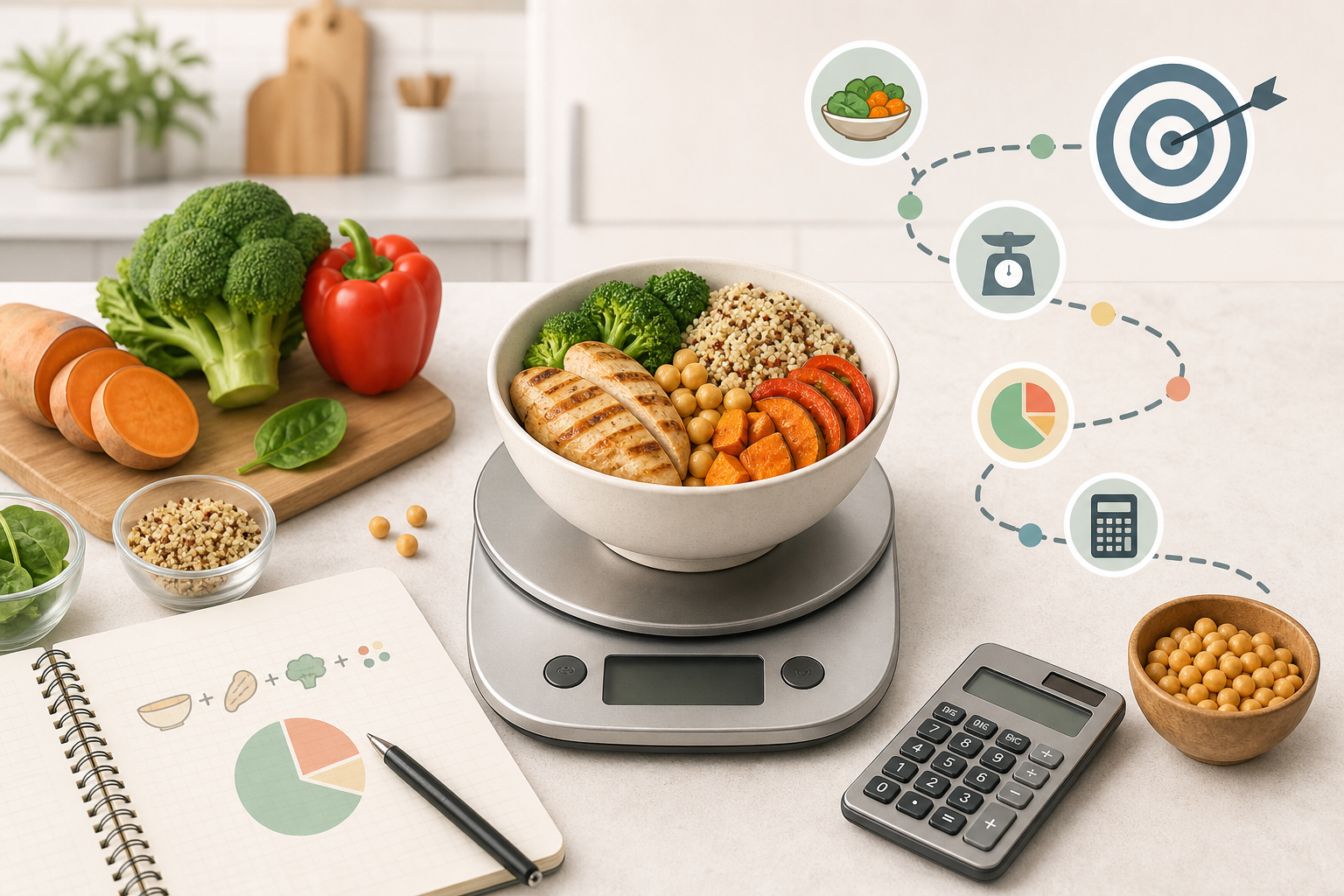
Learning how to estimate calories in homemade meals starts with a simple process: record every calorie-containing ingredient, calculate each ingredient’s contribution, add them to find the recipe total, and divide that total by the amount you eat. The result is an estimate rather than a measured value, but consistent ingredient and portion records can make it useful for meal planning.
- How to estimate calories in homemade meals step by step
- Collect accurate ingredient information
- Match the value to the amount used
- Use the correct preparation state
- Include easily missed ingredients
- Calculate recipe totals and individual servings
- Method 1: Divide by equal servings
- Method 2: Divide by cooked weight
- Practical homemade pasta example
- Common causes of inaccurate meal calorie estimates
- What a meal calorie calculator can and cannot tell you
- What the calculator can show
- What the calculator cannot show
- Frequently asked questions
- Should I weigh ingredients before or after cooking?
- How do I calculate calories in soup, curry or stew?
- Do herbs, spices and seasonings need to be counted?
- How should I count leftovers?
- Can I estimate a meal when someone else cooked it?
- Putting the method into practice
How to estimate calories in homemade meals step by step
Use the same basic method whether you are preparing a sandwich, soup, casserole or multi-dish dinner:
- List every ingredient, including oils, sauces, toppings and caloric drinks.
- Record the amount of each ingredient used.
- Find the calorie value for that amount from the package label or another suitable food-data source.
- Add all ingredient values to calculate the recipe’s total calories.
- Divide the total by the number of equal servings, or calculate a portion according to its weight.
The general formula is:
Recipe calories = calorie values of all ingredients added together
For equal servings:
Calories per serving = total recipe calories ÷ number of servings
Food labels often use “Calories” to mean kilocalories, written as kcal. When comparing values, check that all entries use the same energy unit.
Collect accurate ingredient information
The quality of the estimate depends on the information entered. Use values from the ingredient’s package when possible because formulations can vary between brands and products. For unpackaged foods, use a consistent food-data source rather than switching between unrelated entries.
Match the value to the amount used
A label may provide calories per serving, per 100 grams or per 100 millilitres. Convert that value to the amount included in your recipe.
For a value listed per 100 grams, use:
Ingredient calories = ingredient weight in grams × calories per 100 grams ÷ 100
For example, if an ingredient provides 240 kcal per 100 grams and the recipe uses 75 grams:
75 × 240 ÷ 100 = 180 kcal
Use the correct preparation state
Match the food entry to the state in which you measured it. If you weighed dry rice, use a dry-rice value. If you weighed cooked rice, use a cooked-rice value. Water absorbed during cooking changes food weight but does not add calories, so dry and cooked values are not interchangeable.
The same issue applies to pasta, beans, meat and other foods whose weight changes during preparation. Record whether each quantity is raw, cooked, drained or prepared with added ingredients.
Include easily missed ingredients
Small additions can affect meal calories, particularly when they are energy-dense or used several times. Check the recipe for:
- Cooking oil, butter or ghee
- Dressings, marinades and sauces
- Sugar, syrup, honey or sweetened condiments
- Cheese, cream, nuts and seeds
- Breading, flour and batter
- Toppings and garnishes
- Milk, juice, alcohol or other caloric drinks served with the meal
Some cooking oil or marinade may remain in a pan or bowl. Unless the amount left behind is measured, its contribution cannot be known precisely. Using the full amount added is a practical estimate, but it may differ from the amount actually eaten.
Calculate recipe totals and individual servings
After calculating every ingredient, add the values to find the total for the complete recipe. How you divide that total depends on whether the portions are equal.
Method 1: Divide by equal servings
If a recipe is divided into four reasonably equal portions, divide its calorie total by four. This method is quick, but it assumes each serving contains a similar share of every ingredient.
A recipe containing 2,000 kcal in total would provide an estimated 500 kcal per serving when split into four equal portions.
Method 2: Divide by cooked weight
Weighing the completed recipe can help when portions differ in size. First weigh the finished edible food, excluding the cooking pot or container. Then calculate the calorie value per gram:
Calories per gram = total recipe calories ÷ total cooked recipe weight
Multiply that result by the weight of the portion served:
Portion calories = calories per gram × portion weight
This method accounts for different portion weights. It still assumes ingredients are distributed relatively evenly throughout the dish, which may not be true for meals containing separate pieces or layers.
Practical homemade pasta example
Suppose a pasta recipe uses the quantities below. The calorie values are illustrative assumptions based on hypothetical labels; they are not universal values for these foods.
| Ingredient | Amount used | Assumed calorie value | Recipe contribution |
|---|---|---|---|
| Dry pasta | 300 g | 350 kcal per 100 g | 1,050 kcal |
| Tomato sauce | 500 g | 60 kcal per 100 g | 300 kcal |
| Olive oil | 20 g | 884 kcal per 100 g | 177 kcal |
| Vegetables | 300 g | 35 kcal per 100 g | 105 kcal |
| Cheese | 80 g | 400 kcal per 100 g | 320 kcal |
| Total | 1,952 kcal |
If the recipe makes four equal servings, each serving contains an estimated 488 kcal:
1,952 ÷ 4 = 488 kcal per serving
If the cooked dish weighs 1,600 grams and one portion weighs 350 grams, the weight-based estimate is about 427 kcal:
1,952 ÷ 1,600 × 350 = 427 kcal
The serving-count and weight methods produce different results here because a 350-gram portion is smaller than one-quarter of the complete 1,600-gram recipe.
Common causes of inaccurate meal calorie estimates
Homemade meal calculations involve unavoidable uncertainty. Recognising the main sources of error helps you interpret the result appropriately.
- Estimating portions by sight: Cups, spoons and visual estimates may not match the quantity assumed in a food entry.
- Ignoring cooking ingredients: Oil, sauces and toppings are part of the meal even when they are not prominent on the plate.
- Mixing raw and cooked data: Cooking can change weight through water gain or loss.
- Using a generic entry for a branded food: Products with similar names may contain different ingredients and calorie values.
- Assuming every portion is equal: A ladle or slice does not always contain the same weight or ingredient distribution.
- Counting the entire purchased amount: Bones, peels, shells, drained liquid and other discarded parts may not be eaten.
- Rounding too early: Keep unrounded ingredient values until the final total, then round the serving estimate if needed.
A kitchen scale can provide a more consistent quantity than estimating by sight, but weighing does not make the calorie data itself exact. Package rounding, natural variation in foods and changes during cooking can still affect the result.
What a meal calorie calculator can and cannot tell you
A meal calorie calculator adds the calorie estimates entered for breakfast, lunch, dinner, snacks and caloric drinks. Its basic method is:
Daily meal calories = breakfast + lunch + dinner + snacks and drinks
For example:
400 + 550 + 650 + 250 = 1,850 kcal per day
To use it with homemade food, first calculate the calories in a meal from its ingredients and your portion. Enter that meal estimate in the relevant breakfast, lunch or dinner field. Repeat the process for snacks and drinks to produce an estimated daily total.
What the calculator can show
- The sum of the meal calories and snack values you enter
- How individual meals contribute to an estimated daily total
- A consistent way to compare different meal plans
- Where a missing snack, drink or topping may need to be recorded
What the calculator cannot show
- The actual energy content of a meal if the entered estimates are inaccurate
- Whether recipe portions were weighed or divided correctly
- How much oil, sauce or marinade remained uneaten
- The vitamin, mineral, fibre or overall nutrient quality of the meals
- An individual energy requirement or a guaranteed change in body weight
Calories describe dietary energy, but foods also differ in carbohydrate, fat, protein and other components. The National Academies’ Dietary Reference Intakes provide broader scientific background on energy and macronutrients. A meal total alone should not be treated as a complete assessment of food quality.
Frequently asked questions
Should I weigh ingredients before or after cooking?
Either approach can work if the calorie value matches the measurement state. Use raw data for a raw weight and cooked data for a cooked weight. For a mixed recipe, it is often simplest to calculate ingredients before cooking and weigh the whole finished dish only to divide it into portions.
How do I calculate calories in soup, curry or stew?
Add the calories from every ingredient, including oil, coconut milk, cream or stock ingredients that provide energy. Weigh the finished edible recipe and use its total cooked weight to calculate each serving. Evaporation changes the weight and concentration of the dish but does not remove the calories from ingredients that remain in it.
Do herbs, spices and seasonings need to be counted?
They can be included for completeness, especially when used in substantial amounts or as part of a sweetened seasoning blend. Very small quantities may make little difference to the rounded total, but sauces, pastes and seasoning mixes can contain oils or sugars and should not automatically be treated as calorie-free.
How should I count leftovers?
Calculate the calories per gram or per serving for the original recipe. Weigh or record the leftover portion and apply the same value when it is eaten. Add any new ingredients used during reheating, such as oil, cheese or sauce.
Can I estimate a meal when someone else cooked it?
You can make a rough estimate using the likely ingredients and portion size, but uncertainty will be greater because the quantities and preparation method are unknown. A visually similar dish may contain a different amount of oil, sauce or other concentrated ingredients, so record the result as an estimate rather than an exact value.
Putting the method into practice
The most workable approach to how to estimate calories in homemade meals is to calculate each ingredient, total the full recipe and divide it according to servings or cooked portion weight. Keep raw and cooked measurements consistent, include additions such as oils and toppings, and retain the recipe calculation for meals you prepare again.
Once individual meal calories have been estimated, they can be added across breakfast, lunch, dinner, snacks and drinks. The final number is only as reliable as the ingredient values and portions entered, so it is best used as a planning estimate rather than a precise measurement.