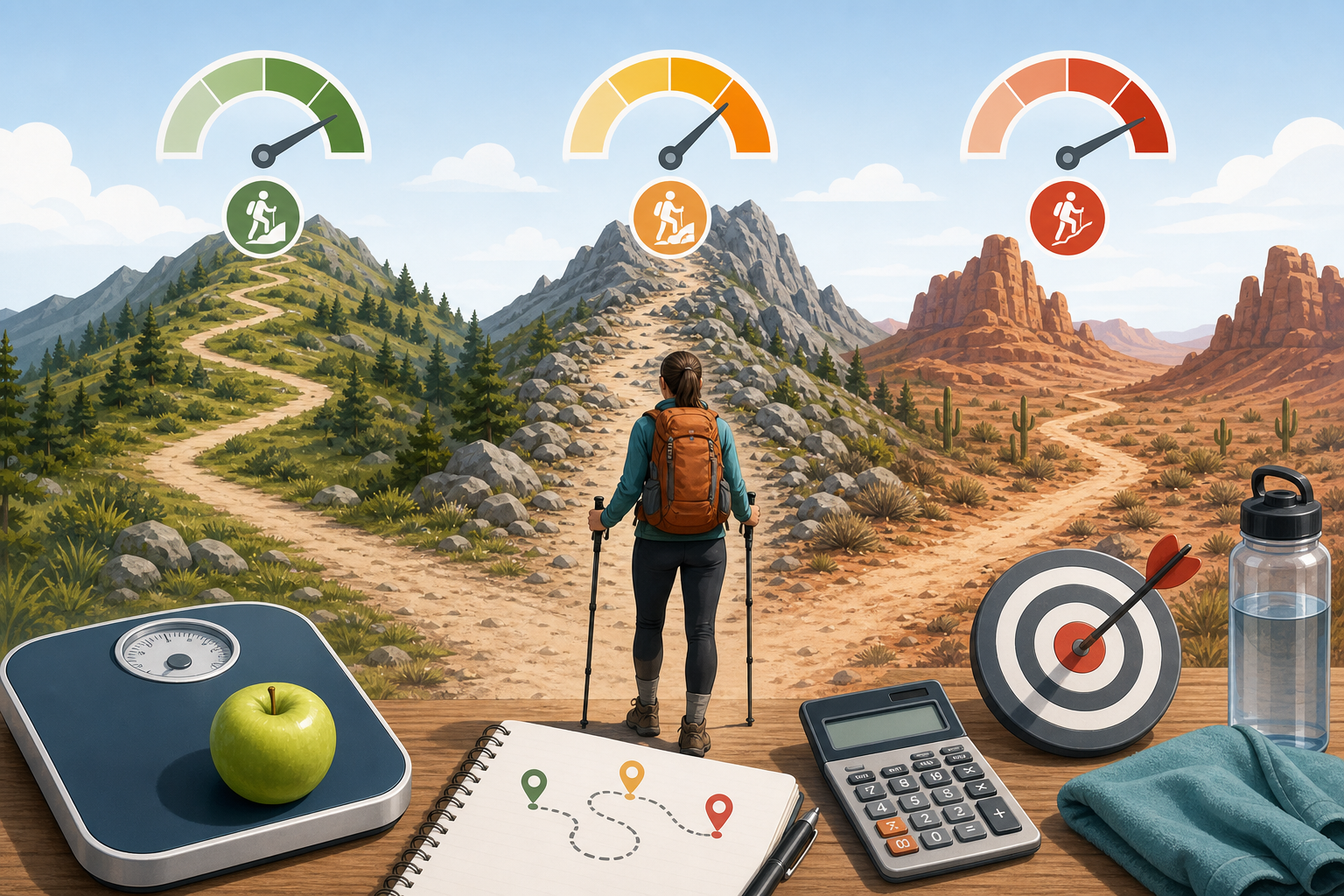
The main reason why hiking calorie estimates vary so much between trails is that distance alone does not describe the work involved. A smooth, mostly level path and a steep, rocky route may cover the same distance but require different effort, pacing, balance and climbing. Body weight, pack weight, hiking time and rest stops add further variation, so any calorie figure should be treated as an estimate rather than a measured value.
- Why hiking calorie estimates vary so much between trails
- Six trail and hiking factors that affect the estimate
- Terrain and steepness
- Surface and footing
- Pace and effort
- Pack weight
- Rest stops and recorded duration
- Weather and trail conditions
- A practical comparison of two similar-distance hikes
- How MET-based hiking estimates work
- What the hiking calories calculator can and cannot tell you
- What it can estimate
- What it cannot measure directly
- How to make trail estimates more comparable
- Frequently asked questions
- Does elevation gain matter more than hiking distance?
- Why does a slow mountain hike sometimes have a high calorie estimate?
- Should rest stops be included in hiking duration?
- How should backpack weight be handled?
- Why does my watch disagree with a hiking calories calculator?
- Putting trail calorie estimates in context
Why hiking calorie estimates vary so much between trails
Most hiking estimates combine body weight, activity intensity and duration. However, trail conditions can change intensity from one minute to the next. A hiker might walk comfortably on a level section, climb slowly over rocks and then pause at a viewpoint, all within the same outing.
Calculators and fitness devices simplify this changing effort into an average. If two tools choose different intensity levels, include different portions of the hike or interpret elevation differently, their estimates of calories burned hiking can vary substantially.
The 2024 Adult Compendium of Physical Activities provides standardised metabolic equivalent, or MET, values for many activities. These values are useful for population-level estimation, but they cannot represent every trail, weather condition or individual response.
Six trail and hiking factors that affect the estimate
Terrain and steepness
Climbing generally requires more effort than walking on level ground because the hiker is moving body mass upward. A route with long, sustained climbs may therefore have a higher average intensity than a flatter route of the same distance.
Total elevation gain is useful, but it does not tell the whole story. A steady climb may allow a consistent rhythm, while repeated short climbs and descents can produce frequent changes in effort. Trail steepness also affects speed: a slow pace on a very steep slope may still feel more demanding than a faster pace on level ground.
Surface and footing
A firm, even track usually allows more efficient movement than loose gravel, mud, sand, snow, roots or uneven rocks. Difficult footing may require shorter steps, greater balance and more careful placement of the feet.
These differences are rarely captured by distance alone. Two trails with similar elevation profiles may produce different hiking calorie burn if one is smooth and the other is technically demanding.
Pace and effort
Faster hiking often increases energy use per minute, but pace must be interpreted alongside terrain. Three kilometres per hour on a steep trail is not equivalent to the same speed on a flat path.
Average speed can also hide variation. A hike that alternates between hard climbs and slow descents may have the same average speed as a steady walk, even though the effort pattern is different.
Pack weight
Carrying water, food, clothing or camping equipment adds to the mass being moved. The effect may become more noticeable during climbs or on trails where maintaining balance is difficult.
A calculator that asks only for body weight may not account directly for a backpack. Selecting a higher terrain or intensity category might partly reflect the added effort, but it does not precisely measure the pack’s contribution.
Rest stops and recorded duration
Elapsed time includes breaks, while moving time excludes them. This distinction can create large differences between estimates.
For example, a four-hour outing might include three hours of hiking and one hour of lunch, photography and viewpoint stops. Applying a hiking intensity to all four hours would probably produce a higher estimate than calculating the three active hours separately.
Short standing pauses are more difficult to separate, especially when a phone or watch automatically decides whether the hiker is moving. Different devices may classify the same pauses differently.
Weather and trail conditions
Heat, cold, wind, rain and slippery conditions can affect pace and perceived effort. Their effect on calorie expenditure is difficult to estimate from ordinary trip details, so most calculators do not model them directly.
Conditions may also change during a hike. A dry trail on the outward journey can become muddy after rain, making the return section slower and less predictable.
A practical comparison of two similar-distance hikes
Consider two hikers of the same body weight completing routes of equal distance.
- Trail A: a broad, firm path with gentle elevation change, a steady pace, no pack and only brief stops.
- Trail B: a steep route with loose rocks, repeated climbs, a loaded backpack and several sections requiring careful footing.
Trail B would generally be assigned a higher hiking intensity even if it took longer and produced a lower average speed. If a calculator used distance or speed without recognising the terrain, it might understate the difference between the routes.
Rest accounting could reverse part of that result. If Trail B included a long summit break and the full elapsed time were entered as active hiking, its estimate could be too high. A more useful comparison would separate moving time from substantial stationary breaks and choose intensity based on the active sections.
How MET-based hiking estimates work
A hiking calories calculator may use a MET value to represent activity intensity. One MET is a standard reference level, while higher MET values represent higher estimated energy expenditure. Hiking categories can differ according to factors such as terrain and effort.
A commonly used estimation formula is:
Estimated kcal = MET × 3.5 × body weight in kilograms ÷ 200 × minutes
For example, at 80 kg, 90 minutes of hiking represented by 6 MET gives:
6 × 3.5 × 80 ÷ 200 × 90 = approximately 756 kcal
This is a calculated estimate, not a direct measurement of that person’s energy use. If the selected MET level does not match the trail, or if the duration includes long stops, the result will be less representative of the actual outing.
The formula also shows why estimates rise with body weight and duration when the selected intensity remains unchanged. It does not mean that every person of the same weight will use exactly the same amount of energy on the same trail.
What the hiking calories calculator can and cannot tell you
The hiking calories calculator estimates energy expenditure from body weight, terrain intensity and duration. It can provide a consistent way to compare planned hikes when the inputs are chosen in the same way.
What it can estimate
- Approximate calories associated with a selected hiking intensity and duration.
- How the estimate changes when body weight, time or terrain category changes.
- A general comparison between an easier hike and a more strenuous hike.
- A planning figure based on standard MET assumptions.
What it cannot measure directly
- Your individual metabolic response during the hike.
- Every change in gradient, surface, wind or weather.
- The exact effect of a backpack unless load is specifically included.
- Whether entered duration is moving time or total elapsed time.
- Energy expenditure with the precision of specialised physiological measurement.
A calculator result should therefore be described as estimated calories, not calories known to have been burned. Even a detailed route profile cannot fully capture differences in movement efficiency, pacing and trail technique.
How to make trail estimates more comparable
Consistency in the inputs is often more useful than trying to produce a perfectly precise number. The following approach can reduce avoidable differences:
- Use active hiking time consistently. Exclude long meals and extended stationary breaks if the calculator assumes continuous hiking.
- Choose intensity from the whole route. Consider gradient, surface and footing rather than relying only on average speed.
- Note the pack. Record whether the hike was completed without a load, with a day pack or with heavier equipment.
- Keep elevation gain separate from distance. Two routes of equal length may have very different climbing demands.
- Compare like with like. Use the same calculator, unit system and method for handling pauses across hikes.
- Avoid false precision. A rounded estimate better reflects the uncertainty than treating a single-calorie result as exact.
Fitness watches, route apps and calculators may still disagree because they use different assumptions. A watch may incorporate heart-rate and motion data, while a basic calculator may use a standard MET category. Additional data do not automatically make a result exact; they simply produce a different kind of estimate.
Frequently asked questions
Does elevation gain matter more than hiking distance?
Neither measure is sufficient by itself. Distance describes how far you travelled, while elevation gain helps describe climbing. Surface, gradient, pace, load and duration are also relevant when selecting an intensity estimate.
Why does a slow mountain hike sometimes have a high calorie estimate?
Speed does not fully represent effort on steep or uneven terrain. Moving slowly uphill or across difficult footing may be assigned a higher intensity than walking at the same speed on a smooth, level path.
Should rest stops be included in hiking duration?
Brief pauses may reasonably remain within an overall estimate, but long stationary breaks should generally be separated if the selected MET value represents active hiking. The important point is to handle breaks consistently when comparing routes.
How should backpack weight be handled?
If a tool includes a load option, use the closest appropriate category. If it does not, recognise that an estimate based only on body weight and general terrain may not fully represent a loaded hike. Avoid making an exact manual adjustment unless the method supports it.
Why does my watch disagree with a hiking calories calculator?
The devices may use different intensity assumptions, time definitions and personal data. A watch may estimate from movement and heart rate, whereas a calculator may apply a MET value to body weight and duration. Neither output should be treated as a directly measured calorie total.
Putting trail calorie estimates in context
Understanding why hiking calorie estimates vary so much between trails requires looking beyond distance. Elevation, surface, pace, pack weight and rest stops all influence how well a standard intensity value represents a particular hike.
A hiking calorie burn figure is most useful as a broad planning or comparison estimate. Record the conditions and use consistent inputs, especially active duration and terrain intensity, rather than interpreting small differences between calculator results as meaningful.