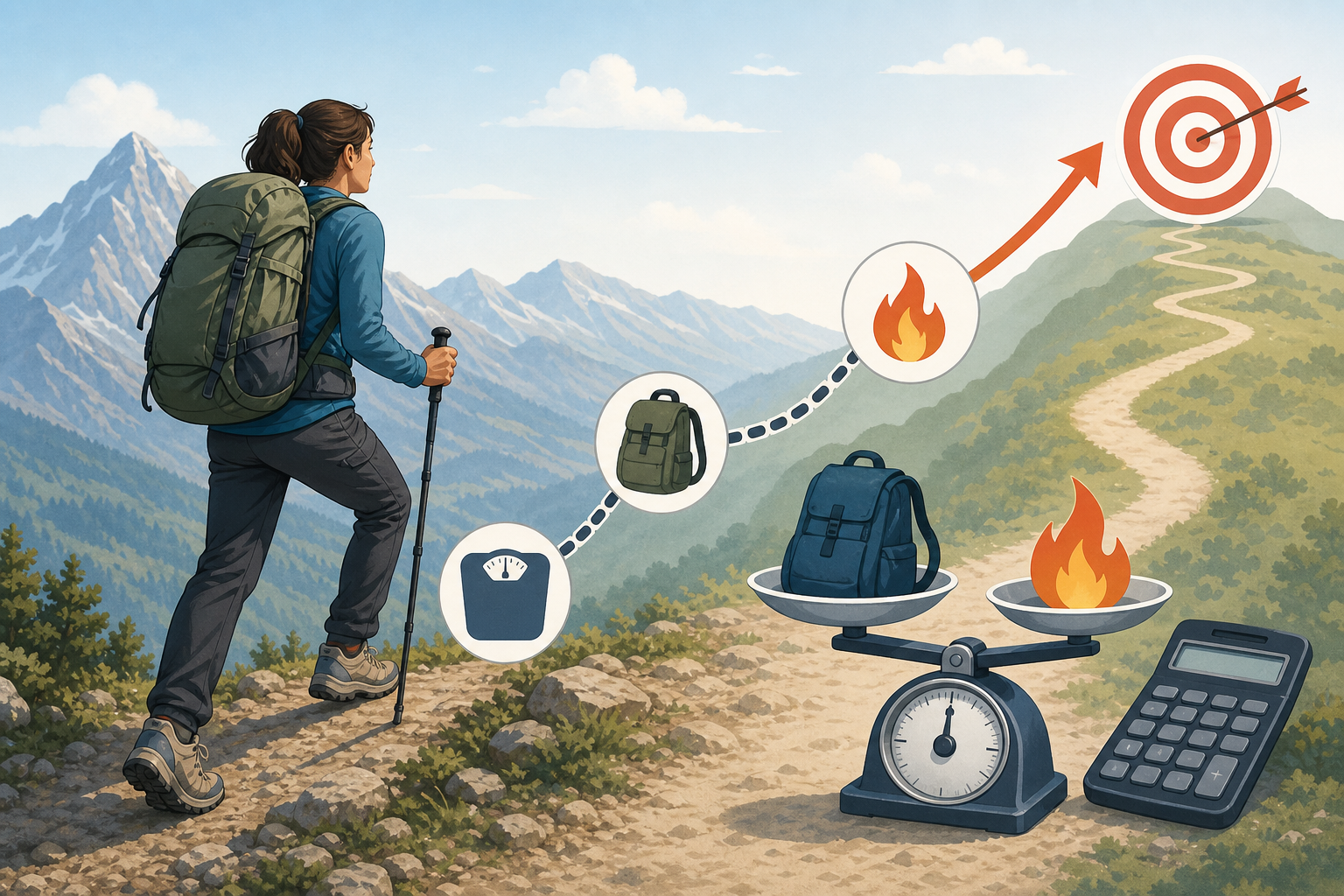
If you are asking, “does carrying a backpack increase hiking calories burned?”, the answer is usually yes. A loaded pack adds mass that your body must move and support, which can increase effort compared with walking the same route at the same pace without a pack. The size of the increase varies with pack weight, gradient, surface, speed, fitness, rest stops and how the load is carried.
A hiking calories calculator can estimate energy expenditure from body weight, activity intensity and duration. However, if it does not request pack weight, its result does not directly calculate the additional energy cost of carrying a load.
Why does carrying a backpack increase hiking calories burned?
Moving a heavier combined mass generally requires more work. Your leg and trunk muscles must propel, balance and stabilise both your body and the backpack. The effect is often more noticeable on climbs because the load must be raised against gravity.
A pack can also change posture, stride and balance. Uneven ground may require frequent adjustments, while soft or loose surfaces can make each step more demanding. These factors help explain why two hikes of the same duration may produce different energy expenditure.
Pack weight is not the only consideration. A well-fitted pack and a poorly adjusted pack of the same weight may feel very different, although comfort or perceived effort cannot be converted reliably into a precise calorie difference.
How much difference can a backpack make?
There is no single percentage that applies to every hiker. Hiking calorie burn does not necessarily rise in direct proportion to pack weight because terrain, pace and individual movement patterns also change the result.
The additional effect may depend on:
- Pack weight relative to the hiker’s body weight
- Uphill, level or downhill travel
- Trail surface, including rock, mud, sand or firm paths
- Walking speed and whether the pace slows under load
- Continuous hiking time versus frequent pauses
- Pack fit, load position and weight distribution
- Individual fitness, gait and movement efficiency
For example, adding a pack may increase effort per minute but also cause a hiker to move more slowly or stop more often. The total calories burned hiking could therefore change differently from what pack weight alone might suggest.
On a steep ascent, carrying extra mass is likely to have a clearer effect than it would during an easy, level walk. Descents can also demand substantial muscular control, but the relationship between downhill effort, pack weight and calories is not simple enough for a universal adjustment rule.
How a hiking calories calculator estimates expenditure
The hiking calories calculator estimates energy use from body weight, terrain intensity and duration. It uses a MET-based formula:
Estimated kcal = MET × 3.5 × body weight in kilograms ÷ 200 × minutes
A MET value represents an estimated activity intensity. The Adult Compendium of Physical Activities provides standardised MET values for many activities, including forms of walking and hiking. These values are useful for population-level estimates, but they do not measure an individual hiker’s energy expenditure directly.
As an example, an 80 kg person hiking for 90 minutes at an estimated intensity of 6 MET would have:
6 × 3.5 × 80 ÷ 200 × 90 = approximately 756 kcal
This is an estimate based on the selected intensity. It is not a measured result, and it should not be interpreted as exactly 756 kcal for every 80 kg hiker completing that activity.
What the calculator can and cannot tell you about pack weight
A calculator is most useful for creating a consistent estimate from a small set of inputs. It can show how estimated expenditure changes when body weight, duration or the selected hiking intensity changes.
| Factor | How it is handled |
|---|---|
| Body weight | Included directly in the MET formula |
| Duration | Included directly as minutes of activity |
| Terrain or hiking intensity | Represented through the selected MET level |
| Backpack weight | Not modelled directly if the calculator does not request it |
| Elevation gain and loss | May be reflected broadly by an intensity choice, but not calculated from a route profile |
| Stops and pace changes | Not captured unless they affect the duration or intensity entered |
If pack weight is not an input, it should not automatically be added to body weight. The body-weight term in a standard MET equation is intended to represent the person’s weight, and treating the combined weight as body weight assumes that every kilogram of pack changes expenditure in exactly the same way as a kilogram of body mass. That assumption may produce a misleading level of precision.
Selecting a more strenuous terrain or activity category may better represent a demanding loaded hike than choosing an easy trail category. However, intensity should reflect the overall activity rather than being increased by an arbitrary amount solely to account for the pack.
A practical loaded-hiking scenario
Consider an 80 kg hiker planning two 90-minute outings. The first is on a moderate, firm trail without a pack. The second follows the same route while carrying camping equipment.
Using a 6 MET input, the calculator estimates about 756 kcal for the 90-minute hike. If the tool has no pack-weight field, it may display the same estimate for both outings when body weight, selected intensity and duration remain unchanged.
That does not mean the pack has no effect. It means the calculator has not been given an input that represents the load. The loaded hike may require more energy, but the example does not provide enough information to calculate the difference accurately.
The comparison becomes more complicated if the hiker moves more slowly with the pack. A lower pace could reduce expenditure per minute, while the added load and longer completion time could increase total expenditure. Route conditions and actual moving time would determine how those effects combine.
How to interpret calories burned hiking estimates
Calorie estimates are best treated as approximate planning values rather than exact measurements. Even when two people have the same body weight and complete the same route, their actual energy expenditure can differ because of pace, movement efficiency, physiology and trail conditions.
For more consistent comparisons:
- Use the same calculator and unit system each time.
- Enter active hiking time consistently rather than mixing moving time with total elapsed time.
- Choose the terrain or intensity description that best matches the overall hike.
- Record pack weight separately if the calculator does not include it.
- Avoid interpreting small differences between estimates as meaningful measured changes.
Wearable devices also provide estimates rather than laboratory measurements. Heart rate, speed, elevation and personal profile data may add information, but pack load, device placement and sensor accuracy can still affect the result.
Frequently asked questions
Should I add my backpack weight to my body weight in the calculator?
Usually not unless the calculator specifically instructs you to enter total carried mass. Adding pack weight to body weight changes the formula, but it does not necessarily model loaded hiking accurately. Record the pack separately and treat the calculator result as a baseline estimate.
Does a heavier backpack always burn more calories?
All else being equal, a heavier load would generally require more effort. In real hiking, however, a heavier pack may change speed, route choice, stride and the number of rest stops. Total hiking calorie burn therefore does not follow one fixed rule.
Is pack weight more important on uphill trails?
Its effect is often more apparent during climbing because the combined mass of the person and pack must gain elevation. Gradient, elevation gain, pace and surface can all influence the overall demand.
Do rest stops count as hiking time?
Use the duration definition requested by the calculator. If it is intended to estimate active hiking, enter moving time rather than including long stationary breaks. Using the same approach each time makes comparisons more consistent.
Can a hiking calories calculator measure my actual calorie expenditure?
No. It applies an equation using standard activity-intensity values and the information entered. Measuring individual energy expenditure requires methods beyond a simple online calculator, so the displayed result should be labelled and understood as an estimate.
The bottom line
So, does carrying a backpack increase hiking calories burned? Usually, because your body must move and stabilise additional mass, particularly on climbs and difficult surfaces. The amount cannot be determined from pack weight alone.
A hiking calories calculator provides a useful estimate based on body weight, selected terrain intensity and duration. If it does not ask for backpack weight, the displayed number should be interpreted as a general hiking estimate rather than a precise calculation of the extra energy used while carrying a load.