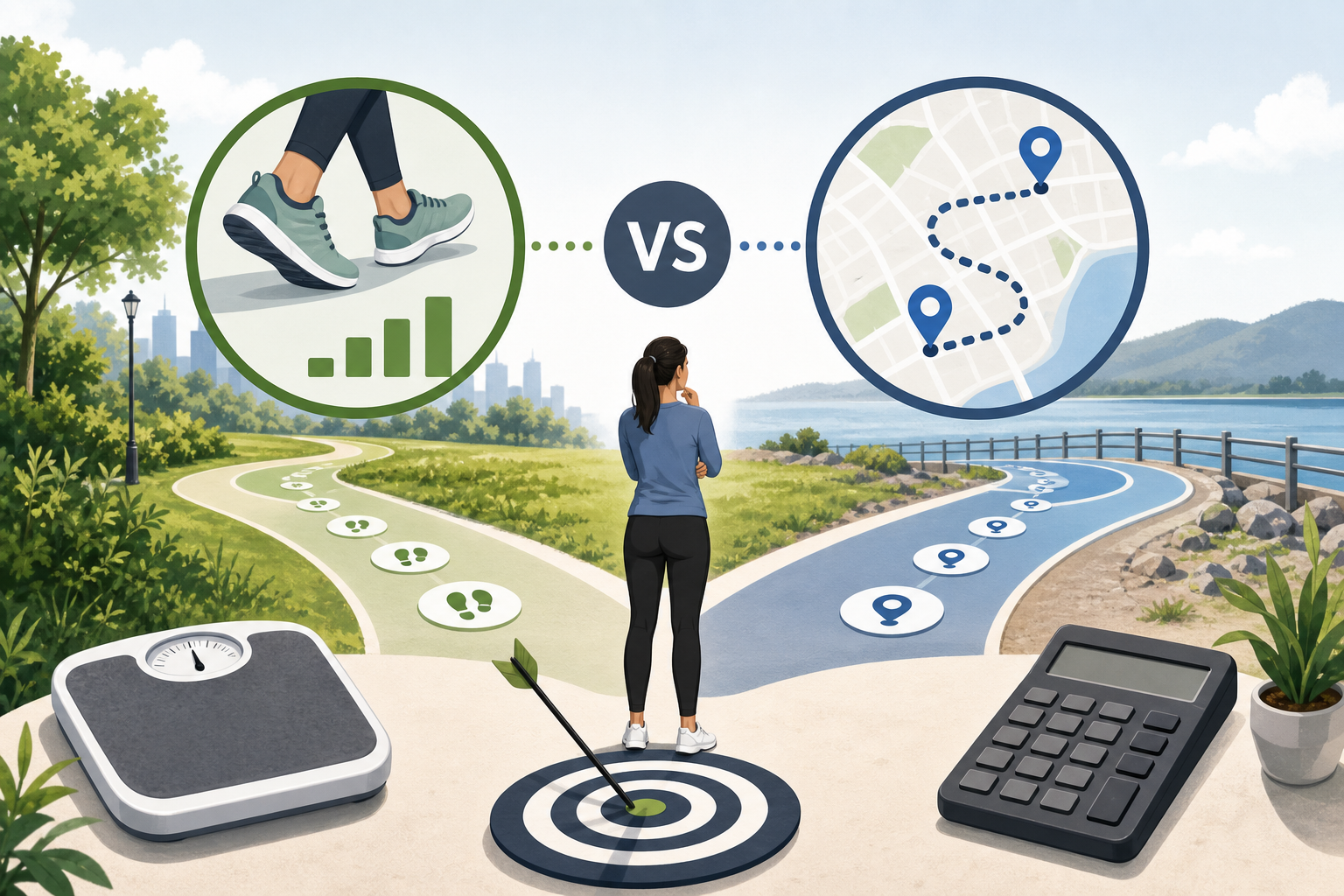
When comparing steps vs miles which is more useful for tracking walking depends on your purpose. Steps are usually more practical for monitoring total daily movement, including short walks around the home or workplace. Miles are more useful for measuring routes, comparing walking pace and planning distance-based sessions. Neither measure is universally better, and many people can use both.
- Steps vs miles which is more useful for tracking walking day to day?
- What step counts and miles actually measure
- Steps count repeated movements
- Miles describe distance travelled
- Steps per mile is not a universal number
- Choosing the better measure for your purpose
- When steps are more useful
- When miles are more useful
- What a steps to miles calculator can and cannot tell you
- What the calculator can do
- What the calculator cannot do
- Practical examples of using both measures
- Converting 10,000 steps into miles
- Tracking an ordinary workday
- Following a weekend walking route
- How to interpret your walking records
- Frequently asked questions
- Is tracking steps more accurate than tracking miles?
- How many steps are in one mile?
- Why does my calculated distance differ from my watch?
- Should I set a daily step goal or a mileage goal?
- Can steps or miles show how many calories I used?
- The practical takeaway
Steps vs miles which is more useful for tracking walking day to day?
Step counts are often the simpler choice for day-to-day tracking because they combine movement from many parts of the day into one total. A walk to a shop, movement at work and a planned evening walk can all contribute to the same step count.
Miles provide a clearer picture of how far you travelled. This makes distance useful when you follow a mapped route, train for a walking event or want to compare walks completed over similar terrain.
The most useful measure is the one that matches the question you are asking:
- “How much have I moved today?” Steps usually answer this more conveniently.
- “How far did I walk?” Miles provide the more direct answer.
- “How long will this route take?” Distance combined with your usual walking time is helpful.
- “How active was the walk?” Steps or miles alone are insufficient; pace, terrain, duration and effort also matter.
What step counts and miles actually measure
Steps count repeated movements
A step count records or estimates the number of steps detected by a phone, watch, pedometer or other device. It does not directly measure distance. Devices may use motion sensors, algorithms and personal information to identify steps, so counts can differ between devices.
Steps can capture movement that is difficult to describe as a route. For example, walking between rooms or moving around a workplace may add meaningfully to a daily total even though you would not normally record the distance.
Miles describe distance travelled
Miles indicate distance rather than the number of movements used to cover it. A person with a longer step length will generally need fewer steps to walk the same distance than a person with a shorter step length.
Distance may come from a mapped route, GPS estimate, treadmill display or conversion from steps. These are not equally precise. A professionally measured course is different from an estimated distance based on step length, and GPS readings can also vary with signal quality and device processing.
Steps per mile is not a universal number
There is no single steps-per-mile value that applies to everyone. Height, leg length, walking speed, gait and terrain can all affect step length. The same person may also take more steps per mile when walking slowly or navigating a crowded or uneven route.
This is why a height-based conversion is usually more individualised than applying one fixed number of steps per mile to every user. It remains an estimate because people of the same height can still have different walking patterns.
Choosing the better measure for your purpose
When steps are more useful
Steps work well when your aim is to monitor general movement throughout the day. They are easy to accumulate across many short periods and do not require you to choose a route or record a dedicated walking session.
They are also useful for comparing your own routine over time, particularly when you use the same device in a similar way. Personal trends are often more informative than comparing your count with another person whose device, gait and routine may be different.
A step goal should be treated as a planning tool rather than a complete assessment of health or exercise quality. The number does not show whether steps were slow or brisk, uphill or downhill, continuous or spread across the day.
When miles are more useful
Miles are preferable when the distance itself matters. Examples include following a two-mile route, preparing for a distance-based event or estimating how long it may take to reach a destination.
Distance can also make repeated walks easier to compare. If you use the same route, you can consider time, perceived effort and conditions alongside the mileage. This gives more context than distance alone.
The 2024 Adult Compendium of Physical Activities classifies walking activities using factors such as pace and context. This supports the practical point that equal distances or step counts do not necessarily represent equal activity intensity.
What a steps to miles calculator can and cannot tell you
A steps to miles calculator converts a step count into estimated distance. The calculation uses an assumed height-based step length, multiplies that length by the number of steps and converts the resulting distance from kilometres to miles.
Using height helps personalise the result, but it does not measure your actual stride. The output should therefore be read as an estimate rather than an exact distance.
What the calculator can do
- Estimate how many miles a recorded number of steps may represent.
- Provide a more individualised result than a single fixed conversion for everyone.
- Help translate a step-based daily record into a familiar distance unit.
- Support rough route, time or activity planning.
What the calculator cannot do
- Measure your actual step length or walking route.
- Confirm that your phone or wearable counted every step correctly.
- Account fully for changes in speed, gait, slopes or uneven terrain.
- Determine walking intensity, fitness improvement or energy expenditure from distance alone.
- Guarantee that its estimate will match GPS, treadmill or mapped-route results.
If greater personal accuracy is important, an average step length can be measured over a known distance and calculated from several normal walks. Even then, the result is an average and may change with pace or conditions.
Practical examples of using both measures
Converting 10,000 steps into miles
For many adults, 10000 steps in miles is roughly 4–5 miles. This is a broad estimate, not a fixed conversion. One person may cover the distance with fewer, longer steps, while another may need more, shorter steps.
Suppose two people each record 10,000 steps. A taller walker with a longer estimated step length may receive a result closer to the upper end of that range. A shorter walker may receive a result closer to the lower end, even though both completed the same number of steps.
Tracking an ordinary workday
A person who moves frequently between rooms, desks or buildings may find steps more informative than miles. Their movement is fragmented, and mapping every short trip would be impractical. Comparing step totals across similar workdays can show how routines differ.
Following a weekend walking route
Someone following a marked five-mile route may care more about miles than steps. The route distance is already known, while the step count will vary according to the walker’s gait. Recording both can still be useful: miles describe the route, and steps show how many movements the individual used to complete it.
How to interpret your walking records
Use consistent measurement methods where possible. Switching between a phone carried in a pocket, a wrist-worn device and a different tracking application can introduce differences that reflect the technology rather than a real change in movement.
Context also matters. Record duration, route or perceived effort if those details are relevant to your purpose. Two walks with the same mileage may feel very different because of pace, hills, surface, weather or stops.
Avoid treating a conversion as a measured value. If 8,000 steps are converted into an estimated number of miles, label the result as estimated distance. If you completed a measured route, the route distance may be the more suitable record.
It is also helpful to focus on personal patterns. A change in your own typical step count or walking distance, measured consistently, is generally easier to interpret than comparisons with someone who has a different stride, device or daily environment.
Frequently asked questions
Is tracking steps more accurate than tracking miles?
Not necessarily. Accuracy depends on the device and method. A wearable may miss or add steps, while GPS distance may vary with signal and route conditions. A measured route provides distance directly, whereas distance converted from steps is an estimate.
How many steps are in one mile?
The number varies with step length. Taller people often take fewer steps per mile than shorter people, but height alone does not determine gait. Walking speed, terrain and individual movement patterns can also change the result.
Why does my calculated distance differ from my watch?
The calculator and watch may use different assumptions. A calculator may estimate step length from height, while a watch may combine motion data, GPS and its own algorithm. Differences do not automatically mean that either result is exact or incorrect.
Should I set a daily step goal or a mileage goal?
A step goal may suit general daily movement, while a mileage goal may suit planned routes or distance-based training. You can also use a primary measure and keep the other as supporting information. The choice should reflect what you want to monitor.
Can steps or miles show how many calories I used?
Neither measure can determine energy expenditure on its own. Estimates would also need assumptions about factors such as body mass, pace, terrain and duration. Even with those inputs, the result remains an estimate rather than a direct measurement.
The practical takeaway
For steps vs miles which is more useful for tracking walking, steps are generally better for summarising movement across an entire day, while miles are better for recording and planning specific distances. Using both can provide complementary information without treating either number as a complete description of activity.
A conversion based on height can make a step count easier to understand as distance, but it cannot reproduce every variation in stride or walking conditions. Interpret calculated mileage as an estimate and choose the tracking measure that best fits your immediate purpose.