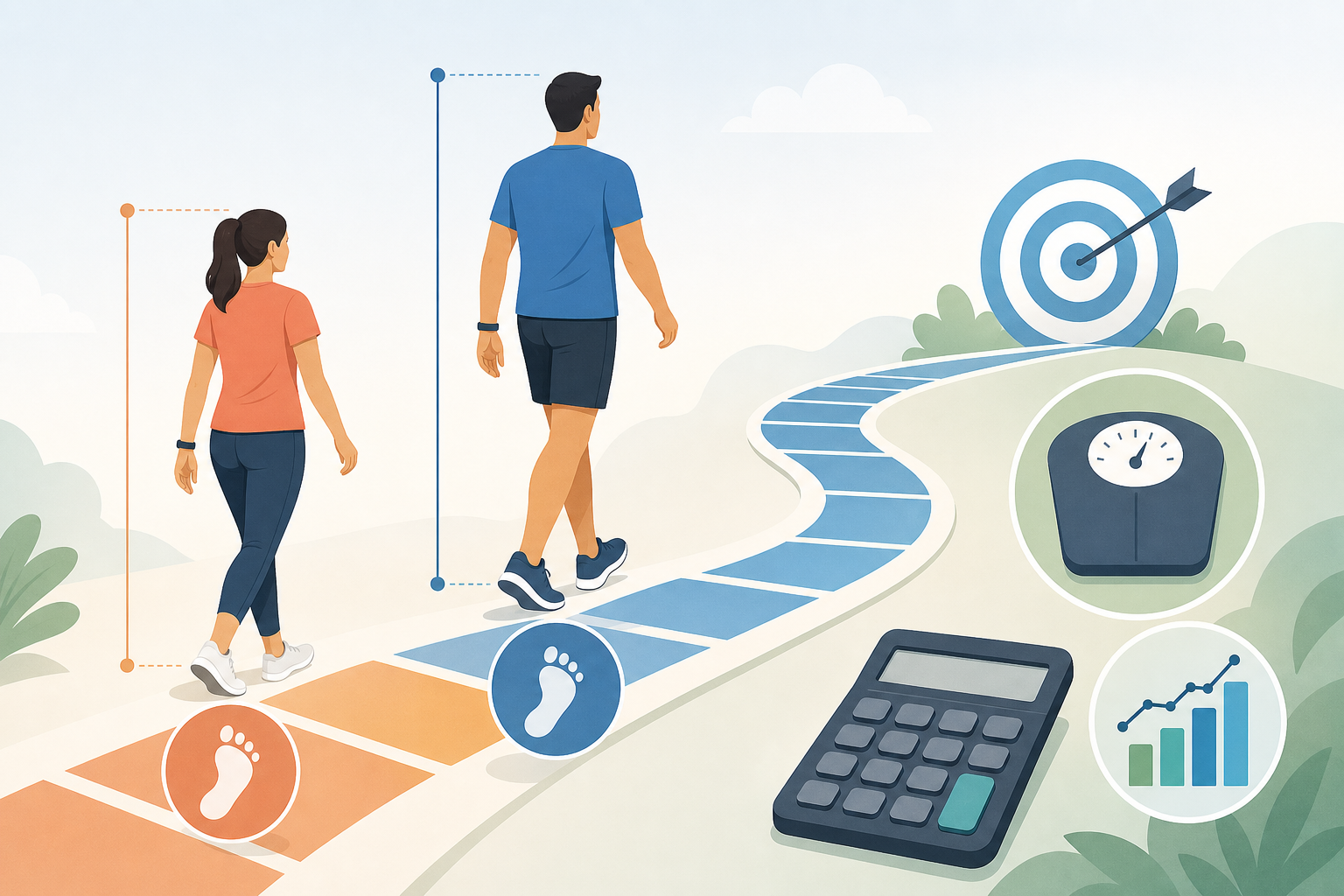
Yes, height can affect the estimated distance represented by a step count. The short answer to “does height change the number of miles in your step count” is that taller people generally have a longer estimated step length, so the same number of steps may cover more miles. Height is not the only factor, however: walking speed, terrain, gait and measurement accuracy can all change the result.
How does height change the number of miles in your step count?
A step count does not measure distance directly. To convert steps into miles, you need an assumed or measured step length. Height offers a practical way to estimate that length because body proportions often influence how far a person travels with each step.
For a fixed step count, a longer estimated step length produces a greater distance. A shorter estimated step length produces a smaller distance. This is why two people can each record 10,000 steps but receive different mileage estimates.
The basic relationship is:
Estimated distance = number of steps × estimated step length
The result can then be converted from metres or kilometres into miles. A height-based calculation is more individualised than applying one universal steps-per-mile figure to everyone, but it remains an estimate rather than a measured route distance.
Why steps per mile vary between people
Steps per mile describes how many steps a person takes to cover one mile. It is closely related to step length: longer steps mean fewer steps per mile, while shorter steps mean more steps per mile.
Height can influence this relationship, but people of the same height do not necessarily walk in the same way. Relevant factors include:
- Walking speed: step length may change when moving slowly, briskly or at a run.
- Individual gait: joint movement, posture and natural walking style differ between people.
- Terrain: hills, uneven paths and stairs can alter how steps translate into horizontal distance.
- Footwear and carrying loads: these may change a person’s usual movement pattern.
- Device placement and algorithm: a phone, wrist tracker and pedometer may not record identical totals.
- Stops and short indoor movements: devices may count movements that do not resemble steady outdoor walking.
Walking is also performed across a wide range of speeds and conditions. The 2024 Adult Compendium of Physical Activities distinguishes among different walking activities rather than treating all walking as one uniform task. This is relevant when interpreting a conversion because pace and activity context can affect how representative an assumed step length is.
What 10000 steps in miles may look like
For many adults, 10000 steps in miles is roughly estimated at 4–5 miles. That range is useful for general orientation, but it is not an exact conversion for every person or every walk.
Consider a hypothetical comparison. One walker has an estimated step length of 0.70 metres, while another has an estimated step length of 0.78 metres. These values are examples for demonstrating the calculation, not recommended values for particular heights.
- 10,000 steps × 0.70 metres = 7,000 metres, or about 4.35 miles.
- 10,000 steps × 0.78 metres = 7,800 metres, or about 4.85 miles.
Both people recorded the same number of steps, yet their estimated distances differ by about half a mile. The difference comes entirely from the step lengths used in the calculation.
The same principle applies to other totals. If a calculator assigns a longer height-based step length, it will estimate more distance from 5,000, 8,000 or 12,000 steps. It does not mean one person’s step count is better or more valuable; it only changes the distance estimate.
How a steps to miles calculator uses height
A steps to miles calculator uses your entered step count and height to estimate distance. The tool derives an estimated step length from height, multiplies it by the number of steps and converts the resulting distance into miles.
Typical use involves the following steps:
- Choose the requested unit system.
- Enter your height and step count.
- Select Calculate to view the estimated distance.
- Review the supporting details and limitations before using the result for planning or comparison.
What the calculator can tell you
- An estimated distance for a given step count.
- How using your height may change the result compared with a fixed conversion.
- An approximate steps-per-mile value based on the model.
- A consistent method for comparing step totals over time.
What the calculator cannot tell you
- Your exact step length during every part of a walk.
- The precise route distance without direct distance measurement.
- Whether a phone or wearable counted every step correctly.
- How speed, hills, fatigue or changes in gait affected individual steps.
- The health effect or energy expenditure associated with the distance.
The output should therefore be treated as an estimate. Height makes the conversion more personalised, but it does not replace direct measurement.
How to obtain a more personal distance estimate
If you regularly walk at a similar pace, measuring your own average step length may produce a more personal conversion than height alone. One approach is to walk a measured distance, record the step total and divide the distance by the number of steps.
For example, if you count steps over a known track distance, you can calculate:
Average step length = measured distance ÷ recorded steps
Using a longer measured section is generally more representative than measuring only one or two steps. Natural walking varies slightly from step to step, and a longer section reduces the effect of any single unusually short or long movement.
Another option is to compare your device’s step count with a route measured by a mapping service or GPS. GPS also has limitations, particularly around buildings, trees or short routes, but it measures distance using a different method and can provide a useful comparison.
Use comparable conditions when monitoring changes. A leisurely indoor day and a brisk outdoor walk may produce different relationships between steps and miles, even for the same person.
Common mistakes when converting steps into miles
Using one universal conversion
A rule such as “2,000 steps always equals one mile” may be convenient, but it assumes a fixed step length. Actual and estimated steps per mile vary, so a height-based result may differ from this shortcut.
Confusing step length with stride length
A step is the movement from one foot contact to the next foot contact. A stride generally covers two steps, from one foot contact to the next contact of that same foot. Entering stride length where step length is required can substantially overstate distance.
Treating the result as a measured value
A calculated result depends on its assumptions. If the tool uses height to estimate step length, the resulting mileage is also estimated. A measured route, treadmill display or GPS distance comes from a different method and may not match exactly.
Ignoring the source of the step count
Wearables and phones use sensors and device-specific algorithms. Arm movements, pushing a trolley, carrying a phone in a bag or walking in short bursts may affect what is recorded. A precise-looking step total is not necessarily perfectly accurate.
Frequently asked questions
Do taller people always walk more miles for the same number of steps?
No. Height-based models generally assign taller people longer step lengths, which increases estimated distance for the same step count. In real life, however, an individual’s gait and walking conditions may produce a different result.
Why does my fitness tracker show a different distance?
Your tracker may use a personal profile, GPS, pace information, previous activity data or its own step-length formula. A separate calculator may use a simpler height-based method, so the two estimates need not match.
Is 10,000 steps exactly five miles?
No. Ten thousand steps is often estimated at roughly 4–5 miles for many adults, but the distance depends on the step length used. Five miles may be a reasonable estimate for some walkers and too high for others.
Does walking faster change steps per mile?
It can. People may alter step length and cadence as speed changes, so a conversion based on a usual walking pace may be less representative during very slow walking, brisk walking or running.
Should I use height or measured step length?
Height is convenient when you do not know your step length. A carefully measured average step length may better reflect your own walking pattern, particularly if it is measured over a known distance at your usual pace.
Putting height-based mileage estimates in context
So, does height change the number of miles in your step count? It changes the estimated miles because height is used to approximate step length. For the same step total, a longer estimated step length gives more miles and fewer steps per mile.
A height-based conversion is useful for everyday planning and consistent comparisons. It should not be mistaken for an exact route measurement, because pace, gait, terrain and device accuracy can all influence the relationship between steps and distance.