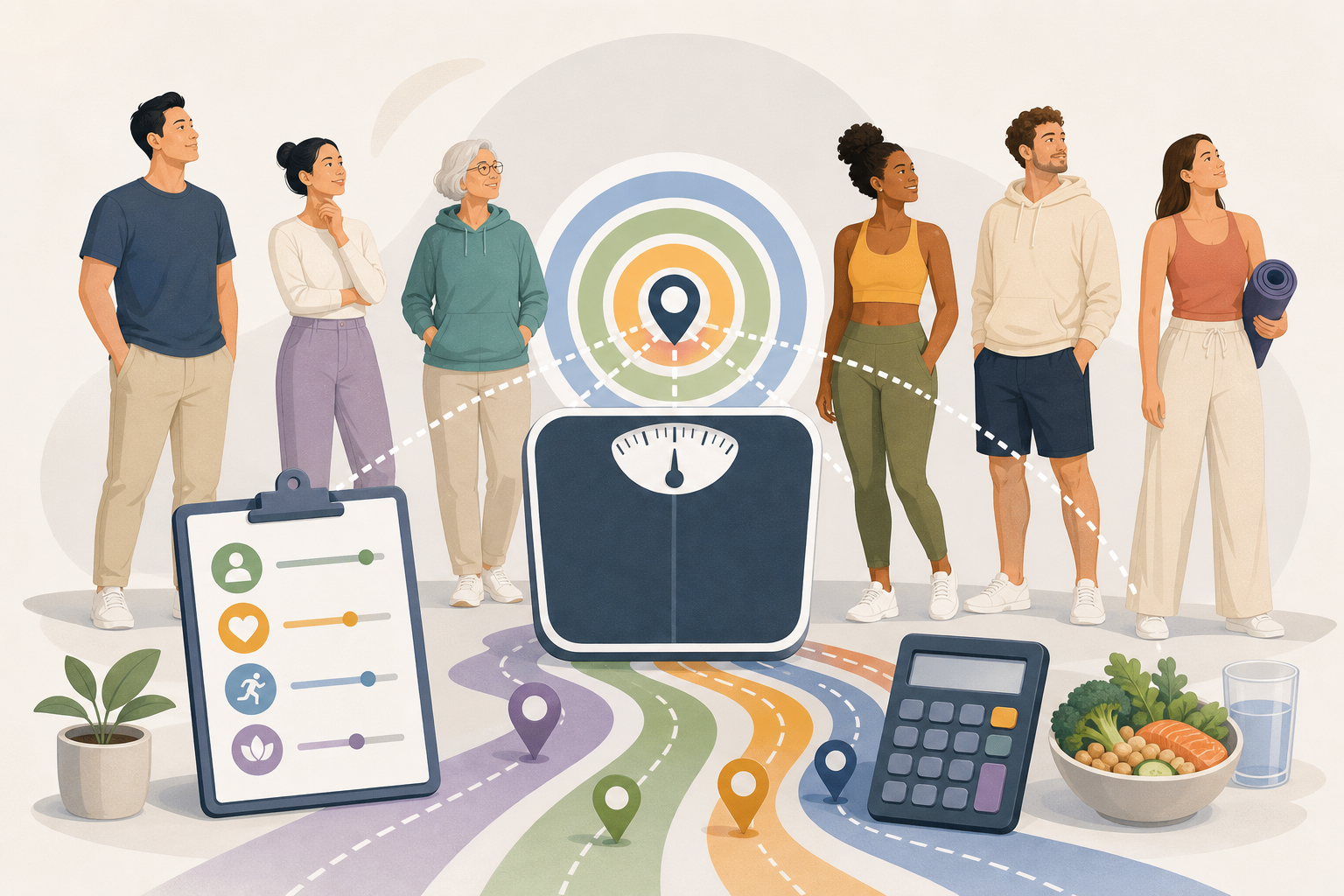
There is no single perfect weight for everyone because body weight alone cannot describe body composition, frame, health, physical function or personal circumstances. Height-based formulas and weight ranges can provide reference points, but they cannot identify one universally healthiest number for every person.
- Why a perfect weight for everyone does not exist
- What body weight does not reveal
- Body composition
- Frame and body structure
- Health and physical function
- A healthy weight range is more useful than one exact number
- What an ideal weight calculator can and cannot tell you
- What the calculator can provide
- What the calculator cannot determine
- A practical example of interpreting the estimates
- How to choose a realistic target weight
- Frequently asked questions
- Is ideal weight the same as healthy weight?
- Should I use the average from the ideal weight calculator as my goal?
- Why do ideal-weight formulas give different answers?
- Can two people of the same height have different healthy weights?
- Is BMI more accurate than an ideal-weight formula?
- How often should a target weight be reviewed?

A useful weight goal therefore needs context. The same scale reading may have different implications for two people of equal height, depending on factors such as muscle mass, body structure, health history, age, daily activity and how their weight affects comfort and function.
Why a perfect weight for everyone does not exist
The idea of a perfect weight suggests that each height corresponds to one exact number. Human bodies do not work that way. People of the same height can differ substantially in build, body composition and physical needs while both functioning well.
Weight also changes naturally over time. Training, ageing, pregnancy, illness, medication, changes in activity and shifts in eating patterns can all influence the scale. A number that was realistic or comfortable at one stage of life may not be the most appropriate target at another.
Even commonly used assessment methods have limits. The US Centers for Disease Control and Prevention describes body mass index, or BMI, as a screening measure based on height and weight. It does not directly measure body fat or provide a complete assessment of an individual’s health.
What body weight does not reveal
Body composition
Total body weight includes muscle, fat, bone, organs and body water. A standard scale cannot show how much each component contributes to the result.
For example, resistance training may increase muscle while fat mass decreases. In that situation, the scale might change only slightly even though strength, measurements or physical capacity have changed. Conversely, a lower number does not automatically establish that someone has a body composition that supports their health and daily needs.
Frame and body structure
People differ in skeletal proportions and overall build. Frame size is not captured by most height-and-weight formulas, so two adults with the same height may not be equally comfortable or functional at the same weight.
Frame is also difficult to reduce to a simple category such as “small”, “medium” or “large”. Those labels may offer context, but they should not be treated as precise measurements or as instructions for choosing a goal.
Health and physical function
Weight is only one part of a broader picture. Energy levels, mobility, strength, sleep, laboratory results, medical history and the ability to perform everyday activities may all be relevant when interpreting a weight goal.
Personal context matters as well. An athlete preparing for an event, an older adult seeking to maintain strength and a person returning to activity after illness may have very different priorities, even if they are the same height.
A healthy weight range is more useful than one exact number
A healthy weight range recognises normal variation between individuals. It can provide room for differences in body composition, build and personal circumstances rather than implying that success depends on reaching a single figure.
BMI is one commonly used way to relate weight to height. Adult BMI categories can support population-level comparisons and initial screening, but they do not distinguish muscle from fat or account for all differences between individuals. The CDC advises that BMI should be considered alongside other information rather than used as a diagnosis by itself.
A range should not be interpreted as a guarantee. Being inside a reference range does not prove that every health measure is favourable, and being outside it does not explain why a person weighs what they do. It is a starting point for interpretation, not a complete judgement.
Day-to-day scale readings also fluctuate because of food, fluid balance and other short-term factors. For planning purposes, a trend over time is generally more informative than treating one isolated reading as a final answer.
What an ideal weight calculator can and cannot tell you
The ideal weight calculator estimates reference body weights using the Devine, Robinson and Miller equations. These are historical, height-based formulas rather than personalised definitions of health.
For adults who are at least 5 feet tall, the calculator displays the three estimates separately and provides their average. Showing several results helps make an important point: even established formulas do not always produce the same answer.
What the calculator can provide
- Several commonly cited height-based reference estimates.
- A comparison between the Devine, Robinson and Miller methods.
- An average of the formula results.
- A neutral starting point for thinking about a possible target weight.
- A value that can be compared with a broader healthy weight range and other relevant information.
What the calculator cannot determine
- Your body composition or distribution of muscle and fat.
- Your frame size, fitness level or physical function.
- The effects of ethnicity, age or medical history.
- Whether a particular weight is sustainable in your circumstances.
- The single healthiest or most comfortable weight for you.
- How quickly, or whether, your weight should change.
The calculator’s results are estimates, not measured physiological values. Their usefulness comes from providing reference points that can be interpreted alongside broader information, rather than from identifying one number that everyone of a particular height should reach.
A practical example of interpreting the estimates
Consider a 5-foot-10-inch male entering his height into the calculator. The Devine, Robinson and Miller formulas produce reference weights that are close to one another but not identical. Their average offers a convenient summary, but it does not make that average uniquely correct.
Suppose this person regularly performs resistance training and has more muscle than another man of the same height. He may weigh more than the formula average while still having favourable health indicators and good physical function. Someone else may have a lighter build and find a lower weight more comfortable and sustainable.
The formulas do not know either person’s body composition, waist measurement, health history, current habits or preferences. The result is therefore best treated as one piece of planning information.
A practical interpretation might be: “These equations cluster around this area, but I will compare that estimate with my current trend, BMI range, strength, comfort, health information and realistic habits.” This avoids turning a historical formula into a rigid requirement.
How to choose a realistic target weight
A target weight can be useful when it provides direction without implying false precision. Rather than choosing an exact number solely because a formula produced it, consider setting an initial range or review point.
-
Start with more than one reference. Compare the formula estimates with a BMI-based healthy weight range, while recognising the limitations of both approaches.
-
Consider your weight history. Previous weights may offer context about what has been maintainable, although past results do not guarantee what will be suitable now.
-
Include function and wellbeing. Think about mobility, strength, energy, sleep, comfort and the activities you want to perform.
-
Use a range where appropriate. A range allows for normal fluctuation and reduces the importance of minor scale changes.
-
Review the goal as circumstances change. Health conditions, medication, training, pregnancy, ageing and changes in daily life may affect how a target should be interpreted.
It may also help to separate outcome goals from behaviour goals. A target weight is an outcome that cannot always be controlled precisely. Regular meals, an appropriate activity routine, adequate rest and consistent monitoring are behaviours that can be reviewed without assuming a guaranteed scale result.
If a proposed goal conflicts with health needs, medical treatment, physical function or a history of difficult eating behaviours, personal guidance from a suitably qualified healthcare professional can provide context that a calculator cannot.
Frequently asked questions
Is ideal weight the same as healthy weight?
Not necessarily. An “ideal weight” formula provides a height-based estimate, while healthy weight is a broader concept involving health, body composition, function and personal context. Neither a formula result nor a BMI category can describe all of those factors on its own.
Should I use the average from the ideal weight calculator as my goal?
The average can be used as a reference, but it does not need to become an exact goal. It may be more useful to compare it with a healthy weight range, your current measurements, your weight history and other relevant health information.
Why do ideal-weight formulas give different answers?
The formulas were developed using different equations and assumptions. Their differences demonstrate that “ideal weight” is not a directly measured biological value. No one formula accounts for all individual variation.
Can two people of the same height have different healthy weights?
Yes. Differences in muscle mass, frame, age, health, activity and personal circumstances can make different weights appropriate for people of the same height. A shared height does not mean two bodies have identical needs.
Is BMI more accurate than an ideal-weight formula?
They answer slightly different questions, but both rely on height and weight and have important limitations. BMI provides a standardised screening category, while ideal-weight formulas estimate reference weights. Neither directly measures body composition or diagnoses health.
How often should a target weight be reviewed?
There is no universal schedule. A review can be useful when health, medication, activity, life stage or physical priorities change. It may also be appropriate when a target is causing an excessive focus on small scale fluctuations or no longer supports practical goals.
Ultimately, there is no perfect weight for everyone because a single number cannot represent the full range of human bodies and circumstances. Calculator estimates are most useful as reference points within a wider assessment of health, function, sustainability and personal preference.