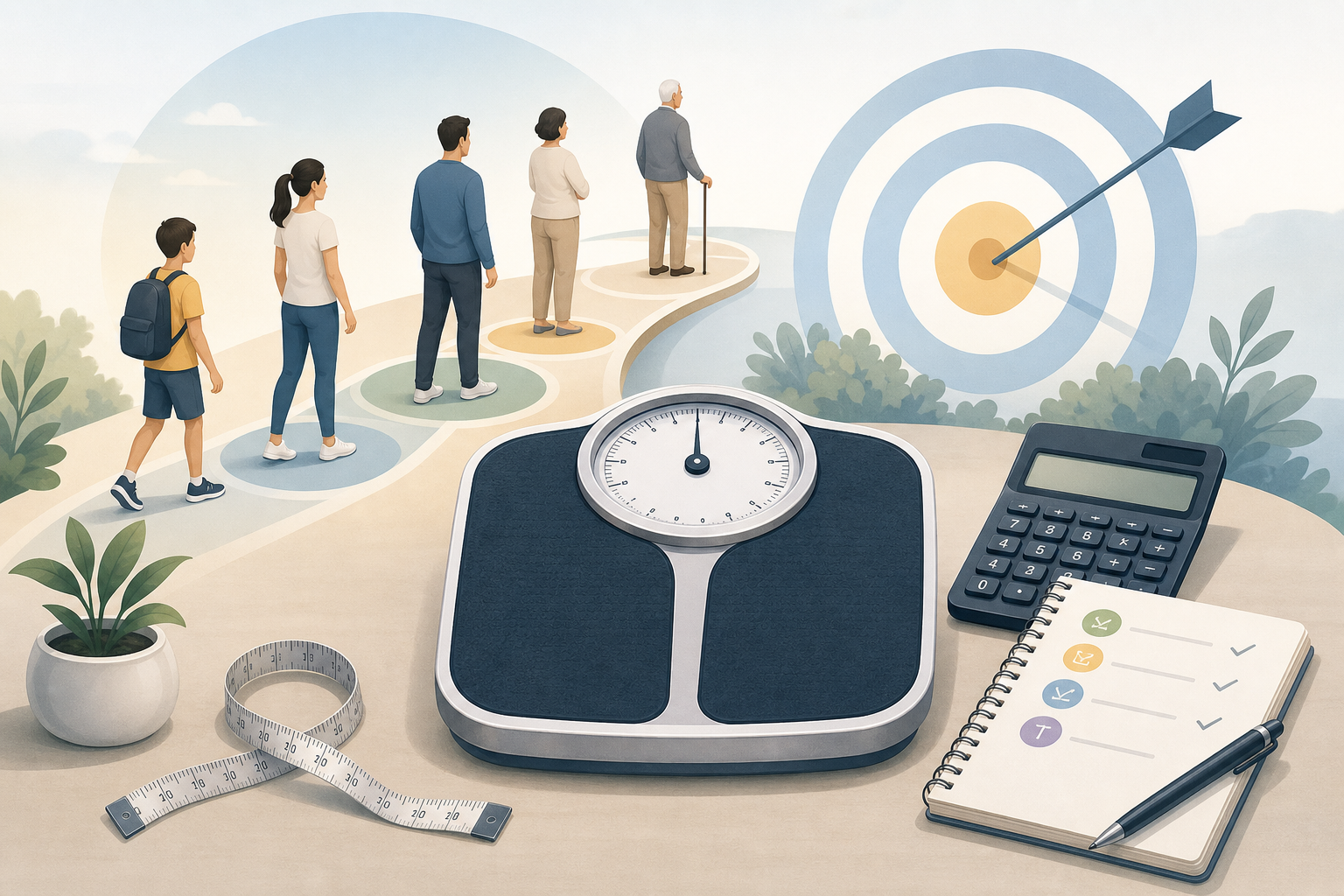
Yes, age can affect how a weight estimate should be interpreted, but it usually does not change the result of a traditional height-based formula. When asking does age affect ideal body weight, it helps to separate the calculator’s mathematical output from a person’s changing body composition, health needs and priorities. A reference weight that seems useful at one stage of adulthood may be less informative at another.
Does age affect ideal body weight in height-based formulas?
Most traditional “ideal weight” equations use height and sex-based inputs, not age. If the same adult enters the same height and other required details at ages 25 and 65, the formula will generally return the same result.
This does not mean age is irrelevant to health or weight planning. It means only that age is outside the scope of these historical equations. Their results are reference estimates rather than age-adjusted assessments of the healthiest weight for a particular person.
Age can affect the interpretation because body composition, physical function, activity patterns and health circumstances may change over time. Two adults with the same height and body weight can have different amounts of muscle and body fat, and a height-based equation cannot identify that difference.
Why body composition matters with age
Body weight includes muscle, fat, bone, organs and body water. A scale reports their combined mass, while an ideal weight formula uses no direct measurement of any of them.
As people get older, changes in activity, muscle mass or fat distribution may occur, although the extent and timing vary considerably. This means a stable body weight does not necessarily indicate stable body composition. Conversely, a small change in weight may not automatically represent a harmful change.
Height can also change over the course of adulthood. Because these equations depend heavily on height, using an old or self-estimated measurement may affect the output. Measuring current height is more appropriate than relying on a value recorded many years ago.
For older adults in particular, physical function, adequate nutrition and the preservation of strength may sometimes be more informative than pursuing a single formula-derived target weight. Individual health conditions and treatment history can also change how weight trends are interpreted.
Reference weight, healthy weight range and target weight are different
The term “ideal weight” can imply that one exact number is best, but the formulas do not establish that. They provide historical reference points based mainly on height.
| Term | What it means | Main limitation |
|---|---|---|
| Formula-based reference weight | An estimate produced by a height-based equation | Does not account for age, body composition or health history |
| Healthy weight range | A broader screening range, often discussed using height and weight | Still cannot directly measure muscle, body fat or individual health |
| Target weight | A personal planning value based on goals and circumstances | May be unrealistic if chosen from a formula alone |
Body mass index, or BMI, is another height-and-weight screening measure. The CDC explains adult BMI and its categories, while also treating BMI as a screening measure rather than a diagnosis. BMI categories for adults apply from age 20, so they do not provide a separate category for every decade of adult life.
A formula estimate and a BMI-based range can be viewed together, but neither identifies one universally correct weight. Waist measurements, weight history, physical function, body composition information and relevant health indicators may add context when available.
What the ideal weight calculator can and cannot tell you
The ideal weight calculator estimates reference body weights using the Devine, Robinson and Miller equations. For adults who are at least 5 feet tall, it displays each result separately and provides an average.
The calculator can help you:
- compare several commonly cited formulas;
- see how closely or widely their estimates differ;
- obtain a height-based reference point; and
- compare that point with a broader healthy weight range or personal planning goal.
The calculator cannot determine:
- your body-fat percentage or muscle mass;
- whether your current weight is medically appropriate;
- how age-related changes affect your individual health;
- the influence of ethnicity, frame size, fitness or medical history; or
- the exact target weight you should pursue.
The average shown by the tool is an average of formula outputs, not a measured biological ideal. Agreement between the equations also does not prove that the result is the healthiest weight for an individual.
A practical example across different ages
Consider two men who are both 5 feet 10 inches tall. One is 30 and regularly performs resistance exercise; the other is 70 and has recently become less active. The Devine, Robinson and Miller formulas will produce the same set of reference weights for both because age, activity and measured muscle mass are not inputs.
However, the identical calculator results may not have identical meaning. Their body composition, strength, weight history and health priorities could be different. The younger adult may have more muscle and weigh above the estimate without that difference being explained by the formula. The older adult may be close to the estimate but still need to consider recent unplanned weight change or reduced physical function.
This scenario does not establish which person is healthier. It demonstrates why a formula result should be treated as a comparison point rather than a personalised conclusion.
How to interpret an estimate over time
When reviewing an estimated ideal weight at different ages, focus on context rather than automatically lowering or raising the number. Useful questions include:
- Was current height measured accurately?
- Has weight changed gradually, intentionally or unexpectedly?
- Have strength, mobility or usual activity levels changed?
- Does the estimate sit within or far outside a broader screening range?
- Is the proposed target weight practical and consistent with personal needs?
Repeated measurements can sometimes be more informative than one isolated result. A formula does not reveal why weight changed, so it should not be used alone to interpret a rapid or unexplained trend.
A target weight also does not have to match the calculator’s average. Depending on body composition, current circumstances and personal preference, a planning range may be more practical than one exact number.
Frequently asked questions
Do ideal weight formulas include age?
The Devine, Robinson and Miller formulas used by this calculator do not directly include age. They mainly estimate reference weight from height and sex-based inputs.
Should ideal body weight increase with age?
A universal age-based increase cannot be determined from these formulas. Changes in weight may need to be interpreted alongside body composition, function, weight history and health circumstances rather than age alone.
Is BMI more accurate for older adults?
BMI provides a standard height-and-weight screening value, but it does not directly measure body fat, muscle mass or fat distribution. It may add context, but it does not remove the limitations of weight-based screening.
Can a muscular person weigh more than the calculator estimate?
Yes. Because the calculator does not measure muscle, a person with more muscle may weigh above its reference estimate. The formula cannot determine whether that difference comes from muscle, body fat or another component of body weight.
Should I use one number as my target weight?
Not necessarily. A range may better reflect normal variation and the uncertainty of formula-based estimates. A useful target should consider current measurements, weight history, preferences and relevant health factors rather than the calculated average alone.
Putting age and ideal weight in perspective
So, does age affect ideal body weight? Age does not usually alter the output of traditional height-based formulas, but it can affect how relevant that output is to an individual. Changes in body composition, height, activity, function and health priorities are not captured by the equations.
An ideal weight calculator is best used as a reference tool. Its results can support comparison and planning, but they should not be treated as a measured ideal or a universal definition of healthy weight.