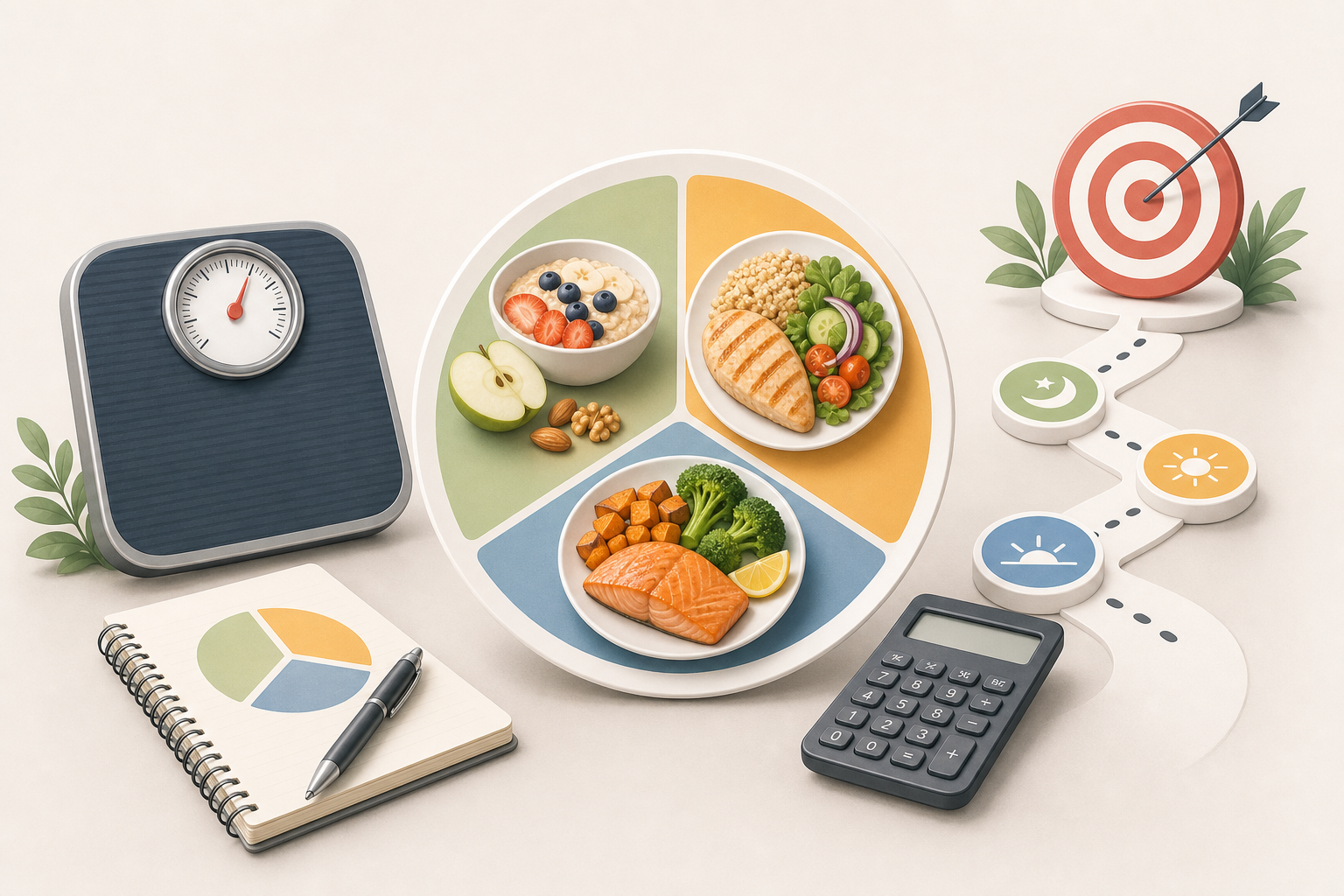
If you are deciding how many calories should you allocate per meal, a practical starting point is to divide your daily calorie target by the number of meals you plan to eat. For example, a target of 2,100 kcal across three meals gives 700 kcal per meal. This is a planning baseline, not a rule: meals can be larger or smaller according to your appetite, schedule, snack allowance and preferences.
- How many calories should you allocate per meal?
- Account for snacks and drinks before dividing daily calories per meal
- Meal calorie allocation does not have to be equal
- How the calories per meal calculator works
- What the calculator can tell you
- What the calculator cannot tell you
- Choosing a distribution that fits your routine
- Common meal-allocation mistakes
- Dividing the full target and then adding snacks
- Treating the result as an exact requirement
- Assuming more meals change the daily total
- Using the calculator to set the daily target
- Ignoring whether the pattern is practical
- Frequently asked questions
- Should breakfast, lunch and dinner contain the same number of calories?
- How do I divide calories between three meals and two snacks?
- What happens if I eat four meals instead of three?
- Does eating fewer or larger meals automatically support weight loss?
- Can I use different allocations on different days?
- Are calculator results measured calorie values?
- A flexible answer to how many calories should you allocate per meal
How many calories should you allocate per meal?
For an equal distribution, use this simple formula:
Calories per meal = daily calorie target ÷ number of meals
Here are several equal-split examples:
| Daily calorie target | Number of meals | Calories per meal |
|---|---|---|
| 1,800 kcal | 3 | 600 kcal |
| 2,000 kcal | 4 | 500 kcal |
| 2,100 kcal | 3 | 700 kcal |
| 2,400 kcal | 4 | 600 kcal |
These figures are estimates for planning. They do not mean that every meal must contain exactly the same number of calories. An equal split is useful because it is easy to calculate, but an uneven distribution may fit daily life better.
Your daily target also needs to be considered separately from the meal calculation. Energy needs vary among individuals, and the meal allocation formula does not determine an appropriate daily intake for you.
Account for snacks and drinks before dividing daily calories per meal
If your daily target includes snacks or calorie-containing drinks, set aside an allowance for them before dividing the remaining calories among meals. Otherwise, dividing the full target among meals and then adding snacks could take the planned total above the original target.
Use this adjusted formula:
Calories per meal = (daily calorie target − planned snack and drink calories) ÷ number of meals
Suppose your daily target is 2,100 kcal and you plan to allocate 300 kcal to snacks. That leaves 1,800 kcal for meals. Across three equal meals, the result is 600 kcal per meal.
The snack allowance does not have to be exact. It can simply provide structure, such as leaving some of the daily total available for fruit, yoghurt, a hot drink with milk or another planned item. Remember to include drinks only when they contribute calories; water and other calorie-free drinks do not require an allocation.
Meal calorie allocation does not have to be equal
Equal meals are only one option. You may prefer a larger breakfast, a lighter lunch and a larger evening meal, or you may need more of your daily allocation around work, study or training.
For example, a 2,100 kcal daily target could be divided as follows:
| Meal | Share of daily target | Planned calories |
|---|---|---|
| Breakfast | 25% | 525 kcal |
| Lunch | 35% | 735 kcal |
| Dinner | 40% | 840 kcal |
This distribution still totals 2,100 kcal. It simply places more of the available calories later in the day.
Another person might use a larger lunch because that is when they are most hungry, or reserve part of the total for an evening snack. Cultural meal patterns, family routines, food access and working hours can all affect which distribution is practical.
There is no need to force equal meals if doing so makes the plan difficult to follow. The arithmetic should support your routine rather than dictate it.
How the calories per meal calculator works
The calories per meal calculator divides a daily calorie target across a chosen number of meals. It provides a quick alternative to calculating the result manually.
To use it, enter the daily calorie target and select the number of meals requested by the tool. After calculating, review the estimated calories assigned to each meal and any supporting details displayed with the result.
What the calculator can tell you
- The result of dividing your chosen daily target equally across your selected number of meals.
- A simple baseline for planning breakfasts, lunches and dinners.
- How the per-meal amount changes when you increase or reduce the number of meals.
- A starting figure that you can adapt into an uneven meal distribution.
What the calculator cannot tell you
- Whether the daily calorie target entered is appropriate for your individual needs.
- Whether equal-sized meals suit your appetite, culture, schedule or training routine.
- Which foods to choose or whether a meal provides an appropriate balance of nutrients.
- Exactly how many calories your body uses or how your body weight will change.
- The exact calorie content of meals, because the result is an allocation rather than a measurement of food consumed.
The calculator performs planning arithmetic. Its output depends entirely on the daily target and number of meals entered, so it should not be interpreted as a personalised nutrition assessment.
Choosing a distribution that fits your routine
Begin by listing the meals and snacks that normally appear in your day. A theoretical plan built around three meals may not be useful if you regularly eat two meals and two substantial snacks.
Then consider when you usually feel hungry and when eating is practical. You might allocate more to a meal that needs to carry you through a long work period, while keeping another meal smaller because it is eaten close to a snack.
Useful planning factors include:
- The number of meals you realistically eat most days.
- Whether snacks and calorie-containing drinks are part of your routine.
- The time available to prepare and eat each meal.
- Differences between workdays, rest days and days with planned activity.
- Personal and cultural preferences concerning the main meal of the day.
- Whether the allocation leaves enough flexibility for meals shared with other people.
Calories describe energy, but they do not by themselves describe the nutritional composition of a meal. The National Academies’ Dietary Reference Intakes provide broader frameworks for energy and macronutrients, but they do not require a universal calorie distribution across breakfast, lunch and dinner.
It is also reasonable for the plan to vary from day to day. A calorie allocation is a budgeting method, not a requirement for every meal to match a precise figure.
Common meal-allocation mistakes
Dividing the full target and then adding snacks
If snacks are part of the daily target, subtract their planned allowance before calculating meal calories. Alternatively, include snacks as separate eating occasions when organising the total.
Treating the result as an exact requirement
A result of 600 kcal per meal does not mean each plate must contain exactly 600 kcal. Food portions and nutrition information are not perfectly precise, so the figure is best treated as a planning estimate.
Assuming more meals change the daily total
Changing from three meals to four reduces the amount allocated to each meal, but it does not change the entered daily target. For example, 2,000 kcal divided across three meals is about 667 kcal per meal, while the same total across four meals is 500 kcal per meal.
Using the calculator to set the daily target
The calculator divides a number that you provide. It does not assess energy requirements or decide whether that number is suitable.
Ignoring whether the pattern is practical
A mathematically tidy split may not match your day. If an equal distribution repeatedly leaves one meal too small or another unnecessarily large, redistribute the same total rather than assuming the plan has failed.
Frequently asked questions
Should breakfast, lunch and dinner contain the same number of calories?
No. Equal meals provide a straightforward baseline, but there is no requirement for breakfast, lunch and dinner to be identical in size. You can use different allocations while keeping the planned daily total unchanged.
How do I divide calories between three meals and two snacks?
First assign part of the daily target to the two snacks. Subtract that amount from the daily total, then divide the remainder across three meals. The snack allocations can be equal or different.
What happens if I eat four meals instead of three?
The estimated calories per meal become smaller when the same daily target is divided across more meals. For example, 2,400 kcal gives 800 kcal across three equal meals or 600 kcal across four equal meals.
Does eating fewer or larger meals automatically support weight loss?
A meal distribution alone cannot predict weight change. The calculator only divides a daily target; it does not establish how a particular meal frequency will affect an individual.
Can I use different allocations on different days?
Yes. You might use one pattern on workdays and another on weekends, provided each pattern reflects the daily target you intend to plan around. Different schedules do not require identical meal sizes.
Are calculator results measured calorie values?
No. The result is an arithmetic estimate based on the values entered. It is not a measurement of the calories in a prepared meal or of your body’s actual energy use.
A flexible answer to how many calories should you allocate per meal
The simplest answer to how many calories should you allocate per meal is to divide your daily calorie target, after any separate snack allowance, by the number of meals. This gives a convenient starting point rather than a mandatory distribution.
Equal meals may suit some routines, while larger and smaller meals may suit others. The most useful meal calorie allocation is one that accounts for your full daily plan and can be adjusted without treating the calculator result as an exact requirement.