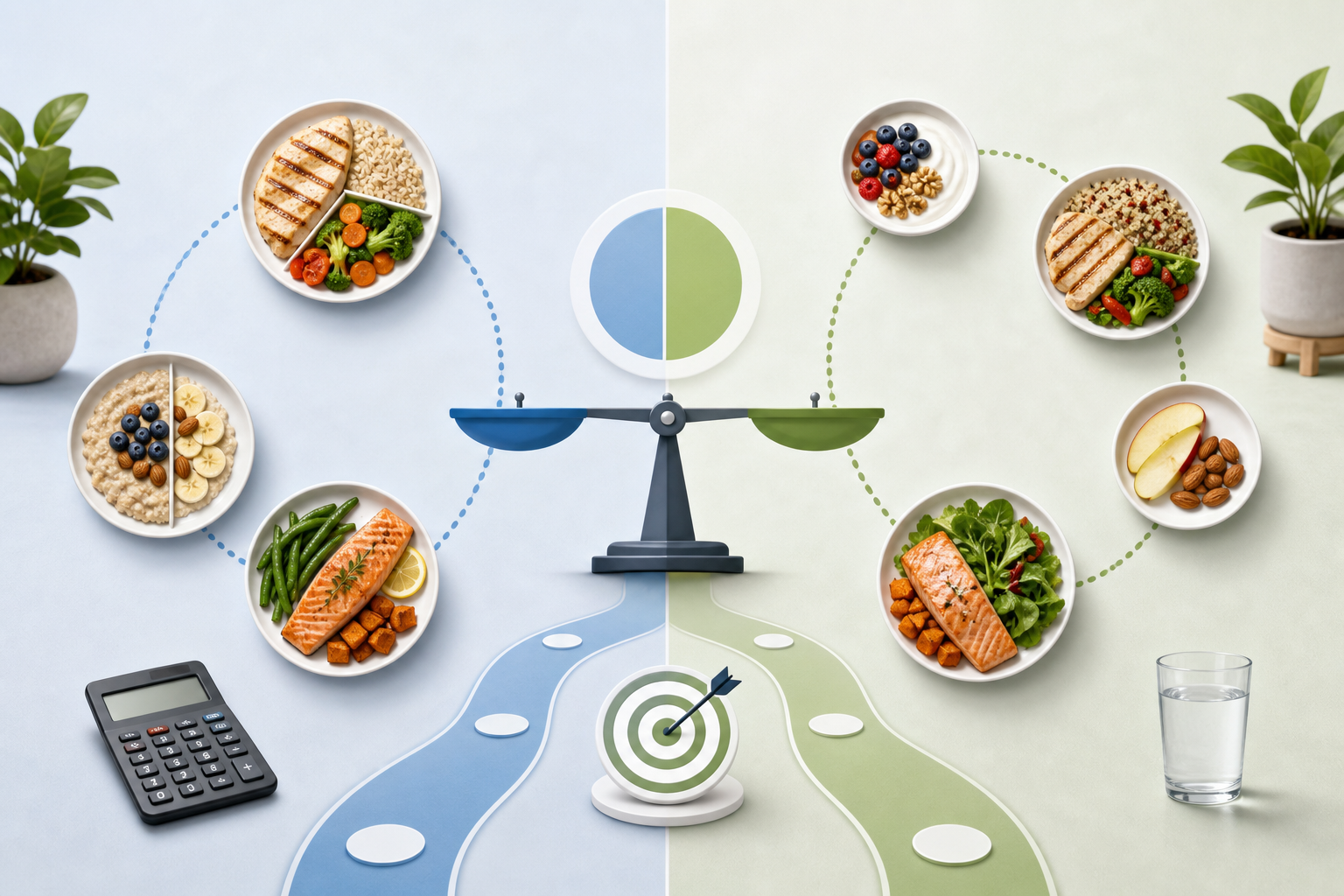
When comparing 3 meals vs 4 meals how does the calorie split change? With the same daily calorie budget, eating four meals produces a smaller average allocation per meal. For example, a 2,100-kcal target allows an average of 700 kcal across three meals or 525 kcal across four meals. The daily total remains 2,100 kcal; only its distribution changes.
3 meals vs 4 meals how does the calorie split change?
The basic calculation is:
Average calories per meal = daily calorie target ÷ number of meals
Moving from three meals to four does not create or remove calories. It divides the same total into one additional eating occasion. Each four-meal allocation is 75% of the corresponding three-meal allocation.
Another way to express this is that the average allocation is 25% lower when the same daily target is divided into four meals rather than three. That percentage applies to any daily calorie target, provided all calories are allocated equally and there is no separate snack budget.
| Daily target | Average over 3 meals | Average over 4 meals | Difference per meal |
|---|---|---|---|
| 1,500 kcal | 500 kcal | 375 kcal | 125 kcal |
| 1,800 kcal | 600 kcal | 450 kcal | 150 kcal |
| 2,100 kcal | 700 kcal | 525 kcal | 175 kcal |
| 2,400 kcal | 800 kcal | 600 kcal | 200 kcal |
These figures are planning allocations, not requirements for every individual meal. A person using a four-meal pattern could still eat one large meal and three smaller meals while keeping the same daily total.
Why meal frequency changes the average, not the daily budget
A daily calorie target is the total available for the day. Meal frequency determines how many portions that total is divided into. Increasing the number of meals therefore reduces the equal-share amount for each meal.
For a 1,800-kcal daily target:
- Three equal meals: 1,800 ÷ 3 = 600 kcal per meal.
- Four equal meals: 1,800 ÷ 4 = 450 kcal per meal.
In both cases, the planned daily total is 1,800 kcal. The four-meal pattern simply redistributes 150 kcal from each of the three original meal allocations to create a fourth 450-kcal meal.
The calculation becomes different if snacks or caloric drinks have their own allowance. Those calories should be subtracted before dividing the remaining budget among meals.
How snacks affect daily calories per meal
A common planning error is to divide the full daily target among meals and then add snacks without accounting for them. If snacks are part of the target, allocate them first or count them as one of the eating occasions.
Consider a person planning 2,100 kcal per day with three meals and one 300-kcal snack:
- Subtract the snack allocation: 2,100 − 300 = 1,800 kcal.
- Divide the remainder across three meals: 1,800 ÷ 3 = 600 kcal.
- The plan is three 600-kcal meals plus one 300-kcal snack.
This is not the same as four equal meals. Dividing 2,100 kcal equally across four eating occasions would provide 525 kcal each.
| Plan | Meal or eating-occasion allocations | Daily total |
|---|---|---|
| 3 equal meals | 700 + 700 + 700 kcal | 2,100 kcal |
| 4 equal meals | 525 + 525 + 525 + 525 kcal | 2,100 kcal |
| 3 meals plus a snack | 600 + 600 + 600 + 300 kcal | 2,100 kcal |
Whether an eating occasion is called a meal or a snack does not change the arithmetic. What matters is that every allocation is included in the daily total.
Equal meal calorie allocation is only a baseline
Equal division is convenient, but meal sizes do not have to be identical. Appetite, work hours, training schedules, family routines and cultural eating patterns may make an uneven split more practical.
For example, a four-meal 2,100-kcal plan could be allocated as follows:
- Breakfast: 450 kcal
- Lunch: 600 kcal
- Afternoon meal: 350 kcal
- Dinner: 700 kcal
The allocations still total 2,100 kcal, even though none equals the 525-kcal average. In this context, the average is a reference point rather than a limit for each eating occasion.
Meal calorie allocation also does not describe the nutritional composition of a meal. Two meals with similar calorie values can contain different amounts of protein, carbohydrate, fat, fibre, vitamins and minerals. The National Academies’ Dietary Reference Intakes address energy and macronutrients separately, so dividing calories across meals should not be treated as a complete nutrition assessment.
What the calories per meal calculator can and cannot tell you
A calories per meal calculator divides a daily calorie target by the selected number of meals. It is useful for creating a simple, consistent planning baseline.
What it can tell you
- The equal average calorie allocation for each meal.
- How the average changes when meal frequency changes.
- Whether a proposed set of meal allocations fits within the entered daily total.
- A starting point for planning meals of similar size.
What it cannot tell you
- Whether the entered daily calorie target is appropriate for your needs.
- How accurately a person absorbs or expends energy.
- Whether equal-sized meals will suit appetite, routine or food preferences.
- The protein, carbohydrate, fat, fibre or micronutrient content of the meals.
- The exact calorie content of food unless the underlying portions and nutrition data are accurate.
The calculator’s division is mathematically exact for the number entered, but the daily target itself may be an estimate. Food labels, serving sizes, recipes and tracking methods may also introduce variation. The result should therefore be understood as a planning value rather than a measured description of energy intake.
Choosing between three and four meals
The arithmetic does not show that one meal frequency is inherently better. It only shows how the available calories are distributed. A practical pattern is one that fits the daily budget and can be followed within a person’s routine and preferences.
Three meals may provide more calories at each sitting and require fewer planned eating occasions. Four meals may provide smaller portions more frequently. However, adding a fourth meal without reducing the other three would increase the planned daily total.
Questions that can help clarify the choice include:
- Will snacks be included within the calorie target?
- Are larger or smaller meals more comfortable?
- Does the daily schedule allow four planned eating occasions?
- Should more calories be assigned to a particular meal?
- Do exercise or work schedules make one distribution easier to use?
It can also help to distinguish meal frequency from meal timing. Three meals could be eaten close together or spread throughout the day, while four meals could follow many different schedules. The calories-per-meal calculation does not evaluate timing.
Frequently asked questions
Does eating four meals mean eating more calories?
No. Four meals only increase daily calories if the extra meal is added without reducing the calories allocated elsewhere. When the same daily target is divided across four meals, each meal has a smaller average allocation.
How do I calculate calories for three meals and two snacks?
First assign calories to the two snacks and subtract their combined amount from the daily target. Divide the remaining calories by three for an equal meal baseline. Alternatively, treat all five eating occasions equally by dividing the full target by five.
Do all four meals need to contain the calculated average?
No. The calculated result is an average. Meals can be larger or smaller as long as the allocations add up to the intended daily total.
What happens if the result is not a whole number?
You can round individual allocations while keeping the daily total in view. For example, 2,000 kcal divided across three meals is about 667 kcal per meal. A practical split might be 667, 667 and 666 kcal, although that level of precision is rarely necessary for ordinary meal planning.
Is a snack the same as a fourth meal in the calculation?
It can be if all four eating occasions receive equal allocations. If the snack is intended to be smaller, set aside its calories first and divide the remainder among the three main meals.
What is the main takeaway from comparing three meals with four?
For 3 meals vs 4 meals how does the calorie split change, the four-meal average is 25% smaller than the three-meal average when the daily target stays the same. The calculation provides a baseline; actual meals can be distributed unevenly to suit the planned total.