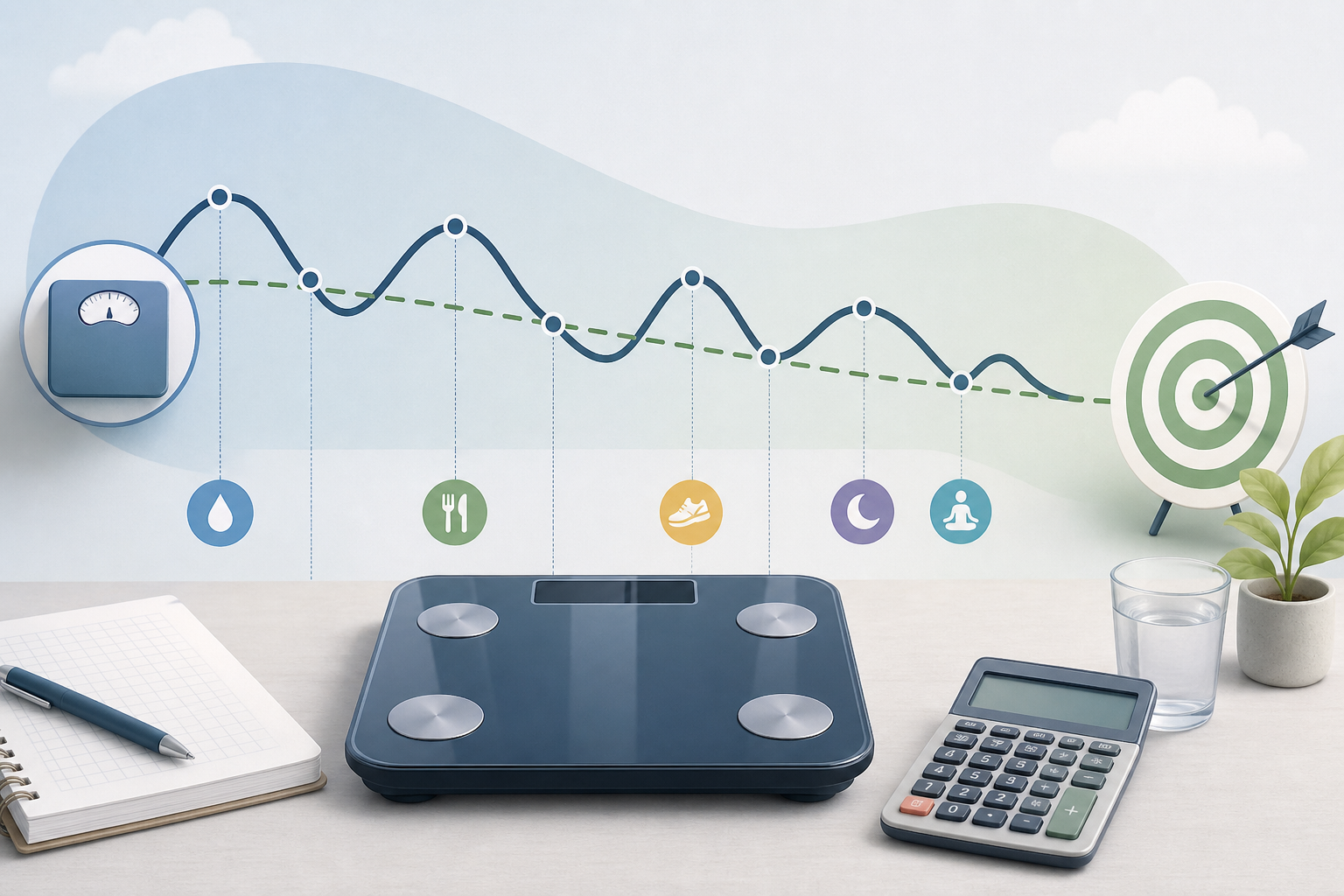
Understanding how daily weight fluctuations can distort a simple weight difference helps prevent an accurate calculation from being given too much meaning. Water balance, sodium intake, food and drink still being digested, bowel contents, clothing and measurement timing can all change the number on a scale. As a result, the difference between two readings may be mathematically correct without representing an equivalent change in body tissue.
How daily weight fluctuations can distort a simple weight difference
A weight difference calculation uses two measurements: a starting weight and a current weight. The basic formula is:
Weight change = current weight − starting weight
A positive result indicates a gain, a negative result indicates a loss, and zero indicates no change. The absolute difference describes the size of the change without the direction.
The calculation itself is straightforward. The difficulty is that each measurement is a snapshot taken under particular conditions. If the starting measurement was taken after waking and the current measurement was taken after an evening meal, the result combines longer-term weight change with normal differences in food, drink and measurement timing.
Two readings also reveal nothing about what happened between them. Weight may have moved gradually, remained stable for most of the period or changed temporarily around one of the measurement dates.
Why scale weight can vary over a short period
Changes in body water
The amount of water held in the body is not fixed. Fluid intake, sweating, carbohydrate intake, physical activity and other everyday factors may affect short-term water balance. These shifts can move scale weight without showing a matching change in body fat or other tissue.
Exercise can also complicate interpretation. Sweating may temporarily lower scale weight, while fluid consumed afterwards may restore it. A single post-exercise reading therefore may not be comparable with a reading taken under ordinary resting conditions.
Sodium intake
Sodium influences fluid balance. A higher-sodium meal may be followed by temporary water retention, although the response and timing vary between people and situations.
This means a higher reading after restaurant food or a salty packaged meal does not, by itself, establish lasting weight gain. A lower reading after sodium intake returns to a usual pattern does not necessarily indicate new tissue loss either.
Food and drink in the digestive system
Anything eaten or drunk has weight while it remains in the body. A meal can therefore raise scale weight immediately, before its energy content has had any longer-term effect on body composition.
Meal size, meal timing, hydration and bowel movements can all influence what the scale shows. Comparing a pre-breakfast measurement with one taken after several meals mainly introduces a difference in measurement conditions.
Time of day and measurement conditions
Morning and evening readings are often affected by different amounts of food, fluid and clothing. The scale surface, scale position and even whether the same device is used can introduce further variation.
Clothing and carried items also matter. Shoes, a phone or heavier clothing become part of the total load measured by the scale, even though they are not part of body weight.
A practical example of misleading short-term weight change
Consider a person who weighs 84.0 kg on Monday morning after using the bathroom and before breakfast. On Friday evening, after dinner and several drinks, the scale shows 85.2 kg.
A weight difference calculator would correctly report:
85.2 kg − 84.0 kg = 1.2 kg gain
However, that result cannot identify what produced the difference. The Friday reading includes the effects of food, drink, clothing and evening measurement timing. It does not demonstrate that 1.2 kg of body tissue was gained.
If the person weighs 84.1 kg the following morning under conditions similar to Monday, the comparison becomes more consistent:
84.1 kg − 84.0 kg = 0.1 kg gain
These examples are illustrative rather than predictions of how much anyone’s weight should fluctuate. Their purpose is to show how the choice of endpoints can strongly affect a simple weight gain loss difference.
How to make two weight measurements more comparable
Standardised measurements cannot remove normal variation, but they can reduce avoidable differences between readings. Useful practices include:
- Use the same scale whenever practical.
- Place the scale on the same firm, level surface.
- Measure at a similar time of day.
- Use similar clothing, or no clothing, for each reading.
- Keep the timing relative to meals and drinks reasonably consistent.
- Record unusual circumstances, such as travel, a large meal or measurement after exercise.
Morning measurement is commonly used because conditions may be easier to repeat before eating and drinking. The most important feature is not that one time is universally correct, but that comparisons are made under reasonably similar conditions.
Recording several measurements may provide more context than relying on isolated readings. Looking at a sequence can help distinguish a brief rise or fall from a change that persists. An average across consistently collected readings may also reduce the influence of one unusually high or low result.
Consistency does not make scale weight a direct measure of body fat. It simply improves the quality of the comparison by reducing differences created by the measurement process.
What a weight difference calculator can and cannot tell you
A weight difference calculator compares a starting weight with a current weight. It can report both the direction and size of the numerical change.
For example, a change from 90 kg to 84 kg is calculated as:
84 kg − 90 kg = −6 kg
The negative result represents a 6 kg loss. The absolute difference is 6 kg.
What the calculator can show
- The numerical difference between two entered weights.
- Whether the current weight is higher, lower or unchanged.
- The magnitude of the gain or loss in the selected unit.
What the calculator cannot show
- Whether the difference came from body water, digestive contents, tissue change or a combination of factors.
- How weight moved between the starting and current measurements.
- Whether both readings were taken under comparable conditions.
- Whether either scale reading was affected by device placement or measurement error.
- What future weight change will occur.
The result should therefore be interpreted as arithmetic based on the entered measurements, not as a body-composition assessment. Longer-term planning tools may use additional information and modelling, but those outputs are also estimates rather than measured future outcomes.
Frequently asked questions
Why can weight be higher at night than in the morning?
By evening, food and fluid consumed during the day may still be present in the digestive system. Clothing, sodium intake, hydration and activity can add further differences. Comparing readings taken at the same time of day usually provides a more consistent view.
Can one salty meal affect a weight difference result?
It can. Higher sodium intake may temporarily affect fluid retention, although the size and duration of the response vary. If one of the two measurements follows an unusually salty meal, the calculated difference may partly reflect water rather than a lasting change.
Is the lowest reading the most accurate weight?
Not necessarily. A low reading may reflect temporary fluid loss, different clothing or a different time of measurement. Accuracy concerns how well the scale measures the load placed on it; interpretation concerns whether the reading is representative and comparable.
Should I use daily readings or weekly readings?
Either can be useful when collected consistently. Daily readings provide more detail but also display more short-term variation. Less frequent readings are simpler, although a single weekly value can still fall on an unusually high or low day.
Why does the calculator show a gain when my recent readings look stable?
The starting value may have been unusually low, or the current value may be temporarily high. Check the dates, times and measurement conditions. A sequence of comparable readings gives more context than the difference between two selected endpoints.
Putting a simple weight change in context
A weight difference is a useful summary, but it is not a complete description of what changed. Fluid balance, sodium, food and drink, bowel contents, clothing and time of day can all influence either endpoint.
Recognising how daily weight fluctuations can distort a simple weight difference allows the result to be interpreted more carefully. Use comparable measurement conditions where possible, consider the pattern across multiple readings, and treat the calculator result as the difference between two scale values rather than proof of a specific change in body tissue.