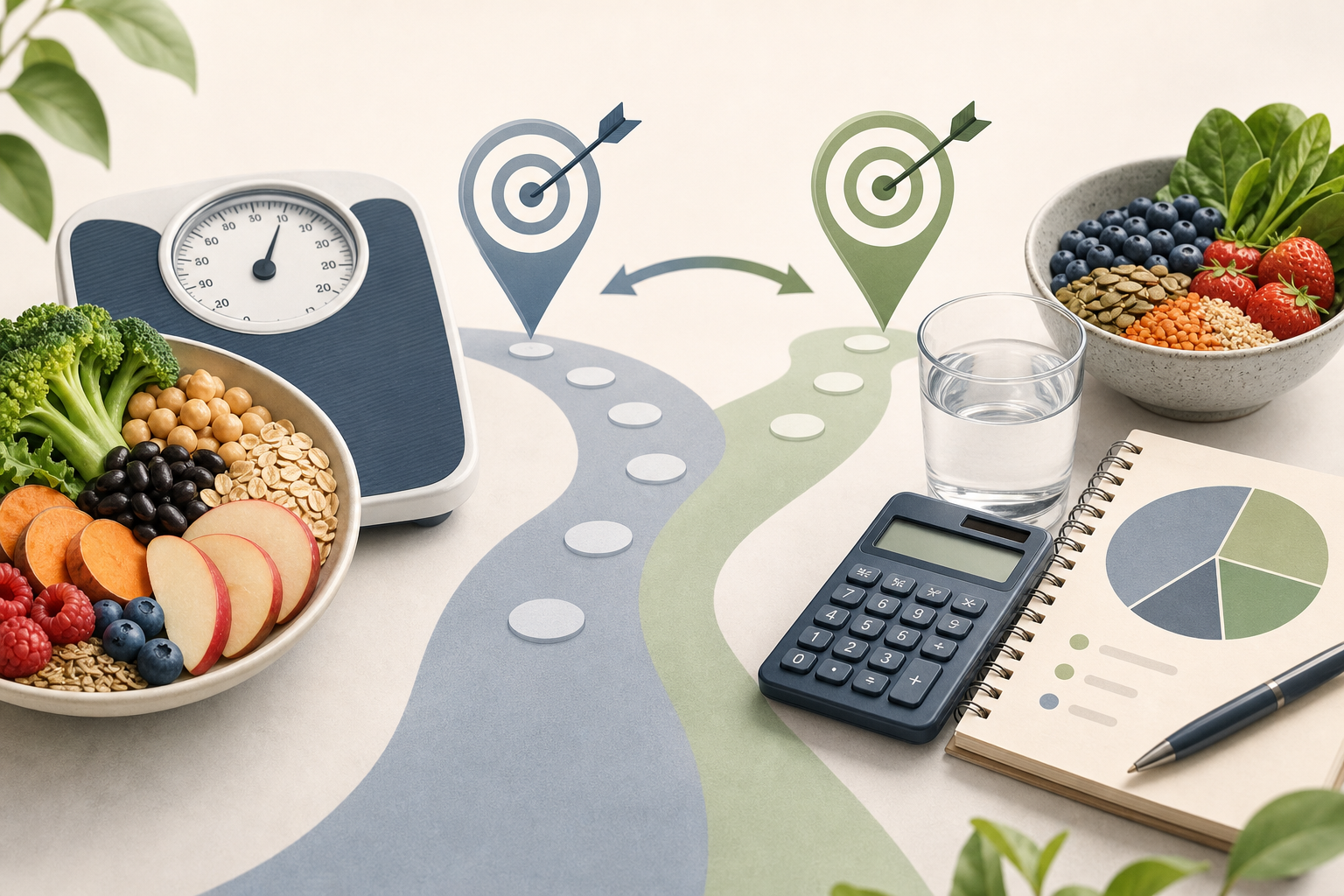
The short answer to “does your fibre target change when your calorie intake changes?” is yes when you use an energy-linked planning method. Based on 14 grams of fibre per 1,000 kilocalories (kcal), a higher calorie intake produces a higher estimated target, while a lower calorie intake produces a lower one. This is a calculated planning estimate rather than a measurement of your individual requirement.
Does your fibre target change when your calorie intake changes?
Under the calorie-linked method, fibre and energy intake change in direct proportion. For every additional 1,000 kcal, the estimated daily fibre intake rises by 14 grams. A change of 500 kcal changes the estimate by 7 grams.
This approach comes from a commonly used Dietary Reference Intake basis of 14 grams per 1,000 kcal. It links fibre with the amount of food energy being consumed instead of assigning everyone the same gram target.
For example, the calculation gives 21 grams at 1,500 kcal, 28 grams at 2,000 kcal and 35 grams at 2,500 kcal. These figures are planning values, not guarantees that each amount will suit every person equally well.
How the calorie-linked fibre calculation works
The formula is:
Fibre target in grams per day = daily calories × 14 ÷ 1,000
At 2,000 kcal per day, the calculation is:
2,000 × 14 ÷ 1,000 = 28 grams of fibre per day
The same method can be applied to other calorie levels:
| Daily calorie intake | Calculation | Estimated fibre target |
|---|---|---|
| 1,200 kcal | 1,200 × 14 ÷ 1,000 | 16.8 g/day |
| 1,500 kcal | 1,500 × 14 ÷ 1,000 | 21 g/day |
| 1,800 kcal | 1,800 × 14 ÷ 1,000 | 25.2 g/day |
| 2,000 kcal | 2,000 × 14 ÷ 1,000 | 28 g/day |
| 2,500 kcal | 2,500 × 14 ÷ 1,000 | 35 g/day |
| 3,000 kcal | 3,000 × 14 ÷ 1,000 | 42 g/day |
Decimal results may be rounded for practical food planning. For example, 25.2 grams could be treated as approximately 25 grams. Rounding does not change the underlying method.
Why calorie changes produce different gram targets
A fixed target and a calorie-linked target answer slightly different planning questions. A fixed target asks how many grams of fibre a person might aim for regardless of energy intake. The energy-linked method asks how much fibre corresponds to a particular amount of food energy.
In mathematical terms, the method maintains the same fibre density: 14 grams for every 1,000 kcal. Someone consuming 2,500 kcal therefore receives a higher gram estimate than someone consuming 1,500 kcal, even though the fibre-to-energy ratio remains identical.
The size of the change can be calculated quickly:
- A 100 kcal change alters the estimate by 1.4 grams.
- A 250 kcal change alters the estimate by 3.5 grams.
- A 500 kcal change alters the estimate by 7 grams.
- A 1,000 kcal change alters the estimate by 14 grams.
This proportional relationship is useful when calorie intake changes during weight-management planning, changes in activity, or other adjustments to food intake. It does not mean that a calculated target automatically reflects digestive tolerance, food preferences or health needs.
Practical examples when calorie intake changes
A reduction from 2,000 to 1,600 kcal
At 2,000 kcal, the estimate is 28 grams per day. At 1,600 kcal, it becomes 22.4 grams:
1,600 × 14 ÷ 1,000 = 22.4 grams per day
The calorie-linked target has fallen by 5.6 grams because the planned energy intake is 400 kcal lower. This does not mean fibre-rich foods must be avoided. It means the same fibre-density formula produces a smaller total gram value from a smaller calorie intake.
An increase from 2,000 to 2,400 kcal
At 2,400 kcal, the estimate is 33.6 grams per day:
2,400 × 14 ÷ 1,000 = 33.6 grams per day
Compared with the 28-gram estimate at 2,000 kcal, this is an increase of 5.6 grams. The proportional relationship works in both directions.
When calorie intake varies from day to day
If daily energy intake varies, each day would technically produce a different result. For general planning, an average calorie intake may be more practical than repeatedly changing the target based on small daily fluctuations.
For example, someone averaging 2,100 kcal across a week would receive an estimated target of 29.4 grams per day. This is an estimate based on the stated calorie average, not a measured assessment of actual intake or individual need.
What the fibre intake calculator can and cannot tell you
The fibre intake calculator applies the same formula automatically. It converts a daily calorie value into an estimated fibre planning target using 14 grams per 1,000 kcal.
The calculator can:
- show how the estimated target changes at different calorie intakes;
- apply the formula consistently without manual arithmetic;
- provide a daily gram figure for meal-planning purposes; and
- help compare scenarios, such as 1,800 kcal versus 2,200 kcal.
The calculator cannot:
- measure how much fibre you currently eat;
- confirm that the calorie value entered matches your actual energy intake;
- assess digestive tolerance or symptoms;
- account for medical conditions that may affect appropriate fibre intake; or
- determine whether a specific food pattern is nutritionally complete.
The result is only as accurate as the calorie value entered and the formula on which it is based. If the calorie input is itself an estimate, the resulting fibre figure is also an estimate.
Using the estimate in everyday food planning
Fibre is found in foods such as vegetables, fruit, legumes, whole grains, nuts and seeds. The amount supplied varies by food, portion and preparation, so a gram target does not by itself specify what to eat.
Food labels and reliable food-composition information can help estimate actual intake. When adding values, check whether the serving size shown matches the amount eaten. A product containing 5 grams per listed serving contributes 10 grams if two full servings are consumed.
Individual tolerance can differ, particularly when intake changes substantially. Increasing fibre gradually and consuming adequate fluids may be easier for some people than making a sudden large increase. Medical conditions and digestive concerns can also affect what amount or type of fibre is appropriate.
It can be useful to treat the calculated number as a planning reference rather than a rigid daily pass-or-fail threshold. Small variations between days are expected because food choices and portions are rarely identical.
Frequently asked questions
How much does the fibre estimate change for every 100 calories?
Using the 14-grams-per-1,000-kcal formula, every 100 kcal changes the result by 1.4 grams. An increase of 100 kcal adds 1.4 grams to the estimate, while a decrease of 100 kcal removes 1.4 grams.
Should I recalculate my target after a small calorie adjustment?
You can, but small changes may have little practical effect. A 50 kcal adjustment changes the estimate by only 0.7 grams. Using an average calorie intake may be simpler when intake varies modestly.
Is the calculator result the amount of fibre I already consume?
No. The result is an estimated target based on the calorie value entered. Actual daily fibre intake must be assessed from the foods and portions consumed.
Why do some sources list a fixed amount of fiber per day?
Recommendations may be presented in different formats, including fixed gram values or energy-linked values. The method discussed here specifically uses 14 grams per 1,000 kcal, so its result changes with calorie intake.
Can I round the calculated result?
Yes. Rounding to the nearest whole gram is usually more practical for food planning. A result of 30.8 grams, for example, can be treated as approximately 31 grams.
Does a lower-calorie plan always require less fibre?
The formula produces a lower gram estimate when calories fall, but it cannot decide what is individually appropriate. Personal tolerance, medical considerations and the overall food pattern are not included in the calculation.
In summary, the answer to “does your fibre target change when your calorie intake changes?” is yes when the target is calculated at 14 grams per 1,000 kcal. The change is proportional, and the result should be understood as an energy-based planning estimate rather than a personalised measurement.