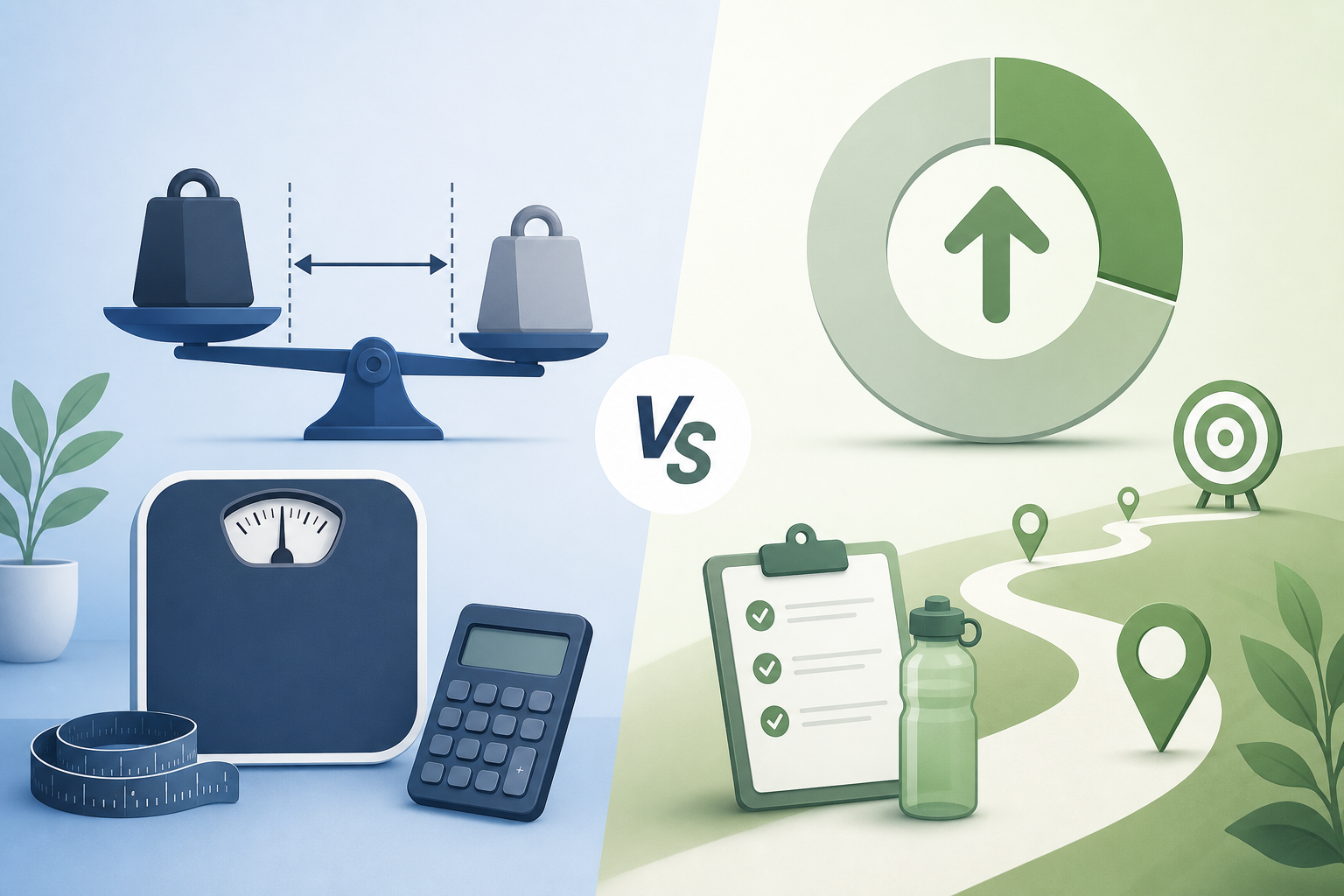
If you are comparing two weigh-ins, you may wonder: weight difference vs weight change percentage whats the difference? Weight difference is the number of kilograms or pounds gained or lost. Weight change percentage expresses that difference relative to the starting weight. The first shows the absolute change; the second adds context about how large that change is for the individual starting point.
Weight difference vs weight change percentage whats the difference in practice?
Weight difference directly compares a starting weight with a current weight. For example, moving from 90 kg to 84 kg represents a difference of 6 kg, reported as a 6 kg loss.
Weight change percentage compares the same change with the starting weight. In this example, the 6 kg loss is approximately 6.7% of the starting weight.
| Measure | What it reports | Example: 90 kg to 84 kg |
|---|---|---|
| Weight difference | The absolute and directional change | 6 kg loss |
| Weight change percentage | The change relative to starting weight | Approximately 6.7% loss |
Neither measure is automatically better. Kilograms or pounds are usually easier to visualise, while a percentage is more useful when comparing changes that began at different body weights.
How the two measures are calculated
Weight difference formula
The standard calculation is:
Weight change = current weight − starting weight
A negative result indicates a loss, a positive result indicates a gain, and zero indicates no difference. Some tools present the direction in words rather than displaying a positive or negative sign.
For a starting weight of 90 kg and a current weight of 84 kg:
84 kg − 90 kg = −6 kg
This can be reported as a 6 kg loss. A weight difference calculator performs this subtraction and labels the result as a gain, loss or no change.
Weight change percentage formula
Percentage change uses the starting measurement as the reference:
Weight change percentage = ((current weight − starting weight) ÷ starting weight) × 100
Using the same example:
((84 − 90) ÷ 90) × 100 = approximately −6.7%
The negative sign indicates a decrease. Written in words, this is approximately a 6.7% loss from the starting weight.
The starting weight must not be zero, and both measurements must use the same unit. The numerical percentage is the same whether the weights are entered in kilograms or pounds, provided the unit is consistent.
Practical examples of absolute and percentage change
Two people can have the same weight difference but different percentage changes. Suppose one person moves from 90 kg to 84 kg, while another moves from 60 kg to 54 kg. Both have a 6 kg loss, but that 6 kg represents a different proportion of each starting weight.
| Starting weight | Current weight | Weight gain/loss difference | Percentage change |
|---|---|---|---|
| 90 kg | 84 kg | 6 kg loss | Approximately 6.7% loss |
| 60 kg | 54 kg | 6 kg loss | 10% loss |
The absolute difference is identical, but the change is proportionally larger for the person who started at 60 kg. This is why percentage change is helpful when comparing results across different starting points.
The same reasoning applies to gains. A change from 70 kg to 73.5 kg is a gain of 3.5 kg, or 5% of the starting weight. Direction should always be stated clearly so that a reader does not mistake a gain for a loss.
What these figures mean and what they leave out
Absolute weight change answers a straightforward question: how many kilograms or pounds separate the two measurements? It is useful for personal records, reviewing a scale trend or describing a change in familiar units.
Percentage change answers a different question: how large is that difference compared with the starting weight? It can make comparisons more meaningful when starting weights vary.
However, neither number explains why weight changed. Two measurements alone do not distinguish changes associated with body fat, body water, digestive contents or other components of body mass. They also do not show whether the change happened steadily or occurred mainly between a few weigh-ins.
Scale readings can vary over short periods because weighing conditions and normal fluid shifts are not always identical. For more comparable records, it may help to use the same scale under reasonably consistent conditions and focus on a series of measurements rather than treating one reading as a complete trend.
These calculations also do not establish whether a particular change is appropriate for an individual. Personal weight planning may involve factors not included in a subtraction or percentage formula. The NIDDK provides broader weight-management information and a Body Weight Planner for estimates based on additional inputs.
What the weight difference calculator can and cannot tell you
The Weight Gain/Loss Difference Calculator is designed to compare a starting weight with a current weight. After you select the requested unit or options, enter both measurements and calculate the result.
The calculator can tell you:
- The numerical difference between two weight measurements.
- Whether the result represents a gain, loss or no change.
- The size of the change in the selected unit.
The calculator cannot tell you:
- What caused the weight change.
- How body composition changed.
- Whether the change occurred steadily between the two dates.
- Whether short-term fluid variation influenced either measurement.
- Whether a particular result is suitable for your circumstances.
Depending on the displayed result, you may need to calculate the percentage separately using the starting weight as the denominator. A weight difference calculator should not be assumed to report percentage change unless that output is specifically shown.
Frequently asked questions
Is weight difference the same as weight loss?
No. Weight difference is neutral: it may represent a gain, a loss or no change. Weight loss applies only when the current measurement is lower than the starting measurement.
Should percentage change use starting weight or current weight?
Standard percentage change uses the starting weight as the reference. Dividing by current weight produces a different figure and should not be labelled as the usual percentage change from baseline.
Can I compare a kilogram change with a percentage change?
Yes, but they describe the result in different ways. Kilograms show the absolute amount changed, while the percentage shows that amount relative to the starting weight. Reporting both often provides the clearest summary.
Does the percentage change depend on whether I use kilograms or pounds?
No, as long as the starting and current measurements use the same unit. Converting both values from kilograms to pounds changes the absolute numbers but not their proportional relationship.
Why can two equal weight differences have different percentages?
The percentage uses starting weight as its denominator. A 5 kg difference represents a larger share of 50 kg than of 100 kg, so the resulting percentages are different even though the absolute change is the same.
How should no weight change be reported?
If current weight equals starting weight, the difference is 0 kg or 0 lb and the percentage change is 0%. This only means the two recorded measurements are equal; it does not describe any variation that may have occurred between them.
Summary
For weight difference vs weight change percentage whats the difference, the key distinction is the reference point. Weight difference reports the number of kilograms or pounds gained or lost. Percentage change divides that difference by the starting weight, showing how large the change is in relative terms.
Use absolute change when you need a direct, familiar measurement. Use percentage change when comparing changes from different starting weights. In either case, remember that two scale readings describe the endpoints, not the pattern or cause of change between them.