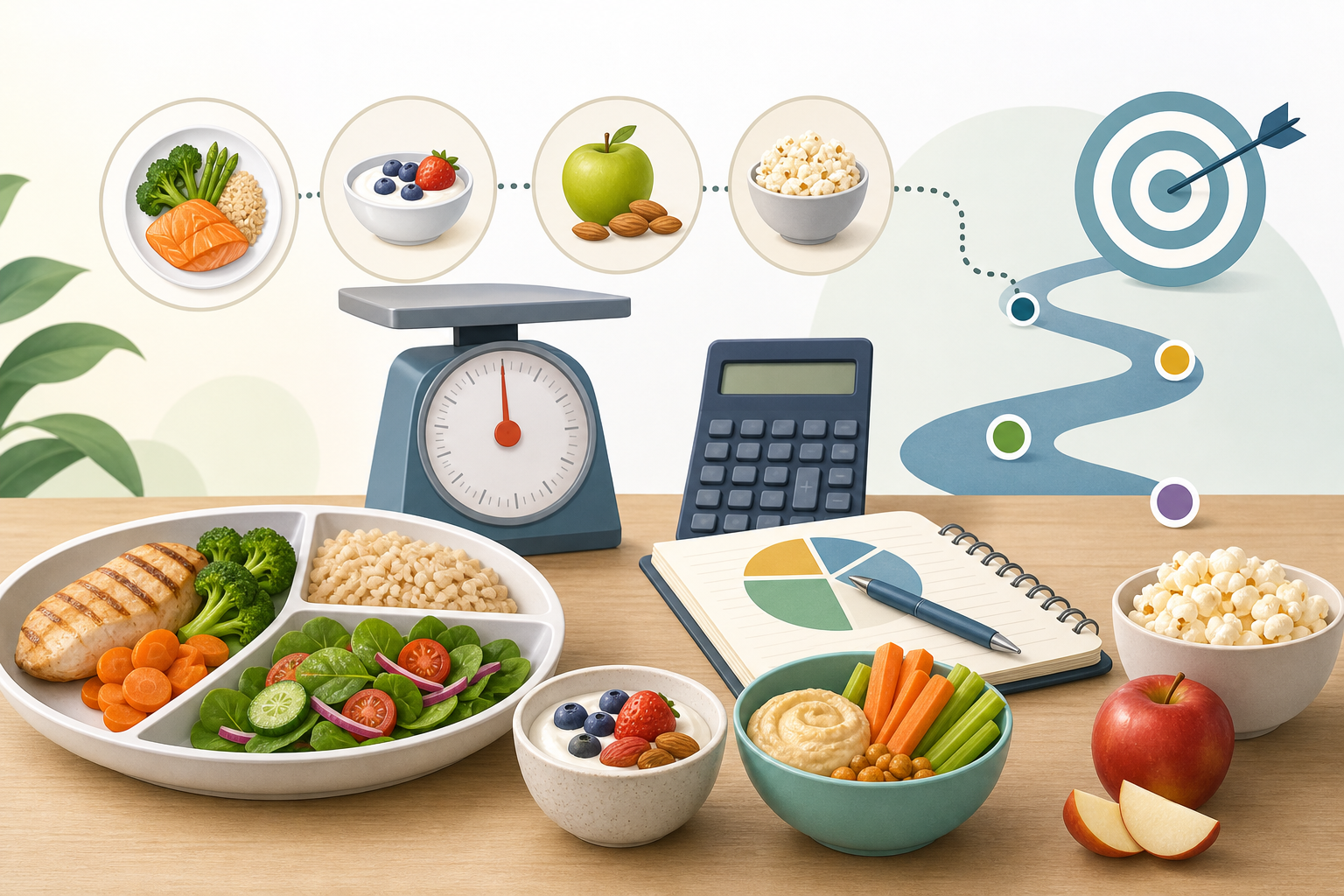
Learning how to include snacks in a caloriespermeal plan starts with one simple adjustment: reserve calories for snacks before dividing the rest of your daily target among meals. For example, if your planning target is 2,100 kcal and you reserve 300 kcal for snacks, divide the remaining 1,800 kcal across your chosen meals. Snack calories are therefore treated as part of the daily total, not added on top of it.
- How to include snacks in a caloriespermeal plan step by step
- Choosing a practical snack allocation
- Start with your usual eating pattern
- Review the whole day
- Example of meal calorie allocation with snacks
- Daily calories per meal do not need to be equal
- What the calories per meal calculator can and cannot tell you
- What it can tell you
- What it cannot tell you
- Common planning mistakes to avoid
- Adding snacks after dividing the full daily target
- Counting drinks, toppings or small bites inconsistently
- Treating calculator results as exact limits
- Making the snack allowance too rigid
- Frequently asked questions
- Should snacks be entered as meals in the calculator?
- What if I do not snack every day?
- Can I have one large snack instead of two small snacks?
- Do I need to eat the same calories at every meal?
- What happens if my snack is larger than planned?
How to include snacks in a caloriespermeal plan step by step
A standard equal-split calculation uses this formula:
Calories per meal = daily calorie target ÷ number of meals
When snacks have a separate allowance, modify the formula:
Calories per meal = (daily calorie target − snack allocation) ÷ number of meals
- Start with your daily calorie target.
- Decide how many snacks you expect to have.
- Reserve a total calorie amount for those snacks.
- Subtract the snack allocation from the daily target.
- Divide the remaining calories among your planned meals.
- Adjust individual meal sizes if an equal split does not suit your schedule or appetite.
This method keeps the complete plan within the original daily target. It also makes snacks visible in advance instead of leaving them as unplanned additions.
Choosing a practical snack allocation
There is no universal percentage of daily calories that must be assigned to snacks. The most useful allocation depends on how often you snack, the foods you choose and how you prefer to distribute food across the day.
One approach is to estimate the snacks you are likely to eat and add their calories together. If you usually plan two snacks, you might give them equal allowances or make one larger than the other. These figures are planning estimates; actual calorie content depends on the food and portion consumed.
Start with your usual eating pattern
A plan is generally easier to follow when it resembles your normal schedule. Someone who regularly becomes hungry between lunch and dinner may want to reserve more for an afternoon snack. Another person may prefer larger meals and little or no separate snack allocation.
Consider when snacks are most useful to you rather than distributing them automatically. Work hours, travel, exercise schedules, cultural eating patterns and meal timing can all influence the arrangement.
Review the whole day
A snack budget should not be considered in isolation. Reserving more calories for snacks leaves fewer calories for meals, while reserving less allows larger meals. If the resulting meal portions seem impractical, revise the allocation rather than treating the first calculation as a fixed rule.
Calorie distribution also does not describe the nutritional quality of a plan. Foods with the same estimated calories can differ in protein, carbohydrate, fat, fibre and other nutrients. The National Academies’ Dietary Reference Intakes provide broader scientific background on energy and macronutrient needs, but they do not prescribe one required meal-and-snack schedule.
Example of meal calorie allocation with snacks
Suppose a person is using a daily planning target of 2,100 kcal, eating three meals and planning two snacks. They reserve 300 kcal in total for snacks.
The calculation is:
2,100 kcal − 300 kcal = 1,800 kcal for meals
1,800 kcal ÷ 3 meals = 600 kcal per meal
| Eating occasion | Planned calories |
|---|---|
| Breakfast | 600 kcal |
| Morning or afternoon snack | 150 kcal |
| Lunch | 600 kcal |
| Second snack | 150 kcal |
| Dinner | 600 kcal |
| Daily total | 2,100 kcal |
Without a separate snack allocation, dividing 2,100 kcal by three would produce 700 kcal per meal. If two 150 kcal snacks were then added without changing the meals, the planned total would become 2,400 kcal. Reserving snack calories first prevents that accounting error.
The two snacks do not have to be equal. The same 300 kcal allocation could be divided into a smaller snack and a larger snack while leaving the meal budget unchanged.
Daily calories per meal do not need to be equal
An equal split is a simple baseline, not a requirement. In the example above, the 1,800 kcal meal allowance could be distributed as 500 kcal at breakfast, 600 kcal at lunch and 700 kcal at dinner. The three meals would still total 1,800 kcal.
Unequal distribution may better reflect appetite or daily routines. A person who prefers a substantial breakfast could move calories from dinner to breakfast. Someone who eats socially in the evening might plan a larger dinner and smaller earlier meals.
The same flexibility applies to snacks. A planned snack allocation can be used at one time, divided across several occasions or moved into a meal when no snack is wanted. What matters for the arithmetic is that all planned eating occasions are counted in the same daily total.
What the calories per meal calculator can and cannot tell you
The calories per meal calculator divides a daily calorie target by a selected number of meals. It provides a convenient equal-split estimate that can be used as a starting point for meal planning.
What it can tell you
- The estimated calories per meal when a daily target is divided evenly.
- How the result changes when you select a different number of meals.
- A simple planning baseline for comparing possible meal schedules.
To account for snacks, enter the daily amount left after reserving the snack budget. For instance, if your daily target is 2,100 kcal and 300 kcal is assigned to snacks, use 1,800 kcal as the amount to divide among meals.
What it cannot tell you
- How many snacks you personally need or whether you need snacks at all.
- The best time for you to eat meals or snacks.
- Whether a particular calorie target is appropriate for your circumstances.
- The exact calories in food portions, which can vary by ingredients, preparation and serving size.
- Whether the plan provides suitable amounts of protein, carbohydrate, fat, fibre, vitamins or minerals.
- How hunger, satisfaction or energy levels will respond to a particular distribution.
The result is an estimate for organising a target, not a measured food intake or a complete nutrition assessment. Meal sizes can be adjusted while keeping the same overall meal calorie allocation.
Common planning mistakes to avoid
Adding snacks after dividing the full daily target
If the entire daily target has already been assigned to meals, additional snacks raise the planned total. Either reserve snack calories first or reduce one or more meal allocations when adding a snack.
Counting drinks, toppings or small bites inconsistently
Items eaten or drunk between meals may still contribute to the daily total. Decide in advance whether they belong within a meal, a snack allowance or a separate flexible allowance. Consistent accounting is more useful than trying to create perfect categories.
Treating calculator results as exact limits
Food labels, recipes and portion estimates have practical limitations, so a calculated meal figure should be treated as a planning guide. Small day-to-day differences do not change the underlying method.
Making the snack allowance too rigid
A fixed figure may not suit every day. If a snack is skipped, its allocation can be moved to a meal or left unused. If a planned snack is larger than expected, the remaining meals can be reconsidered without assuming that every meal must stay equal.
Frequently asked questions
Should snacks be entered as meals in the calculator?
You can count every eating occasion in one equal split, but this gives meals and snacks the same calorie allowance. If you want smaller snacks and larger meals, reserve the total snack budget first and use the calculator only for the remaining meal calories.
What if I do not snack every day?
You do not need a permanent snack allocation. On days when you expect to snack, reserve an amount before dividing the meal budget. On other days, divide the full daily target among meals or use a smaller flexible allowance.
Can I have one large snack instead of two small snacks?
Yes. The number and size of snacks do not affect the calculation as long as their combined allocation is subtracted before the meal calories are divided. Choose a distribution that fits your schedule and preferences.
Do I need to eat the same calories at every meal?
No. Equal daily calories per meal offer a straightforward baseline, but breakfast, lunch and dinner may be different sizes. You can redistribute the meal allowance while keeping the combined total unchanged.
What happens if my snack is larger than planned?
You can treat the difference as part of the day’s overall plan and adjust later meal allocations if practical. Because food calorie figures are estimates, it is usually more useful to review the total pattern than to treat each meal number as exact.
In summary, how to include snacks in a caloriespermeal plan is mainly a budgeting question: set aside the snack allocation, subtract it from the daily target and divide the remainder among meals. Use the equal result as a baseline, then adapt meal and snack sizes to the eating pattern you intend to follow.