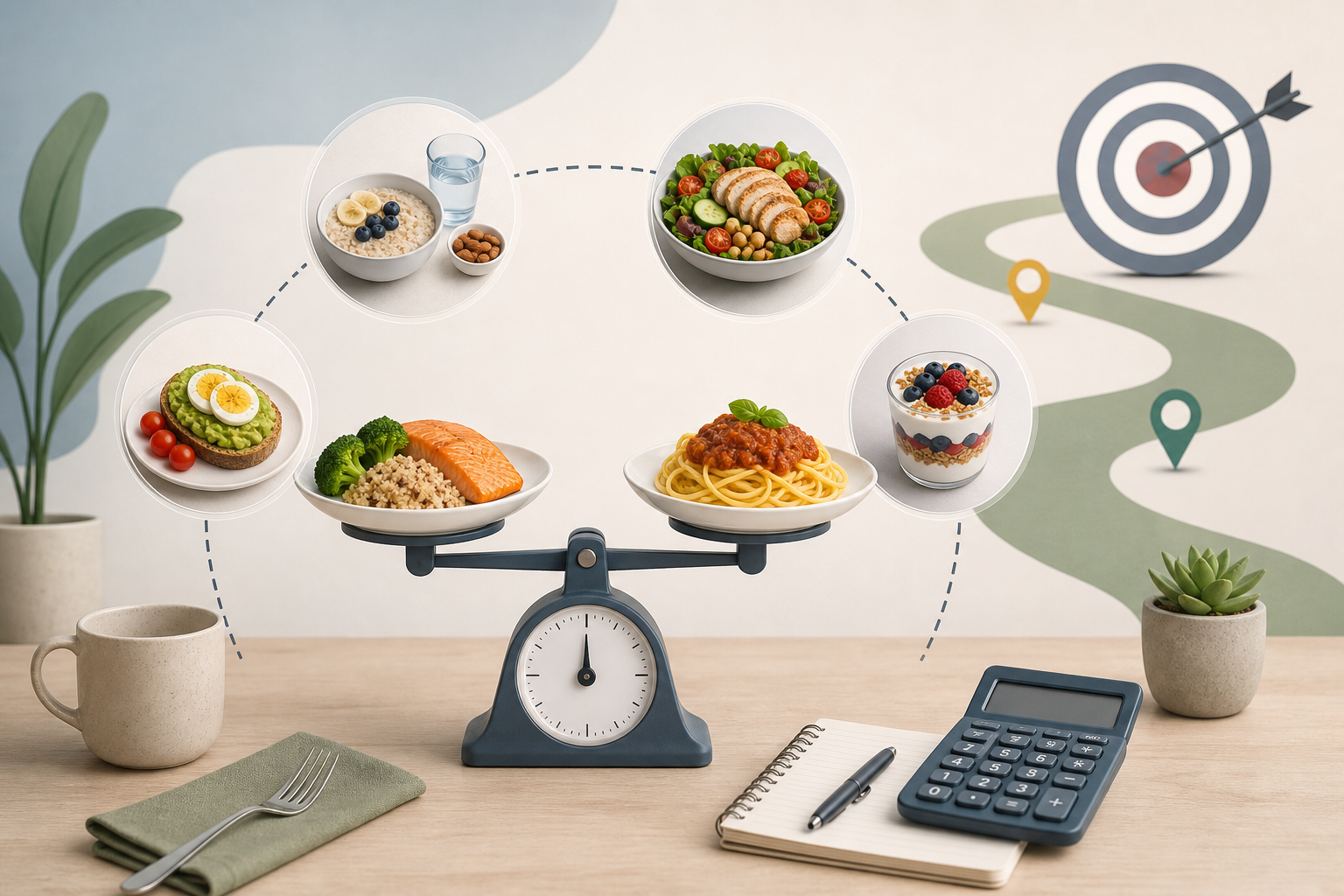
No. If you are wondering, “do all meals need to have the same number of calories,” an equal split is simply a convenient planning method, not a nutritional requirement. You can distribute a daily calorie target evenly or allocate more calories to meals that better match your appetite, work pattern, training schedule, culture and food preferences.
Why do all meals need to have the same number of calories?
They do not. The number of calories in each meal can vary considerably while the meals still fit within the same daily target. What matters for meal planning is how the full day comes together, rather than making breakfast, lunch and dinner identical in size.
An equal allocation can reduce decision-making. For example, dividing 2,100 kcal across three meals produces a baseline of 700 kcal per meal. In practice, someone might prefer a smaller breakfast, a moderate lunch and a larger evening meal.
There is also no need to hit the planned figure exactly at every meal. Calorie values on labels, in food databases and in recipes are estimates, while portions may vary. Meal calorie allocation is therefore best treated as a flexible planning framework rather than a precise rule.
Equal versus uneven calorie distribution
Equal distribution
With an equal distribution, the daily calorie target is divided by the number of meals. This approach may suit people who have a predictable routine and prefer meals of a similar size.
The basic calculation is:
Calories per meal = daily calorie target ÷ number of meals
For a target of 1,800 kcal divided across three meals, the equal baseline is 600 kcal per meal. If snacks are included within the target, their calories should be allocated before dividing the remainder among meals.
Uneven distribution
An uneven distribution assigns different calorie amounts to different meals. This may be more practical when hunger, activity and available eating time are not evenly spread throughout the day.
For example, two people using the same 1,800 kcal planning target might distribute it differently:
| Eating occasion | Equal plan | Uneven plan |
|---|---|---|
| Breakfast | 600 kcal | 400 kcal |
| Lunch | 600 kcal | 550 kcal |
| Dinner | 600 kcal | 750 kcal |
| Snack | Not separately allocated | 100 kcal |
| Daily total | 1,800 kcal | 1,800 kcal |
Neither pattern is automatically better. The more useful option is the one that fits the person’s routine and allows the overall plan to remain practical.
Factors that can shape daily calories per meal
A meal plan is easier to use when it reflects how someone actually eats. Several practical considerations may influence the distribution.
- Appetite: Some people are hungry soon after waking, while others naturally prefer their first substantial meal later.
- Work or study schedule: Limited break times may make a large midday meal inconvenient.
- Exercise timing: People may prefer to place a meal or snack around activity, depending on comfort and routine.
- Cultural eating patterns: The main meal may traditionally be eaten at midday or in the evening.
- Family routine: A shared evening meal may reasonably receive a larger share of the daily target.
- Number of eating occasions: Three meals, three meals plus snacks, or another pattern will each require a different allocation.
- Meal composition: Foods differ in protein, carbohydrate, fat, fibre, water content and micronutrients. Matching a calorie figure alone does not make meals nutritionally equivalent.
Daily energy needs and nutrient requirements are not identical for everyone. They can be influenced by factors such as body size, age, sex and activity. Dietary Reference Intake materials from the National Academies provide broader scientific background on energy and macronutrient requirements, but an individual daily calorie target remains an estimate rather than a directly measured need.
How to build a flexible meal calorie allocation
Start with a daily calorie target appropriate to the planning purpose. Then decide which meals and snacks need a specific allocation. If the target was generated by another calculator, remember that it is an estimate based on the information and assumptions used.
- List the meals and snacks you normally eat rather than creating an idealised schedule.
- Reserve calories for any regular snacks, drinks or other eating occasions that are intended to count toward the daily total.
- Divide the remaining calories evenly to create a simple baseline.
- Move calories between meals to reflect appetite, convenience and preferred meal size.
- Check that the allocations still add up to the intended daily target.
- Review the plan over time and adjust the distribution if it repeatedly feels impractical.
For example, suppose a person has a planning target of 2,100 kcal and wants three meals plus an afternoon snack. They could reserve 200 kcal for the snack, leaving 1,900 kcal for meals.
An equal division of the remaining amount would not produce a particularly convenient number, so the person might allocate 500 kcal to breakfast, 650 kcal to lunch and 750 kcal to dinner. Together with the 200 kcal snack, the plan totals 2,100 kcal.
The allocation does not have to be identical every day. A weekday schedule and a weekend schedule can use different meal patterns while working from the same daily planning target.
What a calories per meal calculator can and cannot tell you
A calories per meal calculator divides a daily calorie target across a selected number of meals. Its standard method is:
Calories per meal = daily calorie target ÷ number of meals
For example, entering 2,100 kcal and three meals gives an estimated baseline of 700 kcal per meal before any separate snack allocation. This result can be useful as a starting point when planning portions, comparing meals or deciding how much of the daily target to reserve for snacks.
What the calculator can tell you
- The mathematical equal share of a daily target for each meal.
- A consistent baseline that can later be adjusted.
- How the per-meal amount changes when the number of meals changes.
What the calculator cannot tell you
- Whether the daily calorie target entered is appropriate for an individual.
- Whether equal meal sizes will suit appetite, activity or schedule.
- How much protein, carbohydrate, fat, fibre or micronutrients a meal contains.
- Whether a particular food choice or meal pattern is suitable for a health condition.
- The exact number of calories a person absorbs or uses.
The output is a calculated estimate based entirely on the daily target and number of meals entered. It is not a measurement of energy needs, and it does not require every meal to match the displayed number.
Common questions about calories per meal
Is it better to eat a large breakfast and a small dinner?
Not necessarily for everyone. Meal size can be organised around appetite, comfort and routine. The calorie distribution should also leave room for a varied overall diet rather than focusing only on which meal is largest.
Should snacks be counted as meals?
They can be, but consistency matters. One option is to include snacks as separate eating occasions when using a calculator. Another is to reserve a snack allowance first and divide the remaining target among the main meals.
What if one meal is higher than its planned calories?
A meal allocation is a planning guide, not a strict ceiling. Someone may choose to adjust later meals, or simply recognise that daily intake will vary. Frequent large differences may indicate that the original distribution does not match the person’s usual appetite or schedule.
Can lunch and dinner have the same calories but different foods?
Yes. Meals with the same estimated calories can differ substantially in portion size and nutrient composition. Calorie totals alone do not describe protein, fat, carbohydrate, fibre, vitamins or minerals.
Does eating more meals increase the daily calorie target?
No. Dividing a target across more meals changes the estimated calories per meal, not the daily total. For example, 2,000 kcal divided across four meals gives a 500 kcal baseline, while dividing the same target across five meals gives 400 kcal per meal.
Do all meals need to have the same number of calories on every day?
No. Equal meals offer a straightforward baseline, but daily calories per meal can be distributed differently across workdays, weekends or days with different routines. The allocations should be viewed as estimates that support planning, not fixed requirements.