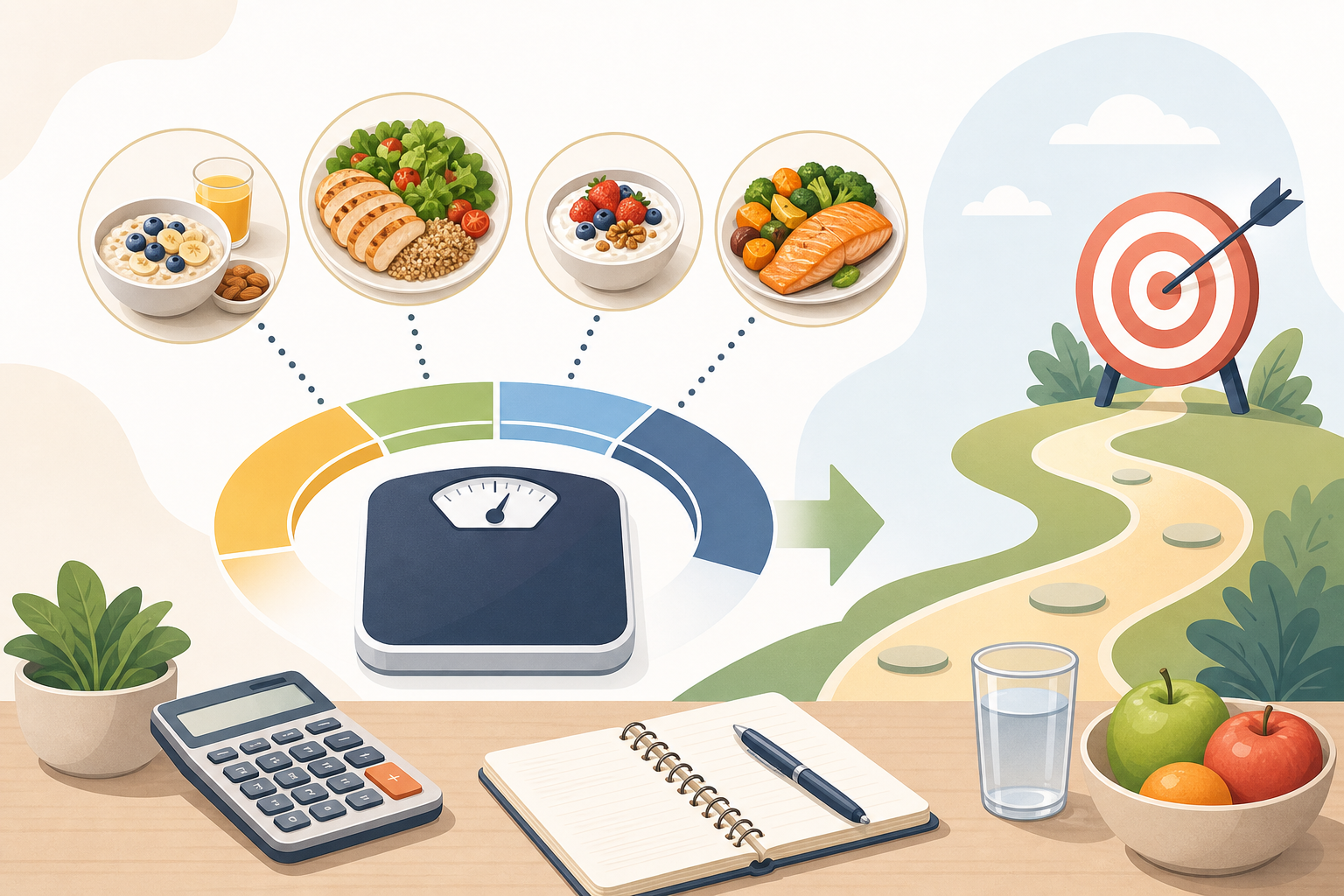
Understanding meal calories vs daily calorie target how they fit together is straightforward: calories estimated for breakfast, lunch, dinner, snacks and caloric drinks can be added, then compared with a broader daily target. The daily target provides an overall planning reference, while each meal estimate shows how part of that total may be distributed across the day.
- Meal calories vs daily calorie target how they fit together
- From individual meals to a daily total
- Planned totals and recorded totals
- A practical meal-planning example
- What a meal calorie calculator can and cannot tell you
- What it can tell you
- What it cannot tell you
- How to compare meal calories with a daily target
- Why calorie distribution can vary
- Frequently asked questions
- Do meal calories have to add up exactly to the daily target?
- Should drinks be included in meal calories?
- Can I use weekly averages instead of matching the target every day?
- Why does my calculated meal total differ from a food-tracking app?
- Does staying within a calorie target mean the meals are nutritionally balanced?
- Putting meal and daily estimates together
Neither number is necessarily exact. A daily calorie target is generally an estimate of planned energy intake, and the calories in a meal depend on the accuracy of food labels, database entries, recipes and portion sizes.
Meal calories vs daily calorie target how they fit together
Meal calories are the estimated energy provided by food and drinks consumed at one eating occasion. A daily calorie target is the total amount of energy a person plans to consume over the full day.
The basic relationship is:
Daily meal calories = breakfast + lunch + dinner + snacks and caloric drinks
For example, if breakfast is estimated at 400 kcal, lunch at 550 kcal, dinner at 650 kcal and snacks or drinks at 250 kcal, the estimated daily meal total is:
400 + 550 + 650 + 250 = 1,850 kcal
This total can then be compared with the daily calorie target. If the target is 1,850 kcal, the planned meals add up to the target. If the target is higher or lower, the comparison shows the estimated difference.
Individual meals do not usually need to contain identical calorie amounts. Some people prefer a larger lunch or dinner, while others spread energy more evenly. The relevant comparison is between the complete daily total and the planning target, unless a person has a specific reason to structure meals differently.
From individual meals to a daily total
A daily total is only as complete as the entries included in it. Breakfast, lunch and dinner are obvious categories, but smaller items can also contribute to the total.
- Snacks between meals
- Milk, sugar or cream added to drinks
- Juice, soft drinks or other caloric beverages
- Cooking oils, butter, dressings and sauces
- Tastes or small portions eaten while preparing food
- Desserts and after-dinner drinks
Leaving out these items may make the calculated total lower than the energy represented by the full day’s food and drink. This does not mean every bite must always be recorded. It means the result should be interpreted according to how complete the entries are.
Meal estimates may come from package labels, recipe calculations, restaurant information or food databases. Each source can involve uncertainty. A homemade mixed dish, for example, may be harder to estimate than a packaged item with a stated serving size.
Planned totals and recorded totals
A planned total describes food and drinks intended for a future day. A recorded total describes what someone remembers or logs after eating. These serve different purposes and may not match, even when both are prepared carefully.
For planning, rounded calorie values may be sufficient to compare possible meal combinations. For retrospective tracking, portion changes, substitutions and unrecorded ingredients can affect the final estimate.
A practical meal-planning example
Consider a person using a daily target of 2,000 kcal as a planning reference. The number is an example rather than a recommendation.
| Meal or category | Estimated calories | Running daily total |
|---|---|---|
| Breakfast | 450 kcal | 450 kcal |
| Lunch | 600 kcal | 1,050 kcal |
| Snack and drinks | 250 kcal | 1,300 kcal |
| Dinner | 700 kcal | 2,000 kcal |
In this example, the meals add up to the daily target. Dinner contains more calories than breakfast, but that difference does not prevent the full plan from matching the target.
Now suppose lunch includes an extra sauce estimated at 100 kcal and the afternoon drink is 80 kcal higher than first entered. The revised daily total would be 2,180 kcal. The calculation identifies an estimated difference of 180 kcal from the planning target; it does not determine what the person must do in response.
A person could simply note the difference, revise the estimates if a portion was entered incorrectly, or consider it within the context of a longer-term plan. One day’s calculated difference should not be treated as a precise measurement of body-weight change.
What a meal calorie calculator can and cannot tell you
A meal calorie calculator adds the values entered for breakfast, lunch, dinner, snacks and caloric drinks. It is useful for seeing how separate meal estimates contribute to one daily total.
What it can tell you
- The sum of the calorie values entered for each meal category
- How much each category contributes to the entered total
- Whether a planned total is above, below or equal to a chosen daily target
- How a change to one meal affects the overall estimate
- Whether snacks and caloric drinks form a noticeable part of the plan
What it cannot tell you
- The exact energy content of food when the entries or portions are uncertain
- Whether the daily calorie target is appropriate for a particular person
- The nutrient quality, variety or balance of the meals
- Whether reported serving sizes match the amounts actually eaten
- How an individual’s body weight will change
- Whether a meal pattern meets personal, cultural or medical needs
The calculator performs addition; it does not directly measure food energy or personal energy expenditure. It also cannot identify whether a meal provides adequate protein, carbohydrate, fat, fibre, vitamins or minerals.
Energy needs and nutrient requirements are considered separately in the Dietary Reference Intakes developed by the National Academies. A calorie total therefore provides only one part of the information relevant to food planning.
How to compare meal calories with a daily target
A consistent process makes the comparison easier to interpret. The goal is not false precision, but a reasonably complete estimate based on the information available.
- Choose a daily calorie target that will serve as the planning reference.
- Estimate breakfast, lunch, dinner, snacks and caloric drinks using consistent sources where possible.
- Check that serving sizes and recipe portions match the amounts being planned or recorded.
- Add every meal category to calculate the estimated daily total.
- Compare the total with the target and calculate the difference.
- Review likely sources of error before drawing conclusions from a small difference.
- Consider meal quality and nutrient variety separately from the calorie calculation.
Suppose the total is 1,920 kcal against a target of 1,900 kcal. That 20 kcal difference may be smaller than the uncertainty in portions or recipe estimates, so it should not automatically be treated as meaningful precision.
A larger difference may be more useful for planning. For instance, a forgotten caloric drink or an incorrectly entered recipe serving can noticeably change the result. Reviewing the inputs is often more informative than focusing only on the final number.
Why calorie distribution can vary
There is no single meal-by-meal split that suits everyone. Meal timing and size may be shaped by appetite, work schedules, cultural eating patterns, food access, exercise and personal preference.
If the daily target is 1,800 kcal, it does not follow that three meals must each contain 600 kcal. One plan might use a substantial breakfast and lighter dinner, while another might reserve more of the total for an evening meal. The calculator shows the arithmetic of either pattern without deciding which arrangement is preferable.
Frequently asked questions
Do meal calories have to add up exactly to the daily target?
No. Both the target and meal entries are estimates, and food portions can vary. The comparison is most useful as a planning guide rather than an exact limit that must be matched to the final calorie.
Should drinks be included in meal calories?
Caloric drinks should be included if the goal is to estimate the full day’s energy intake. Water and other drinks entered as having no calories do not add to the total, while milk, sweeteners, juice and similar ingredients may contribute.
Can I use weekly averages instead of matching the target every day?
A daily meal calculator reports one day at a time, but daily totals can also be viewed across several days. An average may show the broader pattern, although it still depends on the accuracy and completeness of each day’s entries.
Why does my calculated meal total differ from a food-tracking app?
The two calculations may use different food database entries, recipe assumptions, serving sizes or rounding methods. Compare the individual ingredients and quantities rather than assuming one final total is automatically correct.
Does staying within a calorie target mean the meals are nutritionally balanced?
No. Two daily plans can have similar calorie totals while containing different foods and nutrients. A meal calorie total does not assess protein, fibre, fats, carbohydrates, vitamins, minerals or dietary variety.
Putting meal and daily estimates together
The key to understanding meal calories vs daily calorie target how they fit together is to treat meals as components of a larger daily estimate. Add all meal, snack and drink values, compare the result with the target, and interpret the difference in light of possible portion and data errors.
A meal calorie calculator can make the arithmetic clear, but it cannot validate the target, measure exact intake or assess overall diet quality. The result is best used as a practical comparison tool alongside attention to food variety, portions and the limitations of estimated values.