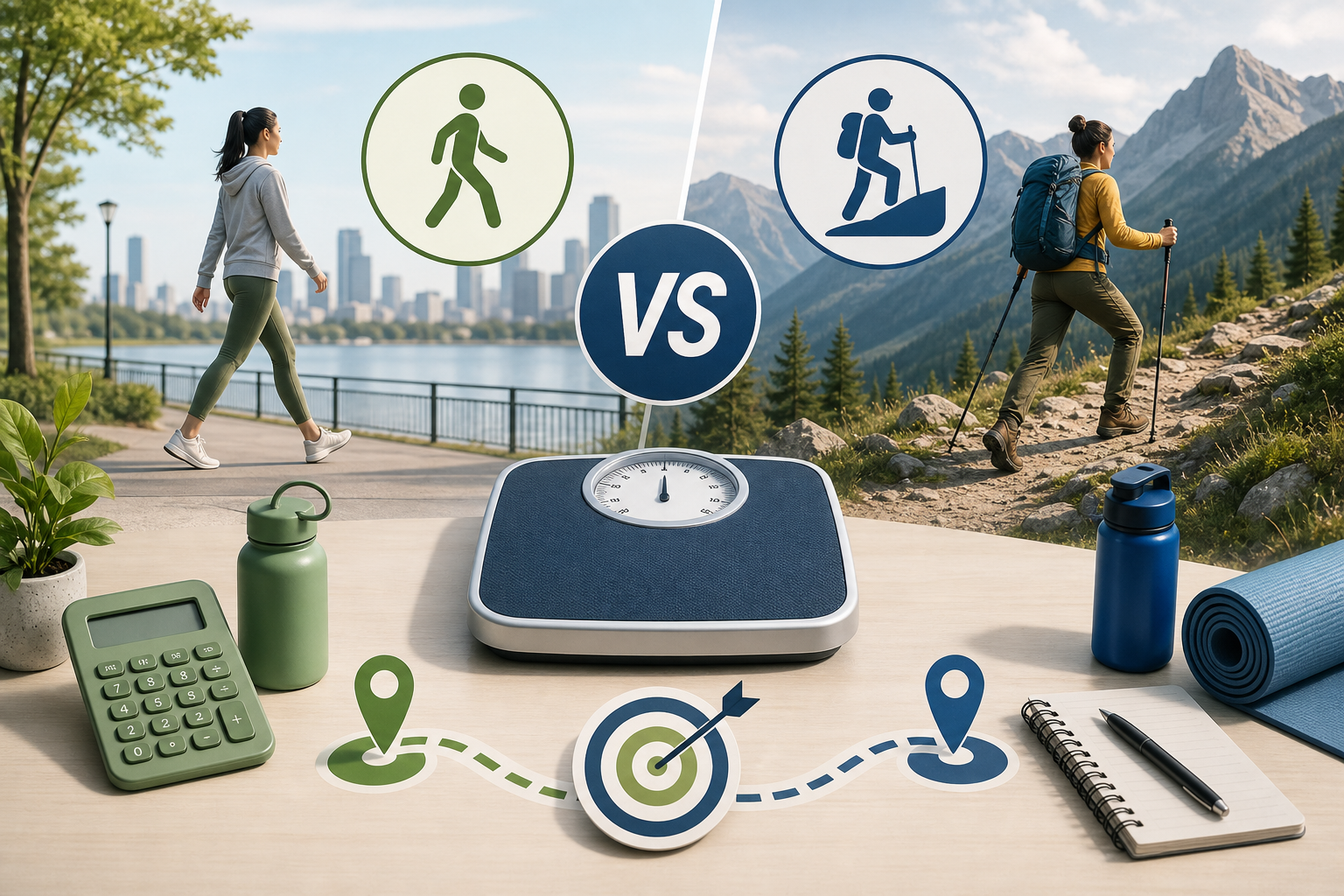
When comparing hiking vs walking calories what is the difference? Hiking usually has a higher estimated calorie cost per minute because trails may involve steeper gradients, uneven surfaces and more strenuous movement. However, an easy, mostly level hike can resemble ordinary walking, while fast or uphill walking may be equally demanding. Duration, body weight and the intensity assigned to each activity ultimately determine the estimate.
- Hiking vs walking calories what is the difference?
- Why hiking calorie burn is often estimated as higher
- How hiking and walking calories are estimated
- Active time versus total outing time
- A practical hiking and walking comparison
- What a hiking calories calculator can and cannot tell you
- What the calculator can estimate
- What the calculator cannot measure
- How to interpret the result responsibly
- Frequently asked questions
- Does hiking always burn more calories than walking?
- Should rest stops be included in hiking duration?
- How does elevation affect calories burned hiking?
- Does carrying a backpack change the estimate?
- Why does my fitness tracker disagree with the hiking calories calculator?
- Can I compare hiking and walking results from different calculators?
Hiking vs walking calories what is the difference?
Walking generally describes movement on roads, pavements, tracks or treadmills. Hiking usually takes place on trails or natural terrain and may include climbing, descending, obstacles and changing surfaces. These are practical distinctions rather than fixed exercise categories.
Calorie estimates often use a metabolic equivalent, or MET, to represent activity intensity. A higher MET value produces a higher estimate when body weight and duration remain the same. The Adult Compendium of Physical Activities provides MET values for different types and intensities of walking and hiking.
The main differences that affect an estimate are:
- Terrain: Rocky, muddy, sandy or uneven ground may require more effort than a smooth pavement.
- Gradient: Sustained uphill movement is generally more demanding than level walking. Descents can also require controlled movement, although they are not necessarily as energy-intensive as climbs.
- Pace: A brisk walk can have a higher intensity than a slow hike on an easy trail.
- Pack weight: Carrying water, food or equipment may increase the work involved.
- Duration: A longer outing can produce a larger total even if its per-minute intensity is moderate.
- Pauses: Rest stops reduce the amount of time spent actively hiking.
For these reasons, the activity label alone does not determine calorie use. A useful comparison needs to consider what the person was actually doing and for how long.
Why hiking calorie burn is often estimated as higher
Many hiking routes repeatedly change elevation and surface. The body may need to climb, maintain balance, adjust stride length and step over obstacles. A walking estimate based on a level, consistent surface may not represent these demands.
Hiking is also commonly performed for longer periods than everyday walking. Even when the intensity is not especially high, spending several hours on a trail can create a substantial total estimate. This does not mean every minute of the outing has the same intensity.
Pack weight is another possible difference. A light day pack may have a smaller effect than a heavily loaded backpack, but a basic hiking estimate may not account for either one. If a calculator asks only for terrain intensity, the selected category is being used as a broad approximation of the outing’s difficulty.
Walking should not automatically be treated as low intensity. Fast walking, steep hill walking or climbing stairs can be more demanding than a relaxed hike. The most appropriate activity description is the one that best matches the pace, terrain and effort involved.
How hiking and walking calories are estimated
A common MET-based equation is:
Estimated kcal = MET × 3.5 × body weight in kilograms ÷ 200 × active minutes
The MET value represents the assumed intensity. Body weight and time then scale the result. This produces an estimate, not a direct measurement of an individual’s energy expenditure.
Changing any input changes the result:
- A higher selected MET increases the estimated calories per minute.
- A longer active duration increases the total in direct proportion.
- A higher body weight produces a higher estimate for the same MET and duration.
The equation does not directly observe elevation, speed, heart rate, pack load, weather, fitness or movement efficiency. Those factors matter only if they are reflected adequately in the selected activity or terrain intensity.
Active time versus total outing time
For a fair comparison, use the same definition of time. A three-hour hike that includes an hour of lunch and rest stops should not necessarily be entered as three hours of continuous hiking. If the tool requests activity duration, active moving time is usually the more appropriate input.
Walking records can create a similar issue. Time spent waiting at crossings, shopping or standing should not automatically be treated as continuous walking. Consistent time inputs make hiking and walking comparisons more meaningful.
A practical hiking and walking comparison
Consider a person who weighs 80 kg and is active for 90 minutes. If a hiking intensity of 6 MET is selected, the approved equation gives:
6 × 3.5 × 80 ÷ 200 × 90 = about 756 kcal
For an illustrative walking comparison, suppose a value of 3.5 MET is selected for the same body weight and duration:
3.5 × 3.5 × 80 ÷ 200 × 90 = about 441 kcal
The difference is about 315 kcal, but it comes from the assumed MET values. It should not be interpreted as a rule that hiking always uses this much more energy than walking. A slower, flatter hike could have a lower assigned intensity, while brisk uphill walking could have a higher one.
Duration can also reverse an expected comparison. A two-hour moderate walk may produce a larger total estimate than a short, strenuous hike because the person remains active for longer. It is helpful to compare both estimated calories per minute and total active time rather than looking only at the activity name.
What a hiking calories calculator can and cannot tell you
A hiking calories calculator estimates energy use from body weight, selected terrain intensity and duration. It is useful for comparing possible routes, reviewing outings on a consistent basis or seeing how changes in time and assumed intensity affect the result.
What the calculator can estimate
- Approximate calories burned hiking for the entered weight and duration.
- The effect of choosing a different terrain or intensity category.
- How the estimate changes when active time increases or decreases.
- A standardised result that can be compared with another estimate produced using the same method.
What the calculator cannot measure
- Your exact energy expenditure during a specific hike.
- Every change in gradient, speed or trail surface.
- The precise effect of pack weight, wind, temperature or altitude.
- Differences in individual movement efficiency or fitness.
- Rest periods unless they are excluded from the entered duration.
For the most useful result, choose the terrain option that best represents most of the route and enter realistic active time. If a hike includes both gentle paths and strenuous climbing, one overall result will smooth out those changes. Estimating separate segments may better reflect a mixed route when the calculator allows repeated calculations.
A wearable device may provide a more personalised-looking number, but it is still generally an estimate unless energy expenditure is measured under specialised conditions. Different tools can disagree because they use different activity categories, sensor data and calculation methods.
How to interpret the result responsibly
Treat hiking calorie burn as a planning estimate rather than an exact amount available to offset food intake. Rounding the result is usually more appropriate than relying on a precise single-calorie figure.
When comparing outings, keep the method consistent. Use the same calculator, enter weight in the same way, separate active time from breaks and apply similar judgement when selecting terrain intensity. Consistency helps show why one estimate differs from another.
Large differences between hiking and walking estimates should be checked against the inputs. Confirm that the duration uses the same units, the weight is entered in the correct unit system and the selected intensity matches the activity. An accidentally high terrain setting or the inclusion of long pauses can distort the comparison.
In summary, the answer to hiking vs walking calories what is the difference is that hiking commonly receives a higher intensity estimate because of gradients and uneven terrain, but there is substantial overlap. Pace, active duration, body weight, route conditions and the selected MET value matter more than the label alone.
Frequently asked questions
Does hiking always burn more calories than walking?
No. A strenuous uphill hike may have a higher estimate than level walking, but an easy trail hike may be similar to ordinary walking. Fast, long or steep walking can also exceed a short, gentle hike.
Should rest stops be included in hiking duration?
If the calculator asks for activity duration, use active hiking time rather than the entire time away from the trailhead. Including extended stops as if they were active movement may overstate the estimate.
How does elevation affect calories burned hiking?
Uphill movement usually requires more effort than movement on level ground. However, a basic calculator may represent elevation only through a general terrain or intensity choice rather than using the route’s measured elevation profile.
Does carrying a backpack change the estimate?
Carrying a load can increase the work involved, particularly on long or steep routes. If the calculator does not request pack weight, its effect may not be fully represented in the result.
Why does my fitness tracker disagree with the hiking calories calculator?
The two tools may use different methods. A hiking calories calculator may rely on body weight, MET intensity and time, while a tracker may also use movement or heart-rate data. Neither number should automatically be treated as an exact measurement.
Can I compare hiking and walking results from different calculators?
You can, but differences may reflect the calculators’ assumptions rather than the activities alone. Comparisons are easier to interpret when both estimates use the same equation, body weight, duration definition and approach to intensity.