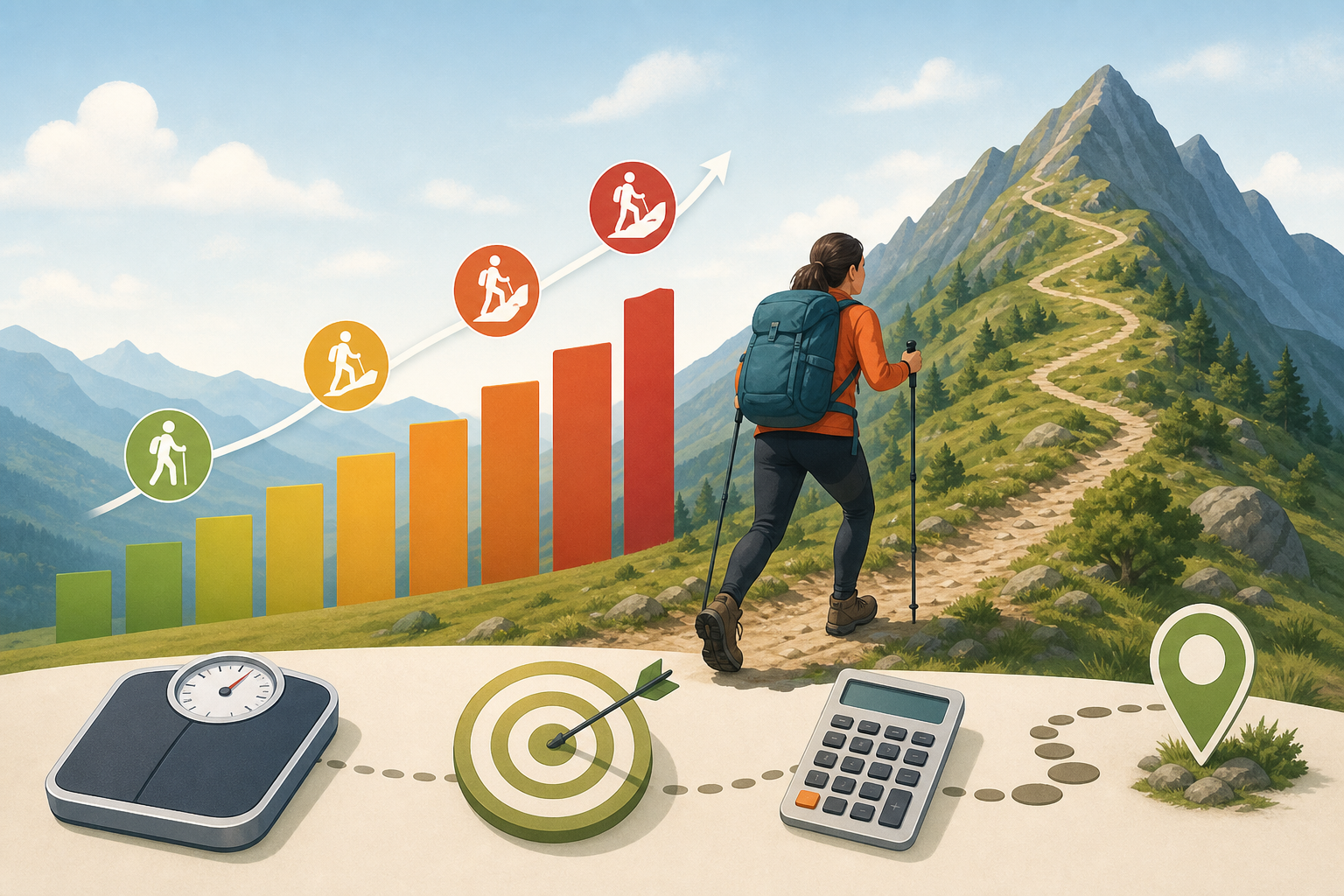
Understanding how hills and elevation change hiking calorie burn starts with a simple principle: climbing requires the body to do more work against gravity than walking at the same speed on level ground. Steeper slopes, greater elevation gain and difficult footing generally raise effort and energy use, although pace, body weight, pack load, descents and rest periods also affect the final estimate.
- How hills and elevation change hiking calorie burn
- Elevation gain is different from altitude
- Elevation gain
- Altitude above sea level
- Why downhill hiking is not the same as level walking
- Other factors that change hiking calorie burn
- A practical hill-hiking example
- What the hiking calories calculator can and cannot tell you
- What it can estimate
- What it cannot measure precisely
- Frequently asked questions
- Does hiking uphill always burn more calories than level hiking?
- Is elevation gain more important than hiking distance?
- Should I count downhill sections as hiking time?
- Does hiking at high altitude burn more calories?
- How should I select an intensity for a route with mixed terrain?
- Why does my wearable differ from a hiking calories calculator?
- Putting hills and elevation into context
How hills and elevation change hiking calorie burn
On a level trail, most effort goes into moving the body forward. During an ascent, the muscles must also lift body mass and any carried equipment to a higher vertical position. This usually increases breathing rate, heart rate and muscular effort compared with level walking at a similar pace.
Gradient matters as well as distance. A short, steep climb may feel more demanding than a longer, gentle incline because the vertical gain is concentrated into less horizontal distance. Hikers often slow down on steep ground, but the effort per minute can still be high.
Exercise estimates commonly express activity intensity as a metabolic equivalent, or MET. Higher MET values represent greater energy expenditure per minute. The 2024 Adult Compendium of Physical Activities assigns different MET values to activities based on their typical intensity, including different forms of walking and hiking.
These values describe representative effort rather than measuring an individual hiker directly. Two people on the same hill may use energy differently because of pace, fitness, movement efficiency, load and trail conditions.
Elevation gain is different from altitude
“Elevation” can refer to two related but distinct features: elevation gain and altitude above sea level. They do not affect hiking calorie burn in exactly the same way.
Elevation gain
Elevation gain is the total amount climbed during a route. A trail that rises from 400 metres to 900 metres has 500 metres of net gain, although its total accumulated gain may be higher if it repeatedly rises and falls.
More climbing generally means more work against gravity. For comparing routes, accumulated elevation gain is often more informative than the difference between the starting and finishing elevations.
Altitude above sea level
Altitude describes how high the trail is above sea level. At higher altitudes, reduced oxygen availability can make a familiar pace feel harder, particularly before a person has adjusted to the conditions. However, altitude alone does not provide enough information to calculate calories burned hiking.
A flat walk at high altitude and a steep climb at low altitude are different activities. A calculator usually reflects altitude only indirectly if the user selects a higher terrain intensity or enters a pace that represents the harder effort.
Why downhill hiking is not the same as level walking
Descending removes much of the work required to lift the body uphill, so a smooth, gentle descent will often require less energy than climbing the same slope. It is not necessarily effortless, however.
On steep or uneven descents, the leg muscles help control speed and absorb impact. Loose stones, roots, mud and large steps may require careful foot placement, balance and repeated braking. This can make a technical descent more demanding than ordinary level walking, even if it does not equal the energy cost of the preceding climb.
Route averages can therefore hide substantial variation. A loop may contain easy level sections, strenuous ascents, cautious descents and stationary breaks. One intensity setting cannot represent every minute perfectly.
Other factors that change hiking calorie burn
- Body weight: Moving a larger total mass generally requires more energy under otherwise similar conditions. Calculator results are therefore specific to the entered body weight.
- Pack weight: Water, food, clothing and equipment increase the mass moved along the trail. A heavy pack can make both climbing and balance more demanding.
- Pace: A faster pace usually increases effort, but trail steepness may force a slower speed. Speed alone is not a complete measure of hiking intensity.
- Surface: Sand, snow, mud, loose rock and irregular ground can require more effort than a firm, smooth path.
- Technical difficulty: Scrambling, large step-ups, stream crossings and careful route finding can increase effort even when average speed is low.
- Weather: Heat, cold, wind and rain may change pace, clothing needs and perceived difficulty. Their effect is not captured precisely by a basic calorie equation.
- Rest time: Long stops reduce average energy use across the full outing. Entering total elapsed time as if every minute were active hiking can overstate the estimate.
- Individual efficiency: Experience, fitness and movement technique can influence how much effort a particular route requires.
A practical hill-hiking example
Consider two 80 kg hikers who are active for 90 minutes. One follows a mostly level, maintained path, while the other completes repeated steep climbs on uneven terrain. Even if they cover the same distance, the hill route would generally have a higher intensity because it involves more vertical work and potentially more demanding footing.
The standard estimation method is:
Estimated kcal = MET × 3.5 × body weight in kg ÷ 200 × active minutes
If the hill hike is represented by an intensity of 6 MET, the calculation is:
6 × 3.5 × 80 ÷ 200 × 90 = approximately 756 kcal
This is an estimate, not a measured value. Choosing a lower intensity for an easy trail would produce a lower result, while choosing a higher intensity for a demanding climb would produce a higher one. The quality of the estimate depends heavily on how well the selected terrain intensity matches the actual hike.
The example also shows why distance is not always enough. Five kilometres on a flat path may involve substantially different effort from five kilometres with sustained climbing, a loaded pack and rough ground.
What the hiking calories calculator can and cannot tell you
A hiking calories calculator estimates energy use from body weight, terrain intensity and duration. It applies a MET-based equation to provide a practical planning figure for a completed or proposed hike.
What it can estimate
- Approximate calories used during a stated period of active hiking.
- How the estimate changes when body weight, duration or intensity changes.
- The likely difference between an easier trail setting and a more strenuous terrain setting.
- A consistent basis for comparing several hiking plans.
What it cannot measure precisely
- Your actual metabolic response during the hike.
- Every change in gradient, footing, pace or weather.
- The exact effect of pack weight unless the tool specifically requests it.
- Differences caused by fitness, hiking technique or movement efficiency.
- A precise altitude adjustment.
- The effect of pauses if active and resting time are combined incorrectly.
For a more representative result, use active hiking time rather than automatically entering the entire period between departure and return. Select the terrain category that best reflects the overall route, including its climbing and surface difficulty, rather than choosing an intensity from distance alone.
Wearable devices also produce estimates rather than laboratory measurements. They may add heart rate, speed or elevation data, but their calorie totals can still differ from a MET-based calculator because the methods and assumptions are not the same.
Frequently asked questions
Does hiking uphill always burn more calories than level hiking?
Uphill hiking generally requires more effort than level hiking at the same speed because the body is being lifted against gravity. In real outings, however, hikers often slow down substantially on steep climbs. Total calories depend on the combined effects of intensity and time, not slope alone.
Is elevation gain more important than hiking distance?
Both are useful, but they describe different demands. Distance indicates how far you travel, while elevation gain indicates how much climbing is involved. Two routes of equal distance can have very different hiking calorie burn if one is flat and the other contains sustained ascents.
Should I count downhill sections as hiking time?
Yes, if you are actively descending. Downhill movement still uses energy, especially on steep or technical terrain. Long stationary breaks should be separated where possible because they do not represent active hiking at the selected intensity.
Does hiking at high altitude burn more calories?
High altitude may make activity feel harder, particularly without acclimatisation, but altitude alone does not determine calorie use. Route gradient, pace, active time, load and terrain remain important, and a basic calculator may not include a separate altitude adjustment.
How should I select an intensity for a route with mixed terrain?
Choose the option that best represents the overall active portion of the hike. If the route contains clearly separate easy and strenuous sections, estimating those sections individually and adding the results may be more representative than applying one intensity to the full duration.
Why does my wearable differ from a hiking calories calculator?
The two tools may use different inputs and equations. A wearable may incorporate heart rate, speed or recorded elevation, while a calculator applies a standard MET value to body weight and duration. Neither result should be treated as an exact measurement.
Putting hills and elevation into context
The clearest explanation of how hills and elevation change hiking calorie burn is that climbing adds vertical work, while steepness and difficult footing can raise the effort needed each minute. Altitude may influence how demanding the hike feels, but it is not interchangeable with elevation gain.
For a useful estimate, consider active duration, accumulated climbing, gradient, surface, pace and pack load together. A hiking calories calculator can organise some of these factors into a consistent estimate, but the result remains an approximation rather than a direct measurement of energy expenditure.