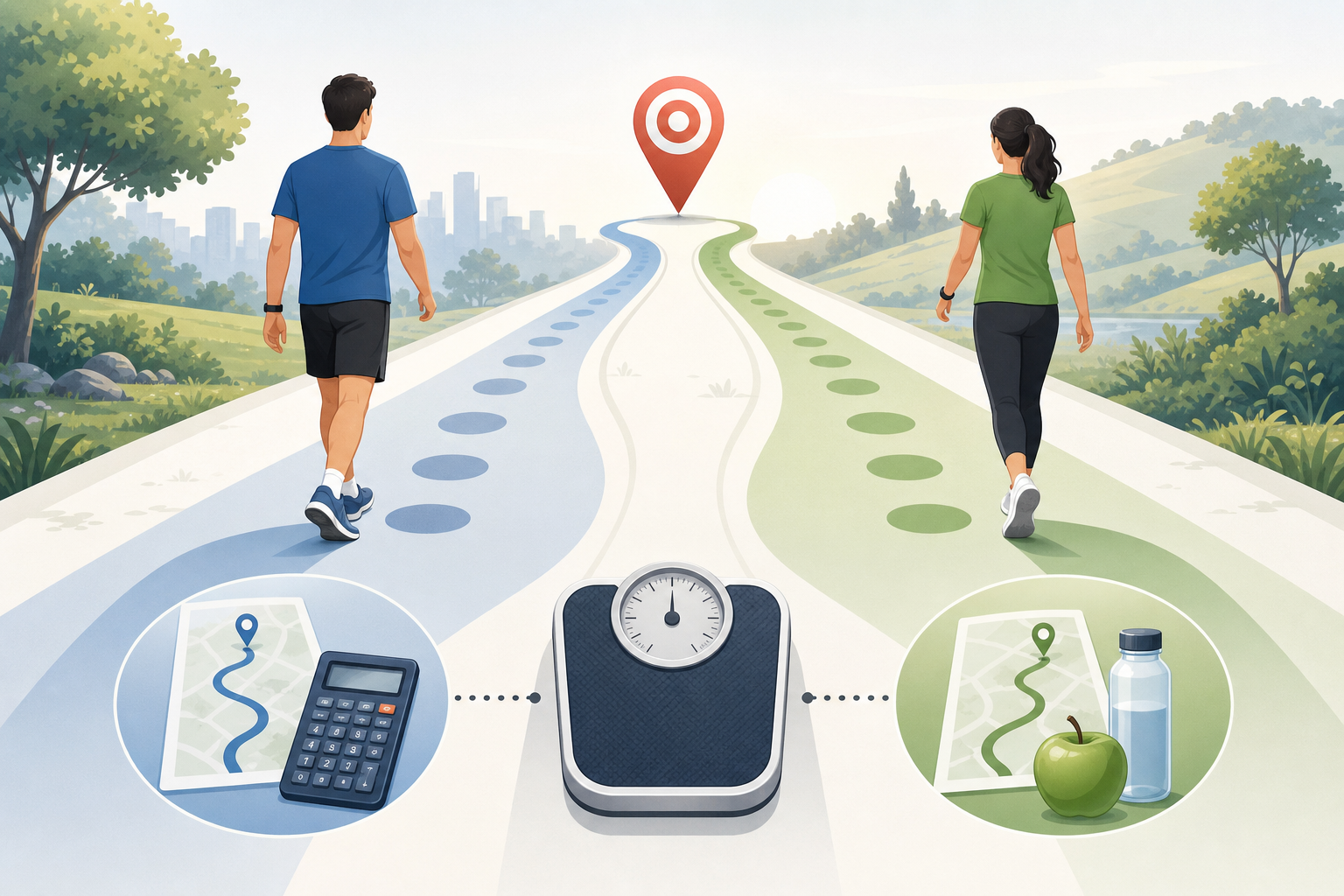
The main reason why two people can walk the same steps but different kilometres is that a step is a count, not a fixed unit of distance. Each person covers a different amount of ground per step because step length varies with height, body proportions, pace, terrain and walking pattern. A taller person with a longer step may therefore travel farther than a shorter person who records the same number of steps.
- Why two people can walk the same steps but different kilometres
- How steps are converted into kilometres
- Why height is useful
- Steps per kilometre work in the opposite direction
- How walking pattern changes the distance
- Practical examples using the same step count
- A steady outdoor walk
- 10,000 steps in km
- Many short indoor movements
- What a steps to kilometres calculator can and cannot tell you
- What it can tell you
- What it cannot tell you
- How to make step-distance estimates more useful
- Frequently asked questions
- Can two people of the same height cover different distances with the same steps?
- Does walking faster always mean fewer steps per kilometre?
- Why does my calculator result differ from my GPS result?
- Is a longer step better than a shorter step?
- Should I use steps or kilometres to track walking?
- What to remember
Why two people can walk the same steps but different kilometres
Step counters record repeated movements that are identified as steps. They do not automatically establish how long each step was. To convert the count into kilometres, the step total must be combined with a measured or estimated step length.
For example, suppose one person averages 60 centimetres per step and another averages 75 centimetres. Over 10,000 steps, the first person would cover an estimated 6 kilometres, while the second would cover 7.5 kilometres.
| Example | Average step length | Step count | Estimated distance |
|---|---|---|---|
| Person A | 60 cm | 10,000 | 6.0 km |
| Person B | 75 cm | 10,000 | 7.5 km |
These figures are illustrations rather than measurements of any particular person. Even one individual may not maintain the same average step length throughout a walk.
How steps are converted into kilometres
A steps-to-distance conversion uses the following method:
Distance in kilometres = steps × estimated step length in centimetres ÷ 100,000
The division by 100,000 converts centimetres into kilometres. The calculation itself is straightforward, but the result depends heavily on the step-length value entered or estimated.
Why height is useful
Height provides a practical starting point because body dimensions often influence how much ground a person covers during a normal step. A height-based estimate is generally more individualised than applying one standard distance to every step count.
However, height does not determine step length exactly. Two people of equal height can still walk differently because of their leg proportions, pace, mobility, footwear or personal movement habits.
Steps per kilometre work in the opposite direction
People with shorter steps need more steps per kilometre. Those with longer steps usually need fewer.
For example, a 60-centimetre average step length equals about 1,667 steps per kilometre. A 75-centimetre step length equals about 1,333 steps per kilometre. These values come from dividing 100,000 centimetres by the average step length.
This is why there is no single universal answer for steps per kilometre.
How walking pattern changes the distance
Step length is not fixed throughout the day. A brisk, uninterrupted walk may produce a different average from short movements around a home, workplace or shop.
- Pace: Some people lengthen their steps as they walk faster, although the response varies.
- Hills: Uphill steps may be shorter, while downhill walking can also alter normal movement.
- Surface: Sand, grass, uneven paths and slippery ground may encourage shorter or more cautious steps.
- Crowds and obstacles: Turning, stopping and moving around objects can add steps without covering much straight-line distance.
- Fatigue: Walking form and step length may change over a long outing.
- Footwear or carried loads: Different shoes, bags or other loads can affect how a person moves.
Walking context also matters when interpreting physical activity. The 2024 Adult Compendium of Physical Activities distinguishes among walking activities performed at different speeds and in different settings. It is primarily a resource for estimating activity energy expenditure, not for converting steps into exact distance, but it illustrates why all walking should not be treated as identical.
Practical examples using the same step count
A steady outdoor walk
Consider two friends who each record 8,000 steps on separate outdoor walks. One has an estimated average step length of 62 centimetres, while the other averages 72 centimetres.
| Step length | Calculation | Estimated distance |
|---|---|---|
| 62 cm | 8,000 × 62 ÷ 100,000 | 4.96 km |
| 72 cm | 8,000 × 72 ÷ 100,000 | 5.76 km |
Their step counts match, but the estimated distances differ by 0.8 kilometres. Neither result means one walk was more valuable; it only reflects a difference in estimated distance per step.
10,000 steps in km
The answer to “how much is 10000 steps in km?” depends on the assumed step length. At 55 centimetres per step, the estimate is 5.5 kilometres. At 70 centimetres, it is 7 kilometres; at 80 centimetres, it is 8 kilometres.
Quoting one fixed kilometre value for 10,000 steps can therefore be misleading. A range or an individual estimate is more informative, particularly when the step count comes from everyday movement rather than one continuous walk.
Many short indoor movements
Imagine that a person accumulates 6,000 steps while cooking, cleaning and moving between rooms. Those steps may include turns, side movements and very short transitions. A height-based conversion may estimate the distance as if the person used a typical forward walking step, so it could differ from the actual ground covered.
By contrast, the same 6,000 steps taken along an open, level route may be closer to the person’s usual walking step length. This does not make either count incorrect; it shows that the conversion and the counter are measuring different things.
What a steps to kilometres calculator can and cannot tell you
A steps to kilometres calculator combines a step count with a height-based estimate of step length. It provides a practical planning value when measured distance is unavailable.
What it can tell you
- An estimated distance for a given number of steps.
- How changing the step count affects the distance estimate.
- Why the same number of steps can represent different distances for people of different heights.
- A consistent way to compare your own step totals when the same calculation method is used each time.
What it cannot tell you
- Your exact average step length during a specific walk.
- The precise route distance measured along every turn or curve.
- How hills, surfaces, pace changes or indoor movements affected each step.
- Whether a wearable detected every step correctly.
- How many calories the walk used based on distance alone.
The output should be read as an estimate, not a measured kilometre total. GPS may provide a different result because it estimates route distance from location data, while a step conversion estimates distance from movement count and assumed step length. GPS itself can also vary where the signal is obstructed or the route contains many tight turns.
How to make step-distance estimates more useful
Consistency is often more useful than searching for a perfectly exact conversion. If you use the same device, placement and calculation method, changes over time are easier to interpret.
- Enter your current height accurately. Check that the selected centimetre or feet-and-inches option matches the number entered.
- Use the same step source. A phone in a pocket may count movement differently from a wrist-worn tracker.
- Separate different walking situations when possible. A continuous outdoor walk may not be directly comparable with a full day of mixed indoor and outdoor movement.
- Compare with a known route. Repeated walks on a mapped route can show whether a height-based estimate tends to run high or low for your walking pattern.
- Avoid false precision. A result such as 6.43 kilometres should not be interpreted as an exact measurement when the underlying step length was estimated.
If distance accuracy matters, measuring a known route and dividing its length by the number of steps can provide a more personalised average. That average is still specific to the pace, terrain and walking conditions used during the measurement.
Frequently asked questions
Can two people of the same height cover different distances with the same steps?
Yes. Height helps estimate step length, but it does not capture differences in body proportions, pace, terrain or personal walking style. Two people of the same height may therefore record the same steps and travel different distances.
Does walking faster always mean fewer steps per kilometre?
Not always. Some people increase both step length and step rate when they speed up, while others rely more heavily on taking steps more quickly. The effect on steps per kilometre depends on how the individual changes their walking pattern.
Why does my calculator result differ from my GPS result?
The calculator uses an estimated step length, whereas GPS uses changing location data to estimate the route. Variable stride, hills, indoor walking, signal quality and tight turns can all contribute to a difference.
Is a longer step better than a shorter step?
No. Step length is a movement characteristic, not a score of walking quality or health. Deliberately overextending the legs simply to cover more distance per step may also feel unnatural.
Should I use steps or kilometres to track walking?
Either can be useful depending on the purpose. Steps reflect movement count, while kilometres describe estimated or measured distance. Using both can add context, provided estimated kilometres are not treated as exact measurements.
What to remember
Understanding why two people can walk the same steps but different kilometres starts with one point: every step does not cover a standard distance. Height can support a useful estimate, but walking pace, terrain and movement pattern create individual and day-to-day variation.
A height-based conversion is suitable for general planning and comparison. For a specific route, treat the result as an estimate and compare it with a mapped or GPS-based distance when greater accuracy is needed.