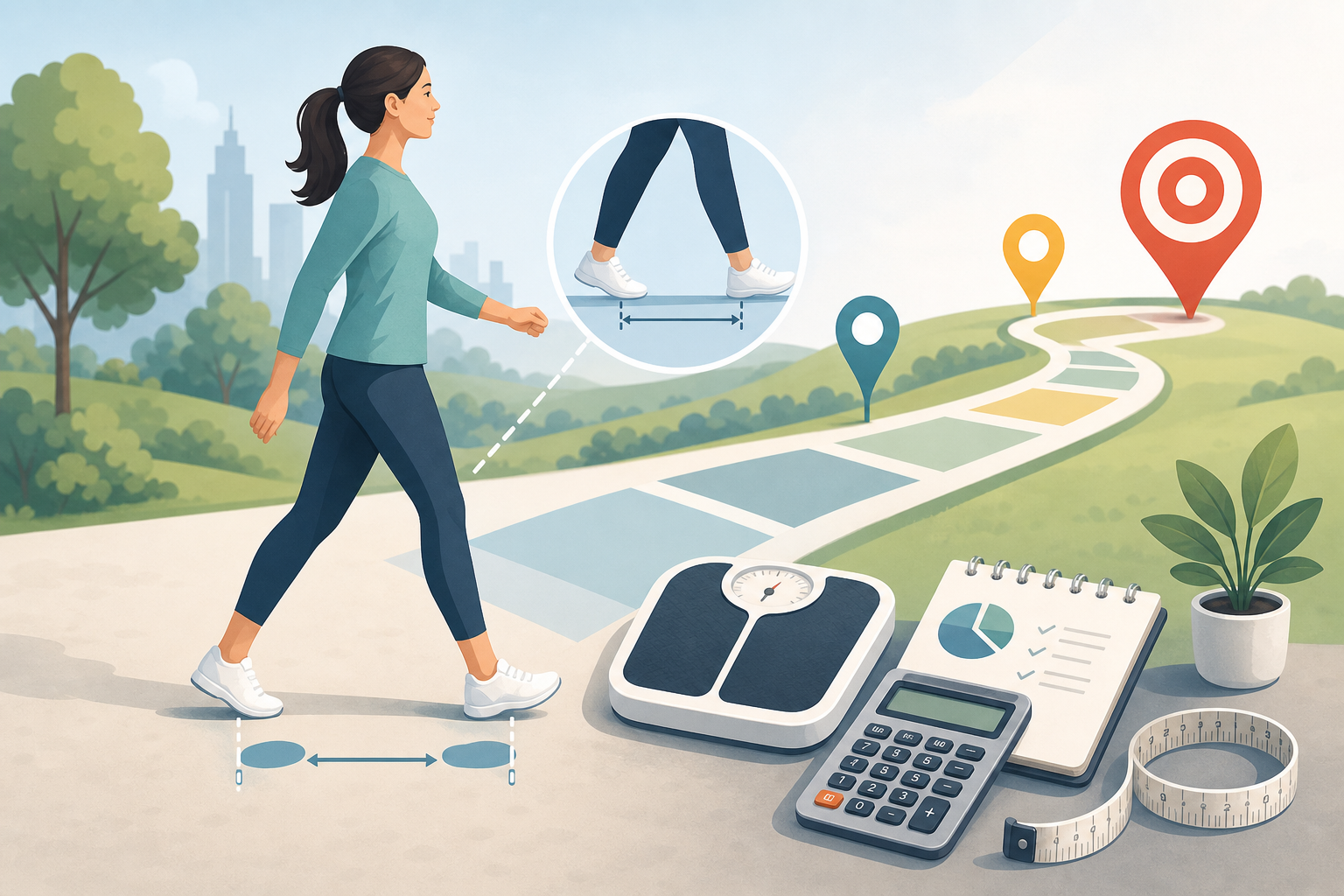
Understanding why step length matters when estimating walking distance starts with a simple relationship: distance equals the number of steps multiplied by the length of each step. Two people can record the same step count yet travel different distances because their steps are not the same length. A steps-to-distance result is therefore an estimate unless step length has been measured for the individual and the conditions of the walk.
- Why step length matters when estimating walking distance
- Step length and stride length are not always the same
- What affects a person’s step length?
- How the same step count can produce different estimates
- A practical comparison
- What a walking distance calculator can and cannot tell you
- How to obtain a more personal distance estimate
- Check the step count as well
- How to interpret steps-to-distance results
- Frequently asked questions
- Can two people walk the same number of steps but cover different distances?
- Is step length determined only by height?
- Why does my walking distance calculator differ from my wearable?
- Does walking faster always mean a longer step?
- Should I use step length or stride length for steps to distance?
- Is walking distance from steps exact?
Why step length matters when estimating walking distance
A step counter records how many steps were detected, not necessarily how far the person travelled. To estimate distance, a calculator must assign a length to each step.
The basic method is:
Distance = number of steps × estimated step length
For example, 8,000 steps with an average step length of 0.65 metres represents an estimated 5,200 metres, or 5.2 kilometres. The same 8,000 steps at 0.80 metres per step represents 6,400 metres, or 6.4 kilometres.
That 1.2-kilometre difference comes entirely from the step-length assumption. This is why a step count by itself is not enough to establish distance accurately.
Step length and stride length are not always the same
Step length usually means the distance from the placement of one foot to the next placement of the other foot. Stride length usually means the distance between successive placements of the same foot, so one stride generally contains two steps.
However, apps, devices and everyday explanations do not always use these terms consistently. Some systems label the distance per step as “stride length.” When entering a value manually, it is important to check which definition the tool expects.
If a calculator expects step length but receives a full two-step stride length, the resulting distance could be substantially overstated. Conversely, entering a one-step measurement where a full stride is expected could understate the result.
What affects a person’s step length?
Height is often used to estimate step length because taller people tend to have longer body segments and may take longer steps. A height-based formula is convenient, but it cannot capture every individual difference.
Actual step length can also change with:
- Walking speed and whether the person is strolling or walking briskly
- Uphill, downhill, uneven or slippery terrain
- Footwear and the load being carried
- Fatigue, comfort, mobility and individual walking pattern
- Congestion, turns, obstacles and frequent stopping
- Indoor movement compared with continuous outdoor walking
A person may therefore have no single step length that applies to every walk. Short steps around a home or workplace can differ from steps taken during a steady walk on a level path.
The 2024 Adult Compendium of Physical Activities lists walking activities across different speeds and settings. This supports treating walking as a varied activity rather than assuming that every recorded step occurs under identical conditions. The Compendium does not provide a personalised step length for an individual.
How the same step count can produce different estimates
Consider two people who each record 10,000 steps. The table shows how different average step lengths change the calculated distance.
| Step count | Average step length | Estimated distance |
|---|---|---|
| 10,000 | 0.60 metres | 6.0 kilometres |
| 10,000 | 0.70 metres | 7.0 kilometres |
| 10,000 | 0.80 metres | 8.0 kilometres |
These are mathematical examples, not expected distances for everyone. They show that each additional 0.10 metre assigned to every step adds 1 kilometre across 10,000 steps.
The effect also works in the other direction. If a height-based formula estimates a step length of 0.75 metres but the person’s average during a particular walk was 0.68 metres, the formula will produce a higher distance than was actually covered.
A practical comparison
Suppose a shorter walker and a taller walker complete the same 4,000-step route. If their average step lengths are 0.62 metres and 0.78 metres, their estimated distances are 2.48 kilometres and 3.12 kilometres respectively.
Neither result is better or worse. The difference reflects how far each step carries the person. It also explains why comparing distance solely from step counts can be misleading.
What a walking distance calculator can and cannot tell you
A walking distance calculator estimates walking distance from steps by applying a height-based step length. The method may use height and a sex-specific factor to generate the step-length estimate, then multiply that value by the entered number of steps.
The calculator can:
- Convert a step count into an estimated distance
- Apply a consistent height-based method
- Present the result in kilometres, miles or other supported units
- Help compare step totals when the same calculation method is used
- Provide a planning estimate when measured distance is unavailable
The calculator cannot:
- Measure the exact path travelled
- Know the person’s actual step length during every part of the walk
- Account fully for changes in speed, slope, surface, footwear or gait
- Correct steps that a phone or wearable missed or counted incorrectly
- Determine energy expenditure or health effects from distance alone
The output should be described as estimated walking distance from steps, not as a measured distance. A mapped route, accurately measured track or properly calibrated distance device may be more suitable when exact route length matters.
How to obtain a more personal distance estimate
A height-based estimate is useful when no individual measurement is available. For a more personalised conversion, average step length can be estimated over a known distance.
- Choose a straight, level route with a reliably known distance.
- Walk naturally rather than deliberately stretching or shortening each step.
- Count the steps taken across the measured distance.
- Divide the known distance by the number of steps.
- Repeat the test and average the results to reduce the effect of counting or starting-position differences.
For example, if a person takes 40 steps to cover 28 metres, the measured average for that trial is 0.70 metres per step. That value may provide a more individual estimate than a general height formula for similar walking conditions.
It still should not be treated as permanent. A measurement taken during steady, level walking may not represent short indoor steps, hill walking or a much faster pace. Separate measurements can be useful if someone regularly wants estimates for distinctly different walking conditions.
Check the step count as well
Even a well-estimated step length cannot compensate for an inaccurate step count. Phones and wearables infer steps from movement signals, and their totals may differ depending on placement, device settings and the type of movement detected.
When comparing results over time, using the same device and wearing or carrying it in a similar way can make the estimates more consistent. Consistency does not guarantee exactness, but it reduces changes caused solely by switching measurement methods.
How to interpret steps-to-distance results
Distance estimates are most useful when their assumptions remain visible. A result such as “6.8 kilometres estimated from 10,000 steps using a 0.68-metre step length” is more informative than presenting 6.8 kilometres as if it had been directly measured.
Small differences should not be overinterpreted. If one day’s estimated distance is slightly higher than another, the change could reflect step count, estimated step length, device detection or walking conditions.
For route planning, allow for uncertainty when the estimate is based only on steps. For tracking patterns, use the same calculator inputs and device method where possible. This makes comparisons more meaningful even though the absolute distances remain approximate.
In summary, why step length matters when estimating walking distance is explained by the conversion formula itself: every recorded step is multiplied by the assumed distance per step. The better that assumption represents the person and the walk, the more useful the final estimate will be.
Frequently asked questions
Can two people walk the same number of steps but cover different distances?
Yes. If their average step lengths differ, the same step count will convert to different distances. Pace, terrain and individual walking patterns can increase the difference.
Is step length determined only by height?
No. Height can support a practical estimate, but it does not determine an exact step length. Speed, terrain, footwear, mobility and personal gait can all influence how long each step is.
Why does my walking distance calculator differ from my wearable?
The calculator and wearable may use different step-length assumptions. A wearable may also use motion data, location data or personal settings, while a basic calculator applies a formula to the entered steps and height. Differences do not automatically show that either result is exact or incorrect.
Does walking faster always mean a longer step?
People often change both step length and step rate when changing speed, but the pattern is not identical for everyone. It is safer to measure step length at the relevant pace than to assume a fixed change.
Should I use step length or stride length for steps to distance?
Use the value required by the specific formula or tool. If distance is calculated as steps multiplied by length, the length should normally represent one step rather than a two-step stride. Check the tool’s definition before entering a manual value.
Is walking distance from steps exact?
Usually not. It is an estimate based on both the detected step count and an assumed or measured average step length. Accuracy can improve with an individual calibration, but step length can still vary within and between walks.