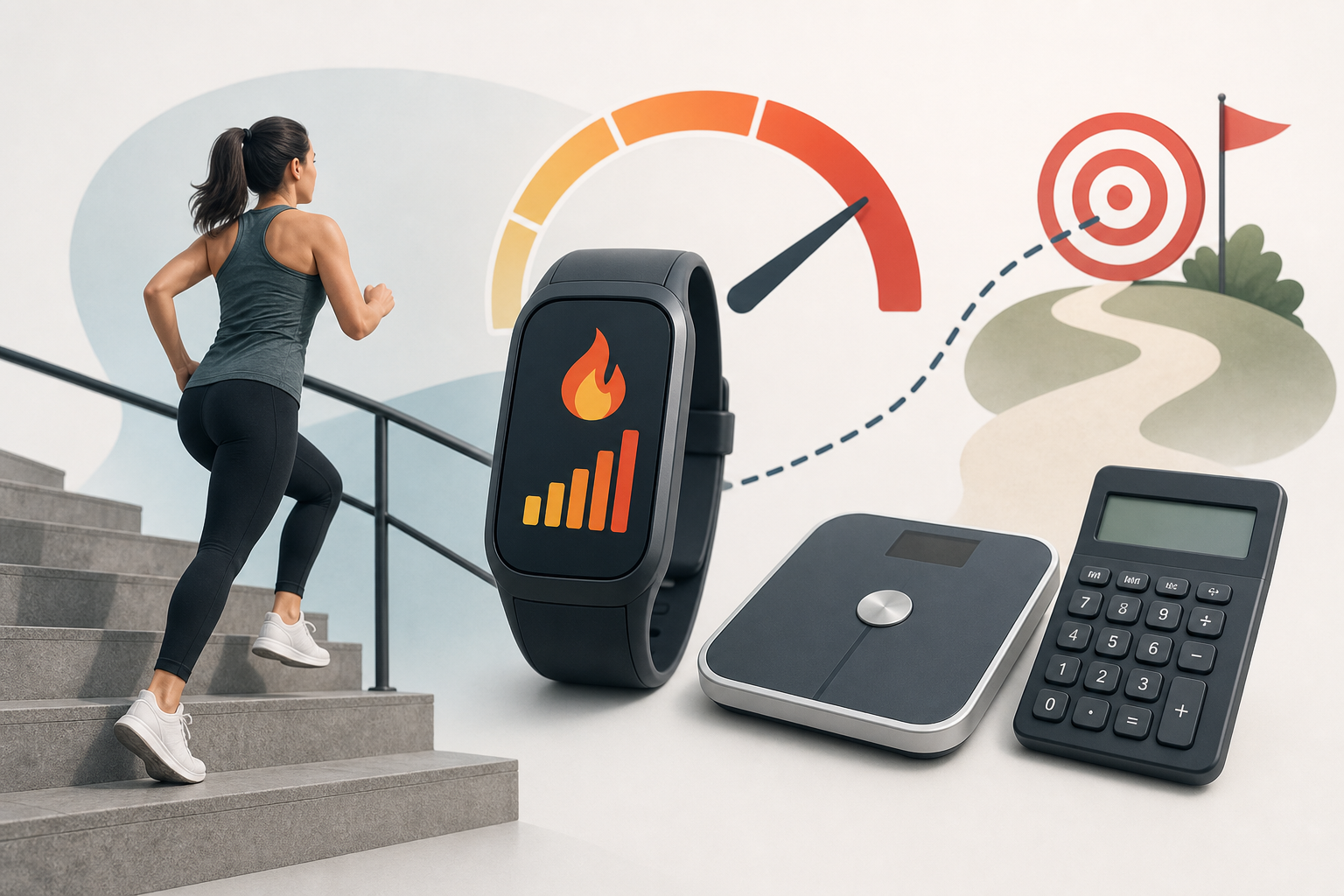
The main reason why stair climbing calorie counters can overestimate your workout is that they calculate energy use from assumptions rather than measure it directly. Generic intensity values, machine algorithms, hand support, pauses and differences in step height can all make the displayed number higher than the energy your session likely required.
- Why stair climbing calorie counters can overestimate your workout
- How generic MET values affect stair calorie burn estimates
- One MET value cannot describe every staircase
- Selected effort may not match average effort
- How machines, handrails and pauses can raise the displayed estimate
- Machine algorithms make assumptions
- Hand support can reduce the work performed
- Pauses can be counted as active climbing
- Step height and movement style matter
- A practical example of possible overestimation
- What the stair climbing calories calculator can and cannot tell you
- What it can help with
- What it cannot determine
- Frequently asked questions
- Are stair machine calorie readings accurate?
- Does holding the handrail always invalidate the calorie estimate?
- Should rest time be included in a stair climbing calories calculator?
- Why does my wearable disagree with the stair machine?
- Do outdoor stairs and a stepmill burn the same calories?
- Is a higher displayed calorie number evidence of a better workout?
- The practical takeaway
A calorie result is therefore best treated as a planning estimate. It can help you compare similar workouts, but it is not a precise measurement of the calories burned climbing stairs.
Why stair climbing calorie counters can overestimate your workout
Most stair calorie burn estimates are based on body weight, workout duration and an assumed intensity. The calculator or machine applies a formula to those inputs, even though it cannot fully observe how you moved.
For example, a counter may assume that you climbed continuously at the selected pace for 20 minutes. It may not know that you paused, leaned on the rails, shortened your steps or reduced the pace during part of the session.
The calculation can still be useful when its assumptions reasonably match the workout. Overestimation becomes more likely when the recorded duration or selected effort represents more work than you actually completed.
How generic MET values affect stair calorie burn estimates
Many activity calculators use metabolic equivalent of task, or MET, values. The Adult Compendium of Physical Activities assigns standard MET values to categories of activity so that energy expenditure can be estimated consistently.
A common calculation is:
Estimated kcal = MET × 3.5 × body weight in kilograms ÷ 200 × minutes
This formula produces an estimate, not a measured value. The MET assigned to an activity describes a standardised intensity, while an individual session may be easier or harder than that category suggests.
One MET value cannot describe every staircase
Stair climbing is weight-bearing, and its energy cost generally rises with body weight, pace and vertical work. However, two workouts described as “stair climbing” may involve different step heights, climbing speeds, movement patterns and recovery periods.
A generic MET value may assume steady climbing. It may fit a continuous ascent better than a session that includes landings, queues, direction changes or time spent descending.
Selected effort may not match average effort
A calculator may offer broad options such as moderate or vigorous effort. These labels require judgement, and a person may select the level that describes the hardest part of the workout rather than its average intensity.
If a high MET value is applied to the full duration, including easier periods, the resulting estimate can be too high. The same issue occurs when a machine’s peak level is treated as the level maintained throughout the session.
How machines, handrails and pauses can raise the displayed estimate
Stair machines and online calculators do not necessarily use the same method. Their results can differ even when the entered body weight and duration are identical.
Machine algorithms make assumptions
A stair machine may combine elapsed time, selected speed or level, and any profile information entered by the user. The exact calculation may not be visible, and different manufacturers can define levels, floors and calories differently.
The machine may also continue counting while the steps are moving, regardless of whether the user is climbing normally. Time spent slowing down, repositioning or preparing to stop may remain part of the displayed workout total.
Another source of confusion is the type of calorie result. Some devices may show estimated total energy used during the period, while others may attempt to show activity calories above resting needs. These figures are not directly interchangeable.
Hand support can reduce the work performed
Using handrails lightly for balance is different from transferring a substantial amount of body weight through the arms. Leaning heavily on the rails can reduce the load supported by the legs and change climbing technique.
A machine usually cannot determine how much weight is being placed on its rails. It may calculate calories as if the full body weight were being lifted with each step, which can make the estimate less representative of the actual session.
Pauses can be counted as active climbing
Elapsed workout time is not always the same as active climbing time. Resting on a landing, waiting for access to a staircase or standing on a stopped machine lowers average intensity.
If the counter applies a stair-climbing MET value to the entire interval, it assumes continuous work. Short breaks may have a small effect, but repeated or extended pauses can make the total increasingly optimistic.
Step height and movement style matter
Taller steps generally require more vertical work than shallow steps. Skipping steps, using a shortened range of motion or allowing a moving step to carry the feet downward can also change the physical demand.
Ordinary stairs, stadium steps and stepmill machines should not automatically be treated as identical. Their geometry and movement patterns may differ even when the displayed pace appears similar.
A practical example of possible overestimation
Consider an 80 kg person who enters 20 minutes of stair climbing at 8.8 MET. Using the standard formula, the estimated expenditure is:
8.8 × 3.5 × 80 ÷ 200 × 20 = about 246 kcal
This result assumes that 8.8 MET reasonably represents the average intensity for all 20 minutes. It does not confirm that 246 kcal was individually measured.
Suppose the person actively climbed for 16 minutes but spent four minutes resting or waiting. Applying 8.8 MET only to the 16 active minutes would produce an activity estimate of about 197 kcal. Some energy would still be used during the pauses, but those minutes should not automatically be valued at the full climbing intensity.
The original 246 kcal estimate could be higher still relative to the session if the person leaned heavily on the rails or if the selected MET represented a faster pace than was maintained. Conversely, unusually tall steps or a harder sustained pace could make the generic estimate too low. The calculation cannot resolve those details without better inputs or direct measurement.
What the stair climbing calories calculator can and cannot tell you
The stair climbing calories calculator estimates energy use from body weight, effort and duration. It uses a standard MET-based method, making it suitable for approximate planning and comparison.
What it can help with
- Estimating calories used during a planned or completed stair-climbing session.
- Comparing sessions of different durations when the pace and conditions are similar.
- Showing how body weight, time and selected effort affect the formula.
- Providing a consistent estimate when you use the same inputs over time.
What it cannot determine
- Your individually measured energy expenditure.
- How much weight you transferred to the handrails.
- Whether every recorded minute involved active climbing.
- The exact effect of step height, stair design or machine mechanics.
- Whether the selected MET accurately represented your average effort.
- The calorie algorithm used by a particular gym machine or wearable.
To use the tool, select the requested unit system, enter your body weight and duration, and choose the effort option that most closely reflects the whole session. After calculating, review the result together with its assumptions and limitations.
For a more consistent estimate, record active climbing time rather than total time at the venue. Choose an average effort level instead of the session’s hardest moment, and compare like with like—for example, the same staircase, machine and hand-support pattern.
Frequently asked questions
Are stair machine calorie readings accurate?
They are algorithm-based estimates. Accuracy depends on the information entered and whether the machine’s assumptions about speed, duration, body weight and movement match the workout. Heavy rail use and unrecorded pauses can reduce how representative the display is.
Does holding the handrail always invalidate the calorie estimate?
No. Light contact for balance may have less effect than leaning or supporting substantial body weight through the arms. Because a counter usually cannot distinguish between these behaviours, the displayed number should still be treated as approximate.
Should rest time be included in a stair climbing calories calculator?
Use active climbing time when the selected MET represents continuous stair climbing. If a workout contains several work and rest intervals, estimate the climbing periods separately rather than applying the higher intensity to the full elapsed time.
Why does my wearable disagree with the stair machine?
The devices may use different inputs and algorithms. A wearable may incorporate movement or heart-rate data, while a machine may rely mainly on speed, level, duration and profile information. Neither result should automatically be considered a direct measurement.
Do outdoor stairs and a stepmill burn the same calories?
Not necessarily. Step height, pace, landings, descending, machine mechanics and hand support can differ. Similar duration does not guarantee the same vertical work or average intensity.
Is a higher displayed calorie number evidence of a better workout?
No. The display reflects an estimate generated from the device’s assumptions. Workout duration, comfort, technique and repeatability can be considered without treating one calorie number as a complete measure of the session.
The practical takeaway
Understanding why stair climbing calorie counters can overestimate your workout helps put the result in context. Generic MET values, machine algorithms, hand support, pauses and stair design all create uncertainty that a single calorie figure cannot show.
Use stair calorie burn results as estimates for broadly similar sessions, not as exact measurements or a basis for replacing a precise amount of food energy. Consistent inputs and honest accounting of active time make comparisons more useful, even though they do not remove every source of error.