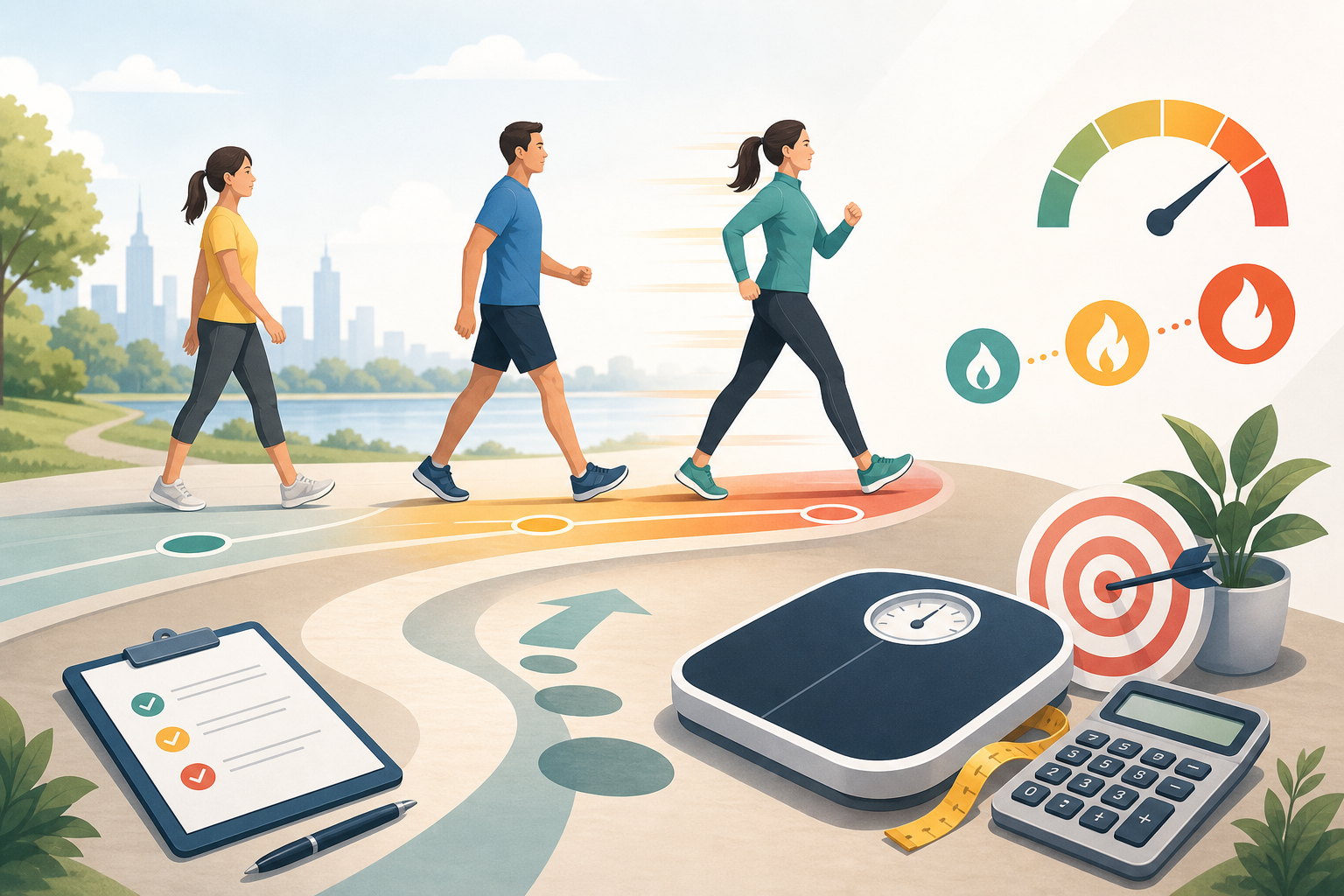
Yes, walking speed affects calories burned, mainly because a faster pace usually requires more energy each minute. However, the relationship between walking speed calories burned, duration and distance is not straightforward: a faster walk may burn more per minute but finish sooner, while a slower walk can use substantial energy if continued for longer.
How walking speed calories burned estimates work
Walking at a quicker pace generally increases intensity. Your muscles must produce force more rapidly, and your heart and breathing rates may rise to support the effort. This usually increases estimated calorie use per minute.
Energy expenditure is often estimated with metabolic equivalent, or MET, values. The 2024 Adult Compendium of Physical Activities assigns approximate MET values to activities performed at different intensities, including several walking speeds and conditions.
A MET-based estimate commonly uses this formula:
Estimated kcal = walking MET × 3.5 × body weight in kilograms ÷ 200 × minutes
The MET value changes with the selected pace. The result is an estimate rather than a measurement because people can use different amounts of energy at the same walking speed.
Pace, duration and distance each affect the result
Pace describes how quickly you walk, duration is how long you continue, and distance is how far you travel. These factors overlap, but they answer different questions.
-
Pace: A faster pace usually raises estimated energy expenditure per minute.
-
Duration: More walking time generally increases the total calories burned walking, even at a comfortable pace.
-
Distance: Covering a longer distance usually requires more total work, although terrain and pace influence the estimate.
-
Body weight: MET formulas produce a higher estimate for a person with a higher body weight performing the same activity for the same time.
Consider two walks lasting 30 minutes. The faster session will generally have a higher estimated calorie total because it combines the same duration with greater intensity. If both walks instead cover the same distance, the faster session ends earlier, so the difference in total calories may be smaller than the difference in calories per minute.
Why faster walking is not always necessary
The quickest pace is not automatically the most useful pace. A speed that is difficult to sustain may shorten the walk, require frequent stops or be unsuitable for the route. A comfortable pace maintained for longer can produce a similar or higher total estimate than a brief, faster session.
Consistency of pace also matters. A calculator may treat a 45-minute entry as though the selected intensity continued throughout, but an outdoor walk can include crossings, pauses, slopes and changes in speed.
Walking intensity is also individual. The same speed can feel easy to one person and demanding to another because of differences in fitness, gait, mobility and walking efficiency. Speed is therefore a useful planning input, not a complete measure of effort.
A practical walking calorie example
Suppose a person weighing 80 kg walks briskly for 45 minutes. Using an approximate walking intensity of 4.3 MET, the calculation is:
4.3 × 3.5 × 80 ÷ 200 × 45 = about 271 kcal
This may be rounded to roughly 270 kcal. It is an estimated energy cost for that session, not a directly measured value.
Now imagine the person chooses a slower pace but walks for 60 minutes. The estimated calories per minute would be lower, but the additional time would partly or fully offset that difference. The exact comparison depends on the MET value assigned to the slower pace.
This illustrates why pace should not be viewed in isolation. When comparing walking sessions, check duration and distance alongside speed.
What a walking calorie calculator can and cannot tell you
A walking calorie calculator estimates energy expenditure from body weight, selected pace and duration. It is useful for comparing planned sessions using the same calculation method.
What it can help with
-
Estimating calories used during a walk.
-
Comparing different combinations of pace and duration.
-
Seeing how the estimate changes with body weight.
-
Planning walking time around a preferred intensity.
What it cannot determine precisely
-
Your measured energy expenditure.
-
The effect of every hill, surface or change in speed.
-
How gait, fitness or individual efficiency affects energy use.
-
The extra effort associated with wind, carrying a load or pushing a stroller.
-
How one walking session will affect body weight.
To use the calculator, select the requested units, enter your weight and walking time, choose the pace that best represents the session, and review the result with its limitations. When comparing walks over time, using the same tool and similar input choices is generally more informative than comparing estimates from different methods.
Walking for weight loss without focusing only on speed
Walking for weight loss does not require every session to be fast. Comfortable walks may be easier to repeat or extend, while brisk walks can provide a higher estimated energy cost per minute. A mixture of paces may also fit different routes, schedules and abilities.
A walking estimate should not be treated as a prediction of body-weight change. Changes in weight depend on overall energy balance over time, and calculator results do not account for food intake or all other daily activity.
For practical planning, treat walking speed calories burned as one part of the picture. Duration, distance, terrain and how consistently the pace can be maintained are also relevant.
Frequently asked questions
Does doubling walking speed double the calories burned?
No. Energy expenditure does not increase in a simple one-to-one relationship with speed. A higher speed generally increases calories per minute, but the size of the change depends on the intensities being compared and how long each pace is maintained.
Is it better to walk faster or farther?
Neither option is universally better. Faster walking may increase estimated energy use per minute, while walking farther increases duration or distance. The more practical choice is the one that fits the walker’s ability, available time and route.
Why does my wearable show a different result?
Wearables and calculators may use different equations, activity classifications and personal data. A wearable may also incorporate heart rate or movement data, but its calorie figure is still an estimate rather than a direct measurement.
Do hills increase calories burned walking?
Walking uphill generally requires more effort than level walking at the same speed. A basic calculator may not capture this unless it includes a separate incline or terrain setting. Downhill walking can also change effort and gait, so a level-walking estimate may not match a hilly route.
Can slow walking still make a meaningful contribution?
Yes. Although the estimated calories used per minute may be lower, total expenditure accumulates with time and distance. A longer slow walk can use more energy overall than a short brisk walk.