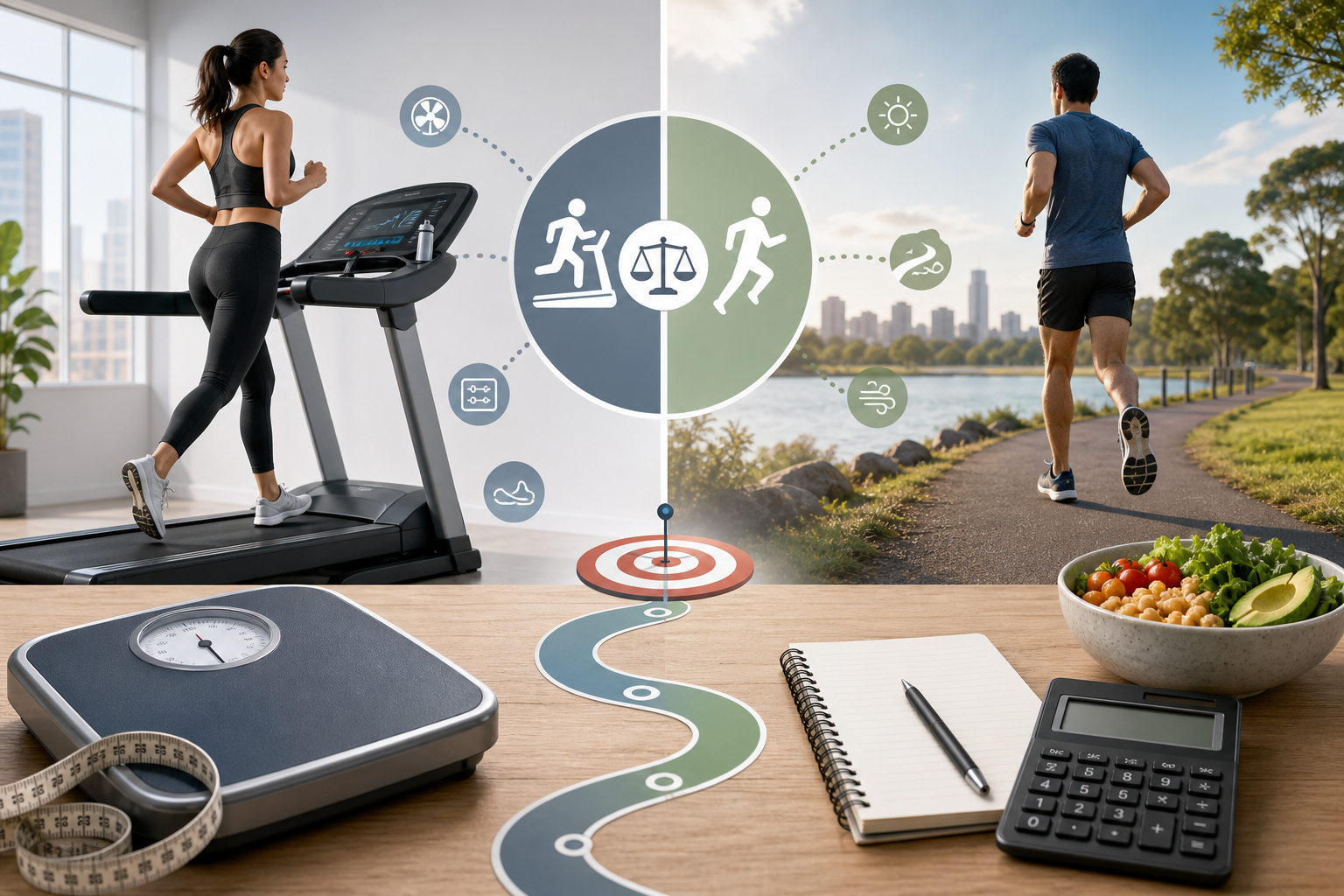
Understanding treadmill vs outdoor running calories why estimates can differ starts with a simple point: the two runs may not involve the same conditions, even when distance, pace and duration appear similar. Terrain, incline, wind, pacing changes, treadmill calibration and the calculation method can all affect the result.
- Understanding treadmill vs outdoor running calories why estimates can differ
- Factors that change treadmill and outdoor running demands
- Terrain and surface
- Incline and elevation
- Wind and air movement
- Pacing and speed changes
- Machine settings and running behaviour
- How the main estimation methods compare
- A practical treadmill and outdoor running example
- What the Running Calories Calculator can and cannot tell you
- How to make calorie comparisons more consistent
- Frequently asked questions
- Does outdoor running always burn more calories than treadmill running?
- Should I add an incline to make treadmill running match outdoor running?
- Why does my treadmill show more calories than my watch?
- Does a faster pace always produce a higher calorie estimate?
- Can heart rate make running calorie estimates exact?
- Putting the estimates in context
Neither environment is always associated with a higher running calorie burn. A steady treadmill session may require more energy if the incline is raised, while an outdoor route may be more demanding because of hills, uneven surfaces or headwinds. Most displayed calorie values are estimates rather than direct measurements.
Understanding treadmill vs outdoor running calories why estimates can differ
Running energy expenditure depends partly on body size, intensity, duration and individual running economy. However, a treadmill console, fitness watch and online calculator may process those factors differently.
A treadmill may estimate calories from belt speed, incline, session duration and an entered or assumed body weight. An outdoor device may use GPS pace, heart-rate data, elevation estimates and a personal profile. A running calories calculator commonly uses a standard activity intensity value, such as a metabolic equivalent of task, or MET.
These approaches are not interchangeable. Two devices can report different values for the same person because their inputs, activity categories and equations differ—not necessarily because one device has identified the exact amount of energy used.
Factors that change treadmill and outdoor running demands
Terrain and surface
A treadmill provides a continuous, predictable belt surface. Outdoor routes can include slopes, corners, kerbs, loose ground, grass and uneven sections. These conditions may change stride pattern, stability demands and pace.
Surface alone does not establish which run uses more energy. A smooth, level outdoor path may be similar to a level treadmill session, while a technical trail may involve substantially different movement even at a slower average pace.
Incline and elevation
Increasing treadmill incline generally raises the intensity of running because the runner is working against a simulated gradient. Outdoors, the effect depends on the route’s total climbing, the steepness of individual hills and whether descents allow recovery or require controlled braking.
Displayed incline is a machine setting, not a direct measurement of physiological effort. Calibration, treadmill design and whether the machine is level can affect how closely the setting represents the intended gradient.
Wind and air movement
Outdoor runners may encounter headwinds, tailwinds and crosswinds. A headwind can increase effort at a given pace, whereas a tailwind may reduce it. Wind direction may also change throughout a loop or out-and-back route.
Indoor treadmills usually remove natural headwind, although room ventilation and fans affect comfort. The absence of outdoor wind does not automatically make every treadmill run easier because incline, temperature and pacing may differ.
Pacing and speed changes
Treadmill running often encourages a steady pace because the belt holds a selected speed. Outdoor running usually involves more variation due to crossings, hills, turns, congestion and deliberate pace changes.
Average pace can hide these differences. A run containing repeated accelerations and slower recovery sections may not have the same energy demand as a continuous run completed at the same average pace.
Machine settings and running behaviour
Treadmill speed and incline readings depend on machine calibration and maintenance. If the displayed belt speed differs from the actual speed, a calorie estimate based on that display will inherit the error.
Holding the handrails can also change the movement required at a given setting. A console may continue calculating from speed and incline without recognising how much support the runner is using.
How the main estimation methods compare
| Method | Common inputs | What can affect the estimate |
|---|---|---|
| Treadmill console | Time, speed, incline and sometimes body weight or age | Assumed body weight, machine calibration, handrail use and the console’s equation |
| Outdoor watch or app | GPS pace, distance, elevation, body profile and sometimes heart rate | GPS accuracy, elevation error, heart-rate measurement and proprietary algorithms |
| MET-based calculator | Body weight, selected running intensity and duration | How closely the chosen MET category matches the session and the individual |
The Adult Compendium of Physical Activities provides standard MET values for many activities and intensities. These values support practical comparisons, but they represent standardised estimates rather than an individual laboratory measurement.
Some tools may also differ in whether they present total energy expenditure during the activity or attempt to show activity calories above resting needs. When comparing results, check that the figures use the same definition as well as the same body weight and duration.
A practical treadmill and outdoor running example
Consider an 80 kg runner completing two 30-minute sessions. The treadmill session is continuous at a selected speed on a level setting. The outdoor session has the same average pace but includes a headwind, several corners, one short climb and a downhill return.
A simple calculator could assign both sessions the same MET value because their recorded pace and duration are the same. In that case, it would produce the same estimate even though the outdoor effort varied during the session.
Using the approved MET formula with an intensity of 8.3 MET:
Estimated kcal = 8.3 × 3.5 × 80 kg ÷ 200 × 30 minutes = about 349 kcal.
This is a standardised estimate. The runner’s actual expenditure could differ because of wind, gradient, running economy, fitness, pacing and measurement error. If the treadmill were set to a meaningful incline, or the outdoor route were flat and sheltered, the relative demands could change.
What the Running Calories Calculator can and cannot tell you
The Running Calories Calculator estimates calories used while running from body weight, intensity and duration. It applies the following MET-based method:
Estimated kcal = MET × 3.5 × body weight in kilograms ÷ 200 × minutes.
The calculator can help with:
- comparing sessions of different durations using a consistent method;
- seeing how body weight affects the mathematical estimate;
- comparing broad running intensities represented by different MET values; and
- creating a repeatable planning estimate when the same inputs are used.
It cannot directly measure:
- the exact effect of wind, temperature or a specific running surface;
- individual differences in running economy;
- unrecorded changes in treadmill speed or incline;
- the effect of holding treadmill rails;
- every acceleration, stop, hill or descent within an outdoor route; or
- your actual energy expenditure without specialised measurement.
MET values are population-based reference values. Selecting the activity category that best reflects the main portion of the run improves consistency, but it does not turn the output into a measured value.
How to make calorie comparisons more consistent
For a useful treadmill-versus-outdoor comparison, keep the input method as consistent as possible. Avoid comparing a treadmill console result with a watch result and assuming the difference is entirely due to the running environment.
- Use the same body weight in each calculation.
- Compare equal durations or clearly account for different session lengths.
- Record treadmill speed and incline rather than speed alone.
- Note outdoor elevation, surface, wind and stops.
- Use the same calculator or device algorithm for both sessions where possible.
- Compare several similar runs rather than placing too much weight on one result.
Consistent estimates are often more useful for tracking than switching repeatedly between different calculation systems. A result that changes because of a new algorithm or device is not necessarily evidence that the physical effort changed by the same amount.
Frequently asked questions
Does outdoor running always burn more calories than treadmill running?
No. Outdoor wind, hills and uneven terrain can raise the effort, but treadmill incline and sustained pacing can also make an indoor session demanding. The details of each session matter more than the location alone.
Should I add an incline to make treadmill running match outdoor running?
There is no single incline setting that reproduces every outdoor run. Outdoor conditions vary with wind, gradient, surface and pace, while treadmill models and calibration also differ. Treat incline as a session variable rather than a universal conversion.
Why does my treadmill show more calories than my watch?
The devices may use different body data, equations and intensity signals. The treadmill may rely mainly on speed and incline, while the watch may use GPS, motion or heart rate. Either result can be an estimate, and a disagreement does not identify which value is exact.
Does a faster pace always produce a higher calorie estimate?
For the same person and duration, selecting a higher running intensity will generally produce a higher MET-based estimate. However, running faster for a shorter time can complicate comparisons with a longer, slower session.
Can heart rate make running calorie estimates exact?
No. Heart rate can provide additional information about exercise intensity, but consumer devices still use algorithms to convert it into calories. Sensor accuracy, individual physiology, temperature, fatigue and other factors may affect the result.
Putting the estimates in context
The central lesson in treadmill vs outdoor running calories why estimates can differ is that both the physical conditions and the estimation method influence the reported number. Terrain, incline, wind and pacing can change the effort, while machine settings and algorithms can change the estimate even when effort is similar.
Use calorie figures as approximate comparisons, not precise measurements. Recording the same inputs and using one calculation method consistently provides a clearer basis for comparing running sessions over time.