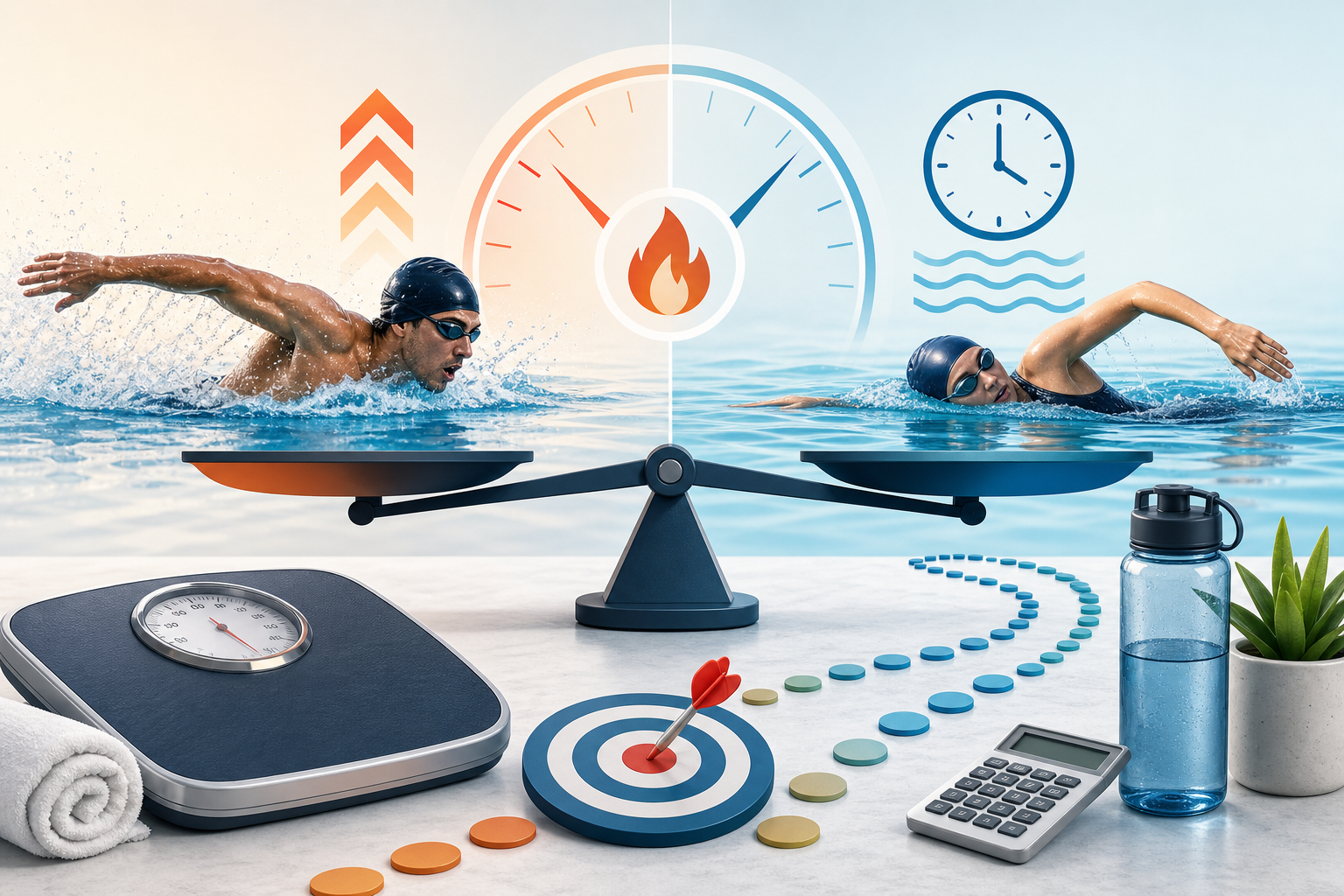
The question “swimming intensity vs duration what drives calorie burn” has a simple answer: both matter. A harder effort raises estimated calorie use per minute, while a longer session provides more minutes in which energy is used. Total swimming calorie burn therefore depends on the combination of average intensity and active duration, not either factor alone.
- Swimming intensity vs duration what drives calorie burn?
- How swimming calorie estimates combine effort and time
- Comparing harder and longer swimming sessions
- Why two similar swims can produce different actual expenditure
- What the swimming calories calculator can and cannot tell you
- What it can estimate
- What it cannot measure
- Practical ways to compare intensity and duration
- Frequently asked questions
- Can 20 minutes of hard swimming burn as many calories as 40 minutes of easy swimming?
- Should rest time be included in swimming duration?
- Which swimming stroke has the highest calorie burn?
- Is swimming distance more useful than duration?
- Does the calculator show my exact swimming calorie burn?
- Balancing effort and time
Swimming intensity vs duration what drives calorie burn?
For a swimmer of a given body weight, intensity affects the rate of estimated energy expenditure. Faster swimming, stronger efforts and strokes requiring more work are generally assigned higher metabolic equivalent, or MET, values than easier swimming.
Duration affects how long that rate continues. If average intensity remains the same, increasing a 30-minute swim to 45 minutes increases the calculated calories burned swimming by 50%. Similarly, if duration stays fixed, raising the assumed MET value by 50% raises the estimate by 50%.
In practice, however, intensity and duration are connected. A pace that is manageable for 15 minutes may not be sustainable for 45 minutes. Harder sessions may also include more recovery time, so their average intensity across the entire pool visit can be lower than the intensity of the fastest laps.
The most useful comparison is therefore:
- Average effort across the session, including easier laps and recovery periods
- Total active swimming time rather than total time spent at the pool
- The swimmer’s body weight, because it is part of the calorie-estimation formula
How swimming calorie estimates combine effort and time
A common estimation method uses MET values. The 2024 Adult Compendium of Physical Activities provides MET values for many activities, including swimming performed in different ways and at different intensities.
The calculation used for an estimate is:
Estimated kcal = MET × 3.5 × body weight in kilograms ÷ 200 × minutes
In this formula, MET represents the assumed intensity, while minutes represent duration. Body weight scales the result to the individual value entered. The output is an estimate, not a direct measurement of energy expenditure.
For example, a 70 kg person swimming for 30 minutes at an assumed intensity of 6 MET would have an estimated expenditure of:
6 × 3.5 × 70 ÷ 200 × 30 = about 221 kcal
Because MET and time are both multiplied in the equation, each has the same proportional effect when everything else stays unchanged. Doubling the duration at the same MET doubles the estimate. Doubling the MET for the same number of minutes also doubles it, although maintaining twice the estimated intensity may not be realistic.
Comparing harder and longer swimming sessions
The following examples show how different combinations of intensity and duration affect the calculation for a 70 kg swimmer. The MET values are illustrative planning inputs rather than measured intensity for a specific swimmer.
| Assumed intensity | Duration | Estimated energy expenditure |
|---|---|---|
| 6 MET | 20 minutes | About 147 kcal |
| 6 MET | 30 minutes | About 221 kcal |
| 6 MET | 45 minutes | About 331 kcal |
| 8 MET | 30 minutes | About 294 kcal |
| 9 MET | 20 minutes | About 221 kcal |
The 20-minute session at 9 MET and the 30-minute session at 6 MET produce the same estimate in this example. The harder session has a higher estimated rate per minute, but the moderate session continues for longer.
This does not mean the sessions are otherwise equivalent. They may feel different, involve different strokes or require different recovery periods. The comparison only shows how intensity and duration interact within a MET-based calorie calculation.
A longer session is not automatically associated with a larger estimate if much of it is spent resting. Likewise, a session containing several fast lengths is not necessarily high intensity overall if long poolside breaks separate those lengths. Average effort over the entered duration is the important input.
Why two similar swims can produce different actual expenditure
MET calculations use standardised activity categories, but swimming varies considerably between people and settings. Two swimmers can cover the same distance in the same time while using different amounts of energy.
Important sources of variation include:
- Stroke choice and how consistently that stroke is maintained
- Technique and swimming efficiency
- Pace changes between lengths
- Rest intervals and time spent holding the wall
- Push-offs, turns and use of training aids
- Currents, waves and water conditions during open-water swimming
- Whether the entered duration represents active swimming or the entire session
Technique is especially relevant. A more efficient swimmer may use less energy than a less efficient swimmer moving at a similar pace. Conversely, a swimmer who struggles to maintain body position may expend more effort without travelling faster.
This is why pace alone does not precisely determine calories burned swimming. Stroke, efficiency and recovery patterns can produce substantial differences that a general MET category cannot fully capture.
What the swimming calories calculator can and cannot tell you
A swimming calories calculator estimates energy use from body weight, selected effort and duration. It is useful for comparing possible sessions under a consistent calculation method.
What it can estimate
- Approximate calories associated with the entered swimming duration
- How the estimate changes when body weight, time or effort changes
- The difference between a shorter, harder session and a longer, easier session
- A consistent planning figure when the same inputs and method are used
What it cannot measure
- Your individual stroke efficiency
- Exact effort during every length
- The effect of unrecorded rest intervals
- Precise energy expenditure in changing water conditions
- Actual calorie use measured directly in a laboratory
Choose the requested unit system, enter body weight and duration, and select the effort option that best represents the session as a whole. If the session alternates between hard intervals and easy recovery swimming, a single intensity selection may not represent every minute accurately.
For a more useful comparison, separate a mixed workout into segments when possible. For example, estimate 10 minutes of easy swimming, 15 minutes of harder intervals and 10 minutes of moderate swimming separately, then add the results. This still produces an estimate, but it may reflect the session better than assigning one hard intensity to all 35 minutes.
Practical ways to compare intensity and duration
When comparing possible sessions, keep two of the three main inputs unchanged: body weight, intensity and duration. This makes it clear which change is affecting the result.
- Enter the same body weight for every comparison.
- Compare different durations at one selected intensity.
- Then compare different intensity options at one fixed duration.
- Use active swimming minutes consistently.
- Review whether the chosen intensity represents the average session rather than its hardest section.
Suppose one session includes 25 minutes of continuous moderate swimming. Another lasts 40 minutes but includes 15 minutes of rest. If both contain 25 active minutes at a similar average effort, entering 40 minutes as swimming time would overstate the second estimate.
For interval swimming, decide whether recovery periods involve easy swimming or complete rest. Easy movement still contributes to expenditure but should not automatically be counted at the same intensity as the hard intervals. Complete rest should not be entered as active swimming time.
Consistency is more important than false precision. Calculator results are best treated as approximate comparisons rather than exact totals suitable for balancing food intake calorie by calorie.
Frequently asked questions
Can 20 minutes of hard swimming burn as many calories as 40 minutes of easy swimming?
It can produce a similar estimate if the average MET value for the harder session is roughly twice that of the easier session. The actual comparison depends on the selected activity categories, active swimming time, body weight, technique and rest periods.
Should rest time be included in swimming duration?
Enter active swimming time if the calculator is estimating swimming itself. If recovery consists of gentle swimming, it can be treated as a separate lower-intensity segment. Time spent completely resting should not be counted at the same MET value as active laps.
Which swimming stroke has the highest calorie burn?
There is no single answer that applies to every swimmer. Stroke-specific estimates differ by pace and activity category, while individual technique affects how much effort is required. A stroke assigned a higher MET value will produce a higher calculator result for the same weight and duration, but the value remains an estimate.
Is swimming distance more useful than duration?
Distance provides useful training context, but a MET-based swimming calories calculator generally requires duration and effort. The same distance may be completed quickly, slowly, continuously or with long breaks, so distance alone does not describe total energy expenditure.
Does the calculator show my exact swimming calorie burn?
No. It applies a standard MET-based equation to the values entered. It cannot directly measure individual efficiency, changing pace, water resistance or physiological responses during the session.
Balancing effort and time
When considering “swimming intensity vs duration what drives calorie burn,” neither factor always matters more. Intensity determines the estimated rate of energy use, while duration determines how long that rate is maintained. Within the calculation, equal proportional changes have equal proportional effects.
Real sessions are less uniform than the formula. Hard efforts may shorten the time a swimmer can continue, while longer swims may include slower lengths or more rest. Use average effort and active duration, and interpret swimming calorie burn as a planning estimate rather than a measured value.