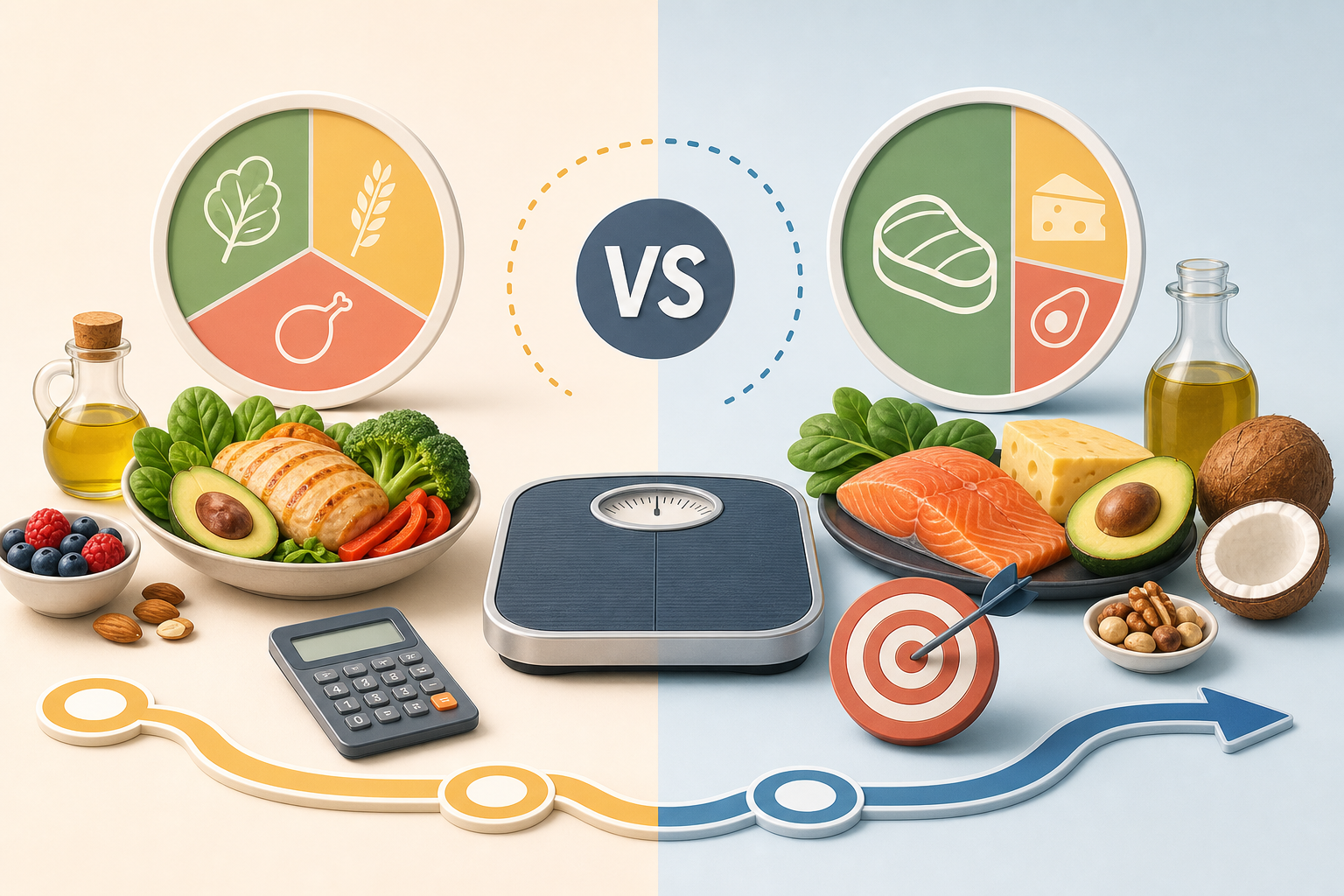
If you are asking “lowcarb vs keto macros whats the difference”, the main distinction is flexibility. A low-carbohydrate plan can use a range of carbohydrate percentages, while a ketogenic preset uses a more restrictive carbohydrate allocation and places more of the remaining energy into fat. Neither label alone tells you whether a plan suits your nutritional needs.
lowcarb vs keto macros whats the difference in practice?
Low-carb macros describe a broad planning approach rather than one fixed ratio. One person might reduce carbohydrate modestly, while another may choose a substantially lower carb percentage. Protein and fat then make up the rest of the calorie target.
A ketogenic macro pattern is narrower. It generally keeps carbohydrate low enough to support nutritional ketosis, a metabolic state in which ketones contribute more to the body’s energy supply. A macro calculation cannot confirm whether an individual will enter or remain in ketosis.
| Planning feature | Flexible low-carb pattern | Ketogenic preset |
|---|---|---|
| Carbohydrate allocation | User-selected from the available percentages | Uses a more restrictive percentage shown by the calculator |
| Protein allocation | Fixed at 30% in this calculator | Also follows the calculator’s displayed planning formula |
| Fat allocation | Receives the calories left after protein and carbohydrate | Usually receives a larger share because carbohydrate is lower |
| Main purpose | Flexible reduction in carbohydrate | A stricter ketogenic-style macro target |
| What the result establishes | A daily planning split | A daily planning split, not measured ketosis |
It is therefore better to compare the displayed percentages and gram targets than to rely only on labels such as “low carb” or “keto.” Different tools and eating plans may use these terms differently.
How the low carb macro calculator sets the targets
The low carb macro calculator converts a daily calorie value into estimated gram targets. Its standard planning model assigns 30% of calories to protein, uses the selected carb percentage, and assigns all remaining calories to fat.
- Protein percentage = 30%
- Carbohydrate percentage = the percentage selected in the tool
- Fat percentage = 100% minus protein percentage minus carbohydrate percentage
For example, choosing 25% carbohydrate leaves 45% for fat because 100% minus 30% protein minus 25% carbohydrate equals 45% fat.
The percentages are converted into grams using the energy supplied by each macronutrient. Carbohydrate and protein provide about 4 kcal per gram, while fat provides about 9 kcal per gram. These standard energy values are useful for planning, although food labels and calculated totals may vary slightly because of rounding and the treatment of components such as fibre.
The calculator does not independently estimate how much protein a person needs from body size, activity or training. The 30% protein share is a feature of this planning model, not a personalised protein requirement.
A practical comparison at 2,000 calories
Consider someone entering a planning value of 2,000 kcal per day and selecting 25% carbohydrate. The calculator divides those calories as follows:
- Protein: 30% of 2,000 kcal equals 600 kcal, or 150 g.
- Carbohydrate: 25% of 2,000 kcal equals 500 kcal, or 125 g.
- Fat: the remaining 45% equals 900 kcal, or about 100 g.
This is a flexible low-carb example. If the person selects the calculator’s more restrictive ketogenic preset, the displayed carbohydrate percentage will be lower. Because protein remains at the tool’s fixed planning share, a lower carbohydrate allocation produces a higher fat percentage.
For illustration, every five-percentage-point reduction in carbohydrate shifts five percentage points to fat under this formula. The exact gram targets depend on the calorie value and the preset shown by the tool.
This mathematical shift does not establish that a person is in ketosis. Ketone production can vary with total carbohydrate intake, food choices, activity, energy intake and individual response. A percentage-based result is therefore a planning estimate rather than a metabolic measurement.
Why carb percentage and carbohydrate grams both matter
Carb percentage describes how much of total planned energy comes from carbohydrate. Carbohydrate grams describe the actual daily quantity. Two plans with the same carb percentage can produce different gram targets if their calorie values differ.
At 25% carbohydrate, a 1,600 kcal plan contains 400 kcal from carbohydrate, equivalent to 100 g. At the same percentage, a 2,400 kcal plan contains 600 kcal from carbohydrate, equivalent to 150 g.
This is important when comparing low carb macros with a keto preset. A percentage shows the overall balance, but grams make the daily target easier to relate to meals and food labels. Neither figure by itself describes carbohydrate quality.
The source of carbohydrate still matters nutritionally. A calculated target does not indicate whether carbohydrate comes from vegetables, legumes, whole grains, fruit, refined grains or added sugars. It also does not assess fibre, vitamins, minerals or the overall variety of the diet.
For context, the National Academies’ Dietary Reference Intakes describe broad adult macronutrient distribution ranges of 45–65% of energy from carbohydrate, 20–35% from fat and 10–35% from protein. A low-carbohydrate or ketogenic-style split may fall outside some of those general ranges, which is another reason to interpret calculator outputs as planning models rather than universal recommendations.
What the calculator can and cannot tell you
What it can estimate
- The calories assigned to protein, carbohydrate and fat.
- Approximate daily grams for each macronutrient.
- How changing the carbohydrate percentage changes the fat allocation.
- The difference between a flexible lower-carbohydrate selection and the tool’s stricter ketogenic preset.
What it cannot determine
- Whether the calorie value entered matches actual energy needs.
- Whether the fixed 30% protein share is suitable for a particular person.
- Whether the resulting pattern will produce ketosis.
- Food quality, fibre intake, micronutrient adequacy or meal variety.
- How hunger, digestion, training performance or other individual responses may change.
- Whether the macro split is medically appropriate.
The output should therefore be read as an estimate based on the values entered. A measured food intake may also differ from the plan because portions, recipes and nutrition labels are not exact.
Choosing between flexible low-carb and the keto preset
A flexible low-carb setting may be more useful when the goal is simply to explore a lower carbohydrate allocation without adopting the tool’s most restrictive option. It also allows the user to compare several carb percentages while keeping the calorie value and fixed protein share unchanged.
The ketogenic preset represents a tighter planning structure. It may require more attention to the carbohydrate content of foods because a smaller daily allocation leaves less room for variation. The preset should not be interpreted as proof that the plan will create a particular ketone level or health outcome.
When reviewing either result, check the calorie value, carb percentage and calculated grams rather than focusing only on the plan’s name. Also remember that changing carbohydrate automatically changes fat in this calculator; it does not change the 30% protein allocation.
In short, the answer to “lowcarb vs keto macros whats the difference” is that low-carb planning offers a selectable carbohydrate range, while the keto preset applies a more restrictive carbohydrate split. Both outputs remain mathematical planning estimates and do not assess dietary quality or individual suitability.
Frequently asked questions
Is every low-carb macro split ketogenic?
No. Low-carbohydrate eating covers a wide range of carbohydrate intakes. A plan may be lower in carbohydrate than a general dietary pattern without being restrictive enough to support nutritional ketosis.
Does selecting the keto preset confirm ketosis?
No. The preset calculates calories and grams from a macro formula. It does not measure ketones or confirm an individual metabolic response.
Why does fat increase when I lower the carb percentage?
The calculator fixes protein at 30% of calories and assigns fat the remaining percentage. Lowering carbohydrate therefore leaves a larger share of total calories for fat.
Can I compare plans using carbohydrate grams alone?
Grams are useful, but they should be considered with total calories and carb percentage. The same percentage produces different gram targets at different calorie levels, while the same number of grams can represent different percentages.
Are the calculated macro grams exact?
No. They are estimates generated from the calorie value and selected percentage. Rounding, food-label rules, portion measurement and recipe variation can cause actual intake to differ from the calculated totals.