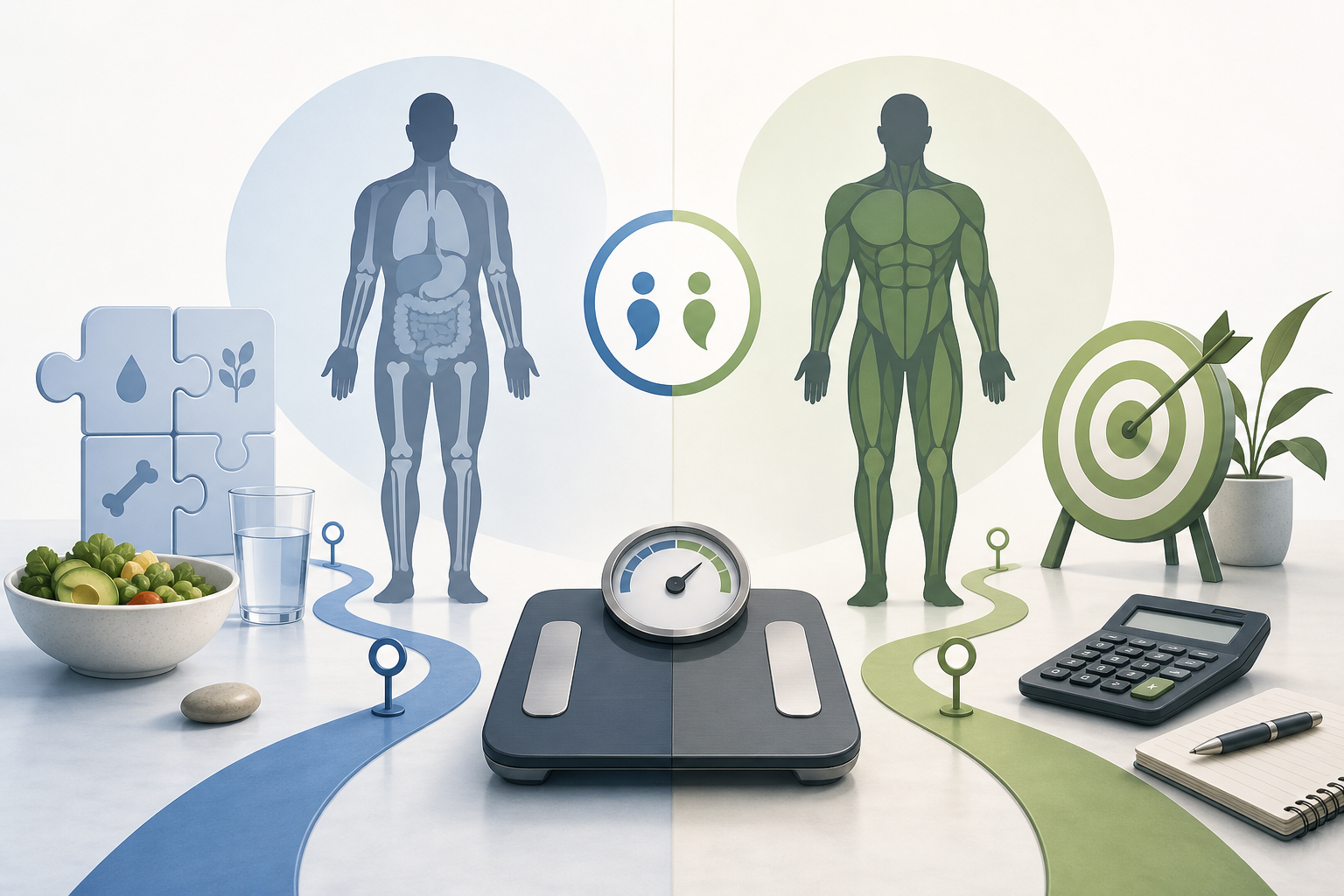
Lean body mass vs muscle mass is the difference between all non-fat tissue and one specific type of tissue. Lean body mass includes skeletal muscle, body water, bones, organs and other non-fat tissues. Muscle mass refers to muscle tissue and is therefore only one part of lean body mass.
These terms are sometimes used loosely by fitness devices and apps, which can make body-composition results confusing. Understanding what each measurement represents helps you interpret changes without assuming that every change in lean mass is a change in muscle.
Lean body mass vs muscle mass: the key distinction
Lean body mass is generally calculated as total body weight minus fat mass. It represents most of the body’s weight that is not stored body fat.
Muscle mass is narrower. In weight-management and fitness discussions, it usually means skeletal muscle: the muscles attached to bones that help produce movement. Some measurement systems may use broader definitions that also account for smooth or cardiac muscle, so it is important to check how a particular device defines its result.
| Measurement | What it includes | What it does not represent |
|---|---|---|
| Lean body mass | Muscle, water, bones, organs and other non-fat tissues | Body fat mass |
| Muscle mass | Muscle tissue, usually with an emphasis on skeletal muscle | The whole of lean body mass |
| Fat mass | Body fat | Muscle, bone, organs and other non-fat tissues |
For example, a person could have 60 kg of lean body mass without having 60 kg of muscle. A substantial part of that lean mass consists of water, bones, organs and other tissues.
What is included in lean mass?
Lean mass is a broad body-composition category. It includes several components that cannot be treated as muscle:
- Skeletal muscle: muscles involved in posture and voluntary movement.
- Body water: water inside and outside cells, including water held within muscle tissue.
- Bone: the mineral and non-mineral components of the skeleton.
- Organs: tissues such as the heart, liver, kidneys and brain.
- Other non-fat tissues: connective tissue, skin and other structures.
Because water is part of lean body mass, short-term changes in hydration can affect some body-composition readings. A higher estimated lean mass on one day does not necessarily mean that new muscle tissue has been gained.
Food intake, recent exercise and the timing of a measurement may also influence readings from methods that estimate body composition through electrical impedance. For useful comparisons, take measurements under reasonably similar conditions and focus on trends rather than isolated results.
Is lean body mass the same as fat-free mass?
Fat-free mass and lean body mass are often used interchangeably in calculators and general health content. Both commonly describe body weight after fat mass has been subtracted.
Some technical definitions distinguish between them because lean tissues can contain small amounts of essential fat, while strictly defined fat-free mass excludes all fat. In everyday calculator use, however, the terms usually refer to the same broad estimate of non-fat body mass.
The label used is less important than the method and definition behind it. When comparing results from different tools, check whether they report lean body mass, fat-free mass, skeletal muscle mass or another body-composition category.
How a lean body mass calculator works
A lean body mass calculator estimates non-fat body mass from height, weight and the sex category selected in the tool. It does not directly measure muscle, bone, organs or body water.
The calculator uses the Boer equations, with weight in kilograms and height in centimetres:
- Male equation: LBM = 0.407 × weight + 0.267 × height − 19.2
- Female equation: LBM = 0.252 × weight + 0.473 × height − 48.3
Example calculation
Consider an 80 kg, 175 cm person using the male equation:
LBM = (0.407 × 80) + (0.267 × 175) − 19.2
LBM = 32.56 + 46.725 − 19.2 = approximately 60.1 kg
The result means that the equation estimates about 60.1 kg of the person’s weight as lean body mass. It does not mean the person has 60.1 kg of skeletal muscle.
How to use the result
- Select the requested unit system and sex category.
- Enter current height and weight.
- Calculate the estimated lean body mass.
- Record the method and date if you plan to compare results over time.
- Interpret the value as an approximation, not a direct tissue measurement.
What the calculator can and cannot tell you
An equation-based estimate can provide a broad starting point for understanding body composition. It may also be used cautiously when comparing changes or when a planning method uses lean mass rather than total body weight.
The calculator can:
- Estimate total lean body mass from height, weight and sex-specific equation coefficients.
- Help distinguish estimated non-fat mass from total body weight.
- Provide a consistent equation for tracking broad changes when inputs are updated.
- Supply an approximate lean-mass value for planning calculations that require one.
The calculator cannot:
- Measure skeletal muscle mass directly.
- Separate muscle from water, bone and organ mass.
- Show where fat or muscle is distributed around the body.
- Confirm that a change in estimated lean mass came from muscle gain or loss.
- Account fully for individual differences in build, hydration or muscularity.
The Boer equations are population-based. Results may be less representative for people at body-size extremes or those with unusually high muscularity. When precision matters, equation results should be compared with an appropriate body-composition assessment rather than treated as measured values.
How to interpret changes in lean body mass
A change in scale weight can involve fat mass, lean tissue, water or a combination of these. The time frame and measurement method matter when interpreting what changed.
Practical scenario
Suppose a person’s body-composition scale reports that lean mass increased by 1 kg over several days. That result alone does not establish that the person gained 1 kg of muscle. Changes in hydration, stored carbohydrate and measurement conditions may contribute to the reading.
If the same general pattern continues over a longer period under similar measurement conditions, it may provide more useful information. Strength, physical measurements and consistently collected body-composition estimates can be considered together, although none should be assumed to provide a perfect muscle measurement.
Likewise, a lower lean-mass estimate during weight change does not automatically show how much skeletal muscle was lost. Equation-based calculators change when body weight changes, while other methods may also respond to hydration.
Frequently asked questions
Can lean body mass increase without gaining muscle?
Yes. Because lean body mass includes water and other non-fat tissues, an increase can reflect hydration or other changes rather than new skeletal muscle. The likelihood depends on the method used and the period between measurements.
Can muscle mass be higher than lean body mass?
No, not when both terms are defined consistently. Muscle is one component of lean body mass, so muscle mass should form only part of the total. Conflicting results may indicate that devices are using different definitions or estimation methods.
Does losing body fat change lean body mass?
Fat loss and lean-mass change are separate, although they may occur at the same time. A person can lose mostly fat, a mixture of fat and lean tissue, or experience short-term water changes that affect the apparent result.
Is a lean body mass calculator a body-fat test?
No. It uses an equation rather than directly testing body composition. Because lean body mass is total weight minus fat mass in the basic model, an estimated result may be used to derive related values, but it remains an approximation.
Which is more useful: lean mass or muscle mass?
That depends on the question. Lean mass can be useful for broad body-composition estimates and calculations based on non-fat weight. Skeletal muscle mass is more specific when the aim is to understand muscle tissue, but it generally requires a method designed to estimate or assess that component.
In summary, the central point in lean body mass vs muscle mass is that muscle is only one part of lean mass. A calculator can estimate the combined weight of non-fat tissues, but it cannot determine exactly how much of that result is skeletal muscle.