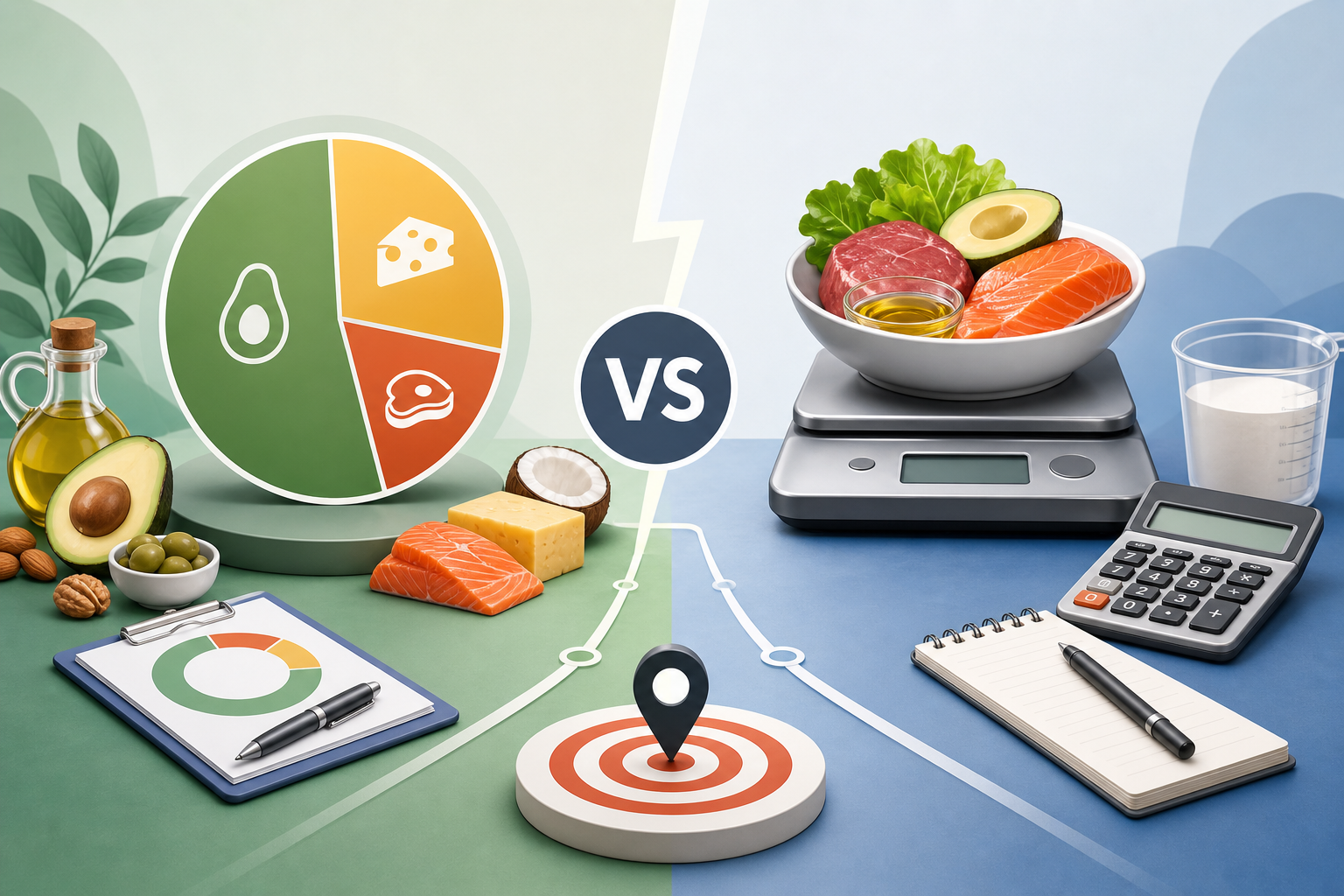
The question “keto macro percentages vs grams whats the difference” comes down to relative versus absolute amounts. Percentages describe each macronutrient’s share of daily calories, while grams describe the amount of protein, carbohydrate and fat planned for the day. The percentage ratio can remain unchanged even when the gram targets change because the total daily calorie amount is different.
Keto macro percentages vs grams whats the difference in practice?
A ketogenic macro ratio is usually expressed as percentages, such as 20% protein, 5% carbohydrate and 75% fat. Together, these percentages account for 100% of the planned daily calories.
Grams answer a different question. Instead of showing the share of calories, they show how much of each macronutrient corresponds to that share. This is often more practical when planning meals or reviewing food labels.
| Format | What it describes | Example |
|---|---|---|
| Percentage | The proportion of total calories supplied by a macronutrient | 5% of calories from carbohydrate |
| Grams | The absolute daily amount of a macronutrient | 25 g of carbohydrate per day |
A percentage alone does not provide a gram amount. To calculate grams, you also need the total daily calorie value and the energy supplied by each macronutrient.
How percentages are converted into grams
Protein and carbohydrate are generally calculated at 4 kilocalories per gram, while fat is calculated at 9 kilocalories per gram. These differences matter because equal calorie percentages do not produce equal gram amounts.
The conversion has two stages:
- Multiply daily calories by the macronutrient percentage to find calories from that macronutrient.
- Divide those calories by 4 for protein or carbohydrate, or by 9 for fat.
The formulas are:
- Protein grams = daily calories × protein percentage ÷ 4
- Carbohydrate grams = daily calories × carbohydrate percentage ÷ 4
- Fat grams = daily calories × fat percentage ÷ 9
Percentages must be entered as decimals in the calculation. For example, 20% becomes 0.20 and 5% becomes 0.05.
Example at 2,000 calories
Using the planning preset of 20% protein, 5% carbohydrate and 75% fat:
- Protein: 2,000 × 0.20 = 400 kcal; 400 ÷ 4 = 100 g
- Carbohydrate: 2,000 × 0.05 = 100 kcal; 100 ÷ 4 = 25 g
- Fat: 2,000 × 0.75 = 1,500 kcal; 1,500 ÷ 9 = about 167 g
The gram values may be rounded for everyday planning. Because of rounding, converting the displayed grams back into calories may not reproduce the total exactly.
Why the same ketogenic macro ratio produces different grams
Macro percentages are relative to total calorie intake. If two people use the same 20% protein, 5% carbohydrate and 75% fat pattern but plan for different calorie amounts, their calculated grams will differ.
| Daily calories | Protein at 20% | Carbohydrate at 5% | Fat at 75% |
|---|---|---|---|
| 1,600 kcal | 80 g | 20 g | About 133 g |
| 2,000 kcal | 100 g | 25 g | About 167 g |
| 2,400 kcal | 120 g | 30 g | 200 g |
In every row, the ketogenic macro ratio is identical. The gram amounts increase with calories because each percentage represents a larger calorie quantity.
This also means that changing the daily calorie input changes all three gram results, even if the percentages stay fixed. A macro target copied from someone else may therefore be inappropriate for a different calorie plan.
When percentages and grams are useful
Percentages are useful for describing the overall structure of an eating pattern. They make it easy to see whether a plan allocates a relatively high or low share of calories to each macronutrient.
Grams are more useful for day-to-day food planning. Nutrition labels and food-tracking tools normally report protein, carbohydrate and fat in grams, so gram targets can be compared more directly with foods and meals.
Use percentages to review the calorie pattern
A percentage view can help answer questions such as whether fat supplies most of the planned calories or whether carbohydrate has been assigned a small share. However, percentages do not show whether the resulting gram amounts fit an individual’s nutritional needs.
Use grams to plan actual food amounts
A gram view can help distribute macros across meals. For example, a daily protein allocation of 100 g could be divided among meals in several ways, while still keeping the same daily total.
Macro grams are not the same as the weight of a food. A food weighing 100 g does not necessarily contain 100 g of protein, carbohydrate or fat because foods may also contain water, fibre and other components.
What a keto macro calculator can and cannot tell you
A keto macro calculator converts a daily calorie amount into keto macros using a defined allocation. The related calculator uses a fixed planning preset of 20% protein, 5% carbohydrate and 75% fat.
It can:
- Allocate daily calories across the three macronutrients.
- Convert each calorie allocation into estimated grams.
- Show how changing daily calories changes the gram results.
- Provide a consistent starting format for meal planning.
It cannot:
- Measure how many calories a person actually consumes or uses.
- Confirm that the preset is nutritionally suitable for a particular person.
- Identify a universal or clinically optimal ketogenic ratio.
- Account automatically for health conditions, medicines, pregnancy, training demands or other individual considerations.
- Guarantee ketosis or a particular change in body weight.
The result is a planning estimate, not a measured intake. Actual intake depends on portion sizes, food composition, label accuracy and how foods are recorded.
Ketogenic diets are not appropriate for everyone and may require individual clinical guidance in some circumstances. The calculator’s 20/5/75 pattern should therefore be understood as a fixed mathematical preset rather than a recommendation that applies universally.
Frequently asked questions
Are keto macro percentages or grams more important?
They serve different purposes. Percentages describe the calorie distribution, while grams provide the quantities used for food planning. A complete macro plan usually needs both the percentage pattern and the daily calorie amount from which the grams are calculated.
Why is the fat gram number not three times the carbohydrate number?
Fat supplies more calories per gram than carbohydrate. Under a 75% fat and 5% carbohydrate allocation, fat receives 15 times the calories, but those calories are divided by 9 rather than 4 when converted to grams.
Do macro percentages have to add up to 100%?
Yes, when the percentages are intended to represent all calories from protein, carbohydrate and fat. If they do not total 100%, some calories are unallocated or the inputs are inconsistent.
Will lowering calories while keeping the same percentages lower every gram target?
Yes. With fixed percentages, a lower calorie input produces fewer calories and therefore fewer grams for each macronutrient. The relative ratio remains unchanged.
Does 5% carbohydrate always mean 25 grams?
No. It equals 25 g only when total intake is 2,000 kcal: 2,000 × 0.05 ÷ 4 = 25 g. At 1,600 kcal, the same 5% allocation equals 20 g, while at 2,400 kcal it equals 30 g.
Bringing percentages and grams together
Understanding “keto macro percentages vs grams whats the difference” requires keeping two ideas separate. Percentages show how total calories are divided, whereas grams show the corresponding daily quantities after the calorie level is included.
The ratio can stay exactly the same while the gram amounts rise or fall. For that reason, any keto macro calculator result should be read alongside its daily calorie input, calculation method and rounding assumptions.