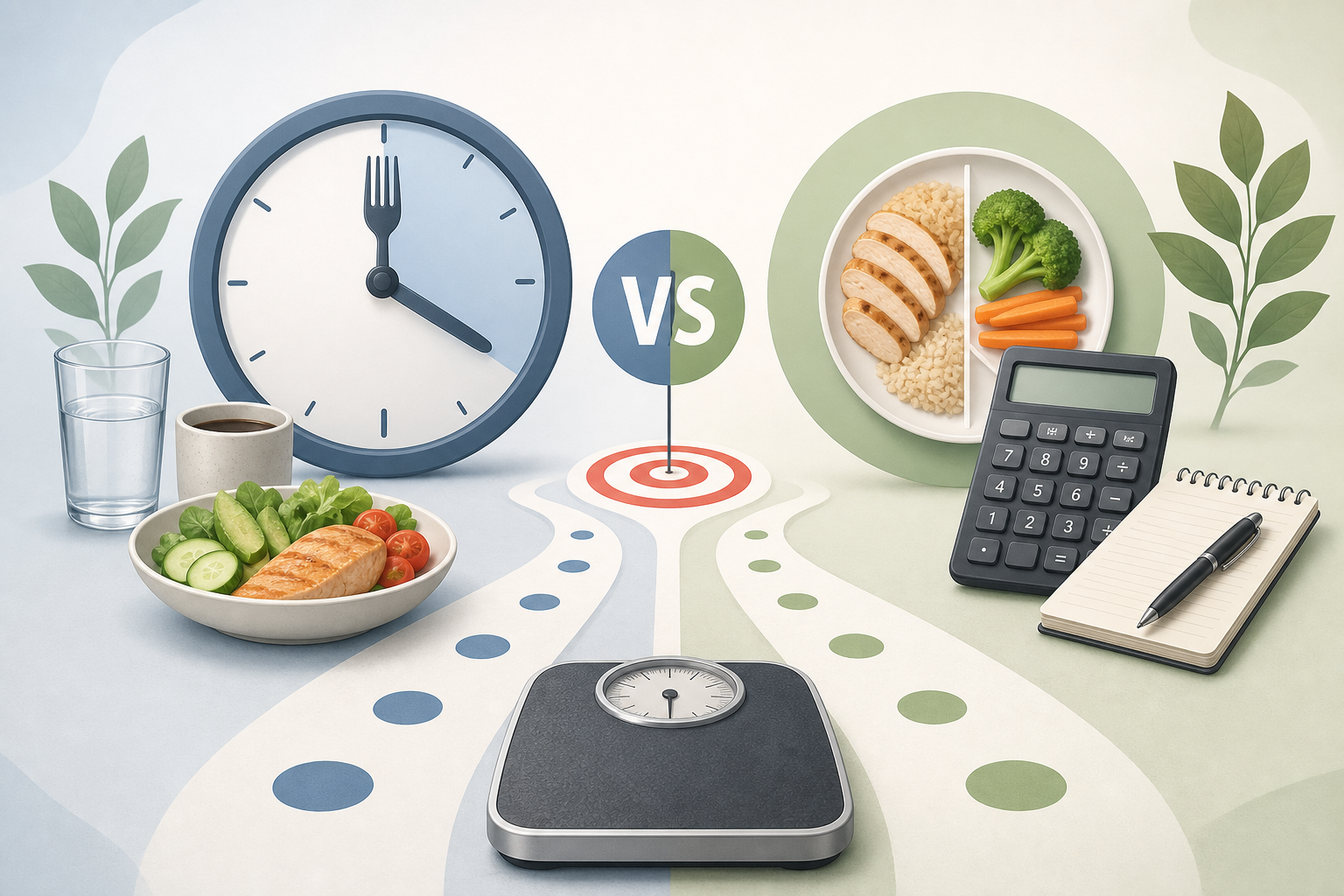
If you are asking intermittent fasting vs calorie deficit whats the difference, the short answer is that intermittent fasting describes when you eat, while a calorie deficit describes the relationship between the energy you consume and the energy your body uses. They can occur together, but neither automatically guarantees the other.
Intermittent fasting vs calorie deficit whats the difference?
Intermittent fasting is a meal-timing pattern. A person alternates between an eating window and a fasting window, often using a repeating daily schedule. For example, 16 8 fasting provides an 8-hour eating window and a 16-hour fasting window within each 24-hour day.
A calorie deficit is an energy-balance condition. It occurs when average energy intake is lower than average energy expenditure over a period of time. It does not require a particular meal schedule, number of meals or fasting window.
| Feature | Intermittent fasting | Calorie deficit |
|---|---|---|
| Main focus | Meal timing | Energy balance |
| Defines when to eat? | Yes | No |
| Defines how many calories to eat? | No | It describes intake relative to expenditure, but does not by itself set a specific target |
| Requires skipping meals? | Not necessarily, although the eating window may reduce usual meal opportunities | No |
| Can exist without the other? | Yes | Yes |
A fasting schedule therefore tells you nothing definite about total calorie intake. Likewise, a calorie deficit does not reveal whether someone eats across four hours, eight hours or the entire day.
How meal timing and energy balance can overlap
Some people find that a shorter eating window reduces opportunities to eat. If this lowers their average energy intake below their average expenditure, their intermittent fasting pattern also produces a calorie deficit.
However, the overlap is not automatic. A person can consume enough energy during a short eating window to match or exceed expenditure. In that situation, the person is following an intermittent fasting schedule without being in a calorie deficit.
The reverse is also possible. Someone may eat breakfast, lunch, dinner and snacks across a conventional daily schedule while consuming less energy than they use. That person has a calorie deficit without practising intermittent fasting.
Daily figures can also vary. It is usually more useful to think about patterns over time than to treat one unusually high- or low-intake day as a complete picture of energy balance.
Practical examples of the difference
Example 1: 16 8 fasting without a calorie deficit
Priya chooses an eating window from 11:00 to 19:00. This is an 8-hour eating window and a 16-hour fasting window.
Her fasting schedule does not specify what she eats during those eight hours. If her meals, drinks and snacks provide approximately as much energy as she uses, she may be near energy balance. If they provide more, she may be in an energy surplus despite fasting for 16 hours.
Example 2: A calorie deficit without fasting
Daniel eats from early morning until the evening and does not follow a fixed fasting window. His average intake is lower than his estimated energy expenditure, so he has an estimated calorie deficit even though his meals are spread across the day.
Both intake and expenditure can be difficult to measure precisely outside controlled conditions. Food labels, portion estimates, activity trackers and energy-needs calculators all provide useful planning information, but their results should be treated as estimates rather than direct measurements.
Example 3: Intermittent fasting combined with a deficit
Mei uses an 8-hour eating window because it suits her work schedule. She also pays attention to portions and overall intake. If her average intake remains below her average expenditure, the meal-timing pattern and calorie deficit are operating together.
In this example, the eating window structures the day, while the calorie deficit describes the energy relationship. They remain separate concepts even when they overlap.
What the intermittent fasting calculator can and cannot tell you
The intermittent fasting calculator compares a selected daily eating window with the corresponding fasting window. It performs time arithmetic rather than assessing calorie intake or predicting weight change.
The calculation is:
Fasting hours = 24 − eating-window hours
For example, an 8-hour eating window corresponds to a 16-hour fasting window. A 10-hour eating window corresponds to a 14-hour fasting window.
What the calculator can show
- The fasting window associated with a chosen eating window.
- How different time-restricted schedules compare within a 24-hour day.
- Whether a planned schedule matches common labels such as 16 8 fasting.
- A simple time framework for meal planning.
What the calculator cannot show
- Whether you are consuming fewer calories than you use.
- How many calories you should eat.
- The calorie, protein, fibre or micronutrient content of your meals.
- Whether intermittent fasting is appropriate for your circumstances.
- How much weight, if any, will change.
- Whether a particular schedule will be easy to maintain.
A calculated fasting window is exact only as time arithmetic. Any assumptions about energy intake, energy expenditure or future body-weight change are separate estimates and require additional information.
How to compare the two approaches in daily life
The most useful comparison is not necessarily “Which one is better?” Instead, consider which question you are trying to answer.
- For meal timing: A fasting schedule answers when eating begins and ends.
- For energy balance: Intake and expenditure estimates help assess whether a calorie deficit may be present.
- For food quality: Neither a fasting label nor a calorie total fully describes the nutritional value, variety or balance of meals.
- For practicality: Work hours, family meals, sleep patterns, training and personal preferences can affect whether a schedule is manageable.
Intermittent fasting should not be treated as a way to make calorie intake irrelevant. At the same time, calorie tracking is not the only way to structure an eating pattern. Some people prefer fixed meal times, while others prefer monitoring portions or using broader meal-planning habits.
Estimated calorie needs can also change with body size, activity and other personal factors. The NIDDK Body Weight Planner and weight-management resources illustrate how planning tools use personal inputs to estimate energy-related changes over time. Such outputs are models, not direct measurements of an individual’s metabolism or future results.
Frequently asked questions
Does 16 8 fasting automatically create a calorie deficit?
No. It limits eating to an 8-hour window, but it does not limit the amount of energy consumed during that window. Total intake may be below, similar to or above expenditure.
Can I have a calorie deficit while eating three meals a day?
Yes. Meal frequency does not determine energy balance by itself. A calorie deficit can occur with three meals, several smaller meals or another pattern if average intake is lower than average expenditure.
Does a longer fasting window mean a larger calorie deficit?
Not necessarily. A longer fasting window reduces the available time for eating, but it does not reveal meal size or calorie intake. Two people using the same window can have very different energy intakes.
Is an intermittent fasting calculator a calorie calculator?
No. An intermittent fasting calculator calculates the relationship between eating hours and fasting hours in a 24-hour period. It does not estimate calorie needs, calorie intake or a calorie deficit.
Do drinks count during a fasting window?
That depends on how the fasting pattern is defined. Drinks containing energy contribute to total energy intake, while different fasting plans may use different rules for non-caloric drinks. The calculator itself only compares time windows and does not classify foods or drinks.
Can a fasting schedule determine future weight change?
No. A schedule alone does not provide enough information to predict weight change. Energy intake, estimated expenditure and changes in behaviour over time would also need to be considered, and any prediction would remain an estimate.
Putting the distinction into one sentence
The clearest answer to intermittent fasting vs calorie deficit whats the difference is this: intermittent fasting sets a time window for eating, while a calorie deficit describes consuming less energy than is expended. A person may use either one independently, combine them or experience neither.
The intermittent fasting calculator can help clarify the timing side of the comparison. It cannot determine calorie balance, meal quality, individual suitability or future results.