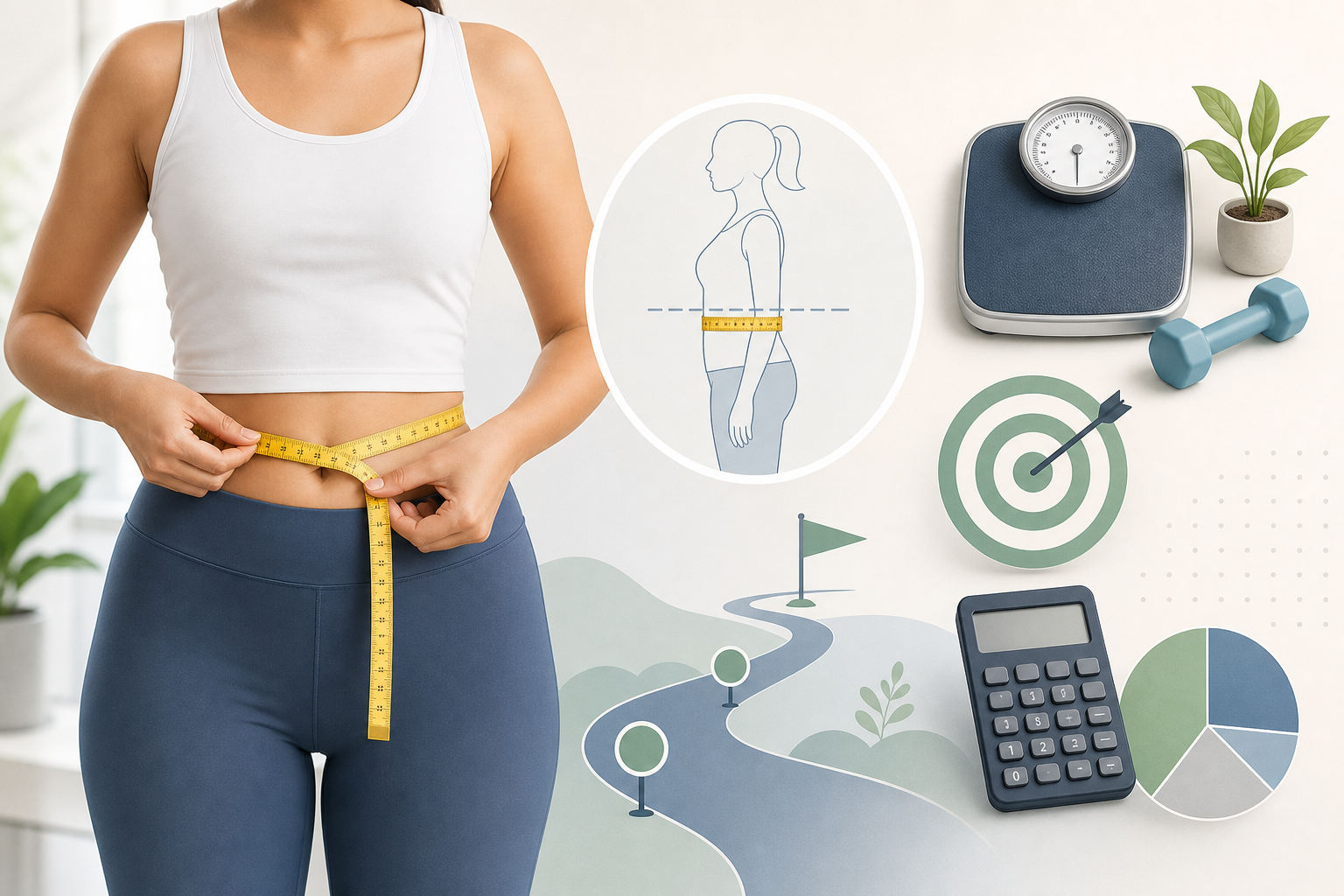
Learning how to measure waist for waist to height ratio starts with a flexible, non-stretch tape and a clearly defined measurement location. Place the tape around your bare abdomen, keep it level and comfortably snug, relax, and record the circumference after a normal breath out. Use the same location and technique each time because even a small change in tape position can alter the calculated ratio.
Waist-to-height ratio compares waist circumference with height. It is an indicator of central body size that may complement other body-size measures, but it is not a diagnosis or a complete assessment of health.
How to measure waist for waist to height ratio step by step
There is more than one recognised protocol for locating the waist. Some protocols use the midpoint between the lowest rib and the top of the hip bone, while others measure at the top of the hip bones or another defined anatomical point. These locations are not always identical, so follow the method specified by the calculator, study or healthcare setting you are using.
If no particular protocol has been specified, choose one clearly identifiable location and apply it consistently. A practical approach is to use the top of the hip bones as your reference point.
- Use a flexible measuring tape that does not stretch. A fabric or fibreglass body-measurement tape is generally easier to position than a rigid tape.
- Remove or lift clothing that covers the measurement area. Measuring over thick clothing can add to the circumference.
- Stand upright with your feet together or comfortably close, your weight distributed evenly and your abdomen relaxed.
- Find the top of your hip bones at the sides of your body. Position the tape horizontally around your abdomen at that level.
- Check the tape in a mirror, or ask another person to check, to make sure it remains parallel to the floor all the way around.
- Keep the tape in contact with the skin without pulling it tightly enough to compress the body.
- Breathe normally. After a normal breath out, read the measurement without deliberately drawing in or pushing out your abdomen.
- Record the value to the nearest practical tape marking, such as the nearest 0.1 cm or quarter inch. Do not report more precision than the tape supports.
Repeat the measurement once or twice after briefly removing and repositioning the tape. If the readings differ noticeably, check the location, tape tension and posture before measuring again. Closely grouped readings are more useful than repeatedly measuring until a preferred number appears.
Why inconsistent tape placement affects the result
The abdomen is not a uniform cylinder. Its circumference can be different at the narrowest point, the navel, the top of the hip bones and the midpoint between the ribs and hips. Moving the tape higher or lower can therefore produce a different waist measurement even when your body has not changed.
Tape angle also matters. If the tape slopes downward at the back or rises at the front, it travels around the body on a longer diagonal path. This can produce a larger reading than a level tape.
Other common sources of variation include:
- measuring over different types or thicknesses of clothing;
- pulling the tape tighter on one occasion than another;
- holding the breath or deliberately tightening the abdomen;
- measuring immediately after a large meal on one occasion but not another;
- using a stretched, twisted or damaged tape;
- rounding one measurement up and another down; and
- switching between centimetres and inches without converting correctly.
If you are comparing measurements over time, try to keep the location, tape, posture and general measuring conditions similar. This does not eliminate all day-to-day variation, but it makes the comparison more meaningful.
Measuring height and calculating the waist height ratio
Height is the second measurement needed for a waist height ratio. Measure without shoes on a firm, level floor. Stand with your back against a vertical wall, look straight ahead, and place a flat object such as a book horizontally on top of your head to mark the wall.
Measure from the floor to the mark. Hair, footwear, carpet and tilted head position can affect the reading. A recent professionally measured height can also be used if it reflects your current height.
The formula is:
Waist-to-height ratio = waist circumference ÷ height
Waist and height must use the same unit. For example, divide centimetres by centimetres or inches by inches. Because the matching units cancel out, the result is unitless.
If the waist measurement is in centimetres and height is in metres, convert one of them before calculating. A height of 1.75 metres is 175 centimetres. Dividing 85 centimetres directly by 1.75 would give an incorrect ratio because the units do not match.
Practical measurement and calculation example
Suppose a person measures at the top of the hip bones and records a waist circumference of 85 cm. Their measured height is 175 cm.
The calculation is:
85 ÷ 175 = 0.486
Rounded to two decimal places, the waist-to-height ratio is about 0.49. The 85 cm waist and 175 cm height are measurement inputs, while 0.49 is the calculated estimate based on those inputs.
Now suppose the tape is placed several centimetres lower during a later measurement and gives a waist reading of 88 cm. With the same height, the calculated ratio would be about 0.50. That difference may reflect tape placement rather than a change in central body size, which is why the measurement protocol should be recorded alongside the result.
What the waist to height ratio calculator can and cannot tell you
The waist to height ratio calculator divides the entered waist circumference by the entered height. It can perform the calculation consistently and reduce arithmetic or unit-conversion mistakes when the required inputs are entered correctly.
The calculator can show:
- the ratio produced by the waist and height values entered;
- how the waist measurement compares numerically with height; and
- supporting information provided with the result.
It cannot verify that the tape was level, that the correct anatomical location was used or that the height was measured accurately. It also cannot determine why a result changed between measurements.
A ratio is a simplified indicator of central body size. It does not directly measure body fat, fat distribution, muscle, fitness, blood pressure or metabolic health. Body-size measures can form part of a broader weight-management or health discussion, but a single ratio should not be treated as a diagnosis.
Frequently asked questions
Should I measure at my navel?
Not automatically. The navel is easy to locate, but it may not match the waist location required by a particular protocol. If previous results were measured at the navel, changing to another location can make comparisons misleading. Record the site you use and keep it consistent.
How tight should the measuring tape be?
The tape should lie flat against the skin without hanging loose or compressing the abdomen. If the tape leaves a deep indentation or changes the body’s shape, it is probably too tight.
Should I hold my breath while measuring?
No. Breathe normally and read the tape after a normal breath out. Avoid taking an unusually deep breath, forcefully exhaling or drawing in your abdomen, as these actions can change the measurement.
Can I measure over clothing?
Bare skin generally provides a more repeatable waist measurement. If that is not practical, use thin clothing and avoid waistbands, belts, pockets or layered fabric. Note that a reading taken over clothing may not be directly comparable with one taken on bare skin.
Why do repeated waist measurements differ?
Differences can result from tape position, tape tension, posture, breathing and normal changes in the abdomen. Remove and reposition the tape rather than simply rereading it in the same position. If repeated values are close, their average may provide a practical estimate, provided all readings used the same protocol.
How often should waist-to-height ratio be checked?
There is no need to check it repeatedly within a short period. Waist measurements can fluctuate and small changes may reflect technique rather than a meaningful difference. When tracking over time, use the same method and allow enough time between measurements for the comparison to be useful.
The central lesson in how to measure waist for waist to height ratio is consistency. A carefully chosen measurement site, level tape, relaxed posture and matching units make the result more repeatable and easier to interpret alongside other relevant information.