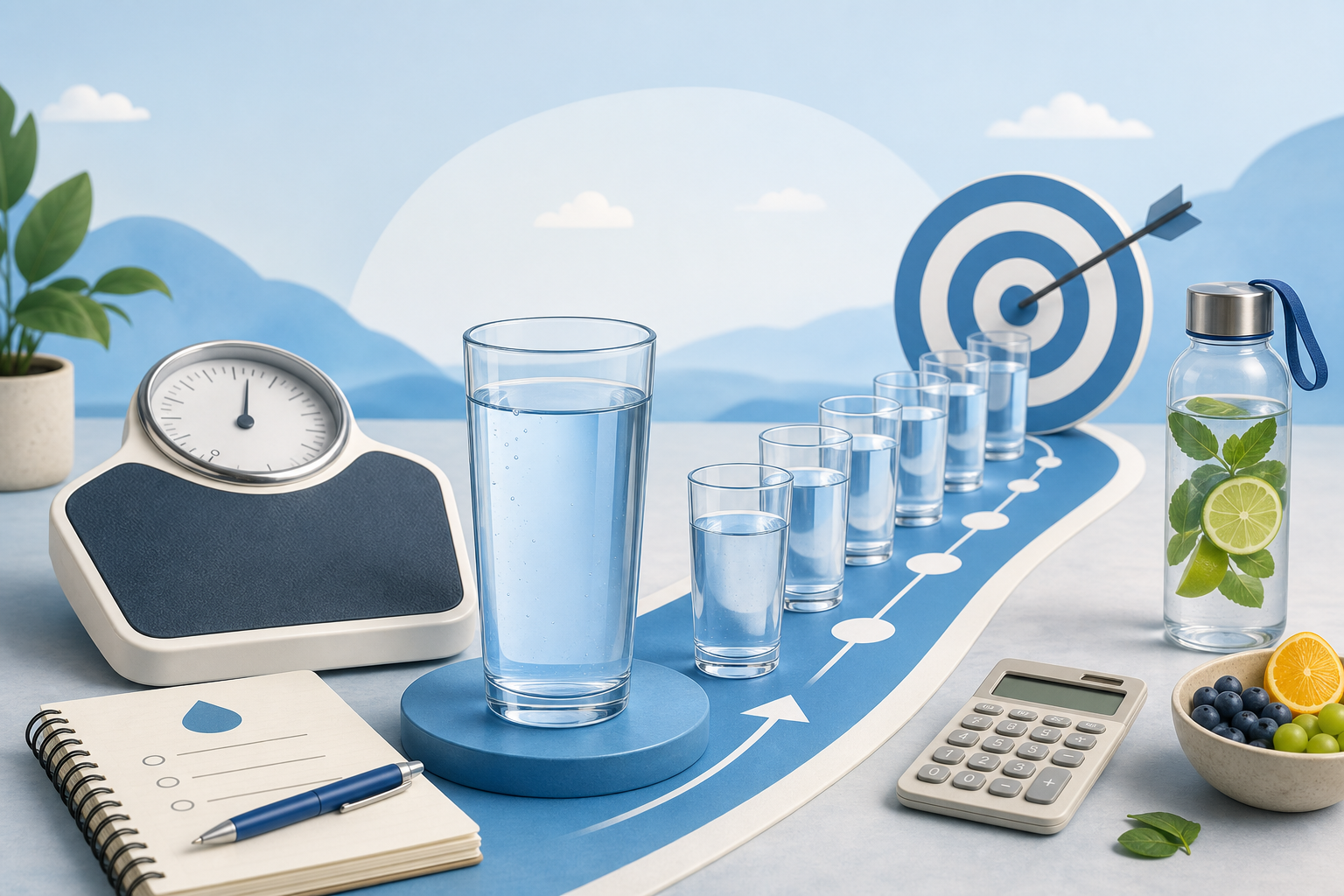
If you are wondering how much water should you drink per day, a general adult reference is about 3.7 litres of total water for men and 2.7 litres for women. These amounts include water from all beverages and the moisture naturally present in food; they are not targets for plain drinking water alone.
These figures are population-level Adequate Intake values from the National Academies, not personalised prescriptions. Your daily water intake can differ substantially with climate, physical activity, diet, pregnancy, breastfeeding, illness and medication use.
How much water should you drink per day?
For generally healthy adults, the reference total-water amounts are:
| Adult reference category | Total water per day | What the amount includes |
|---|---|---|
| Men | Approximately 3.7 litres | Water from beverages and food |
| Women | Approximately 2.7 litres | Water from beverages and food |
These values describe typical population intakes considered adequate. They do not mean every man needs exactly 3.7 litres or every woman needs exactly 2.7 litres each day.
The reference categories are sex-based because that is how the source data are reported. They do not account fully for differences in body size, body composition, activity, environment or individual health circumstances.
What total water intake includes
Total water intake is broader than the amount of plain water you drink. It includes drinking water, other beverages and water contained in foods.
Fruit, vegetables, soups, yoghurt and many cooked foods contain moisture. A diet with plenty of high-moisture foods may provide more water than one based mainly on dry or highly processed foods.
According to the National Academies report, beverages typically provide about four-fifths of total water, with food supplying the remainder. This is an approximate population pattern rather than a fixed rule for every meal or person.
Using that proportion for context, 3.7 litres of total water might correspond to roughly 3.0 litres from beverages, while 2.7 litres might correspond to roughly 2.2 litres from beverages. These are planning estimates, not required drinking amounts.
Why individual water needs vary
No single daily amount can account for every person and situation. Water losses and dietary water sources change from day to day, so an appropriate intake is not necessarily constant.
- Physical activity: Sweating during exercise or physical work can increase fluid losses.
- Climate: Hot conditions may increase sweating, while time at altitude or in very dry environments may also affect hydration planning.
- Diet: The moisture content of food changes how much water needs to come from beverages.
- Pregnancy and breastfeeding: Fluid requirements can differ during these stages.
- Illness: Fever, vomiting or diarrhoea can substantially alter fluid losses.
- Medications: Some medicines affect fluid balance or require specific instructions about fluid intake.
- Personal characteristics: Body size and other individual factors can influence needs.
Because these factors can act together, the reference amount is best treated as a starting point. For example, someone doing outdoor physical work in hot weather may need a different plan from someone spending a cool day indoors, even if both fall into the same reference category.
More water is not automatically better. Drinking substantially beyond your needs, particularly over a short period, can be harmful. People who have been given fluid or dietary instructions for a health condition should follow their individual guidance rather than a general reference estimate.
How to plan daily water intake
A practical hydration plan should consider both beverages and food rather than treating the reference number as a plain-water quota. It can also allow for changing conditions instead of using exactly the same amount every day.
- Start with the adult total-water reference that applies to the calculator category.
- Remember that part of the total normally comes from food.
- Consider whether activity, heat, pregnancy, breastfeeding, illness or medication may change the estimate.
- Spread normal beverage intake through the day rather than treating hydration as a single task.
- Reassess the plan when your routine, environment or health circumstances change.
Thirst can be one useful day-to-day cue, but it does not convert the population reference into an exact personal requirement. Access to fluids, age, health circumstances and activity can affect how useful any single cue is.
A practical planning example
Consider an adult man whose calculator result shows the 3.7-litre total-water reference. He should not interpret this as an instruction to drink 3.7 litres of plain water in addition to tea, other beverages and food.
If roughly four-fifths came from beverages, the contextual beverage estimate would be about 3.0 litres. On a cool, low-activity day, his actual needs may differ from those on a hot day involving prolonged physical work. The calculator cannot measure either day’s fluid losses.
What the water intake calculator can and cannot tell you
The water intake calculator applies the adult sex-based Dietary Reference Intake values. It displays a total-water reference and may show an approximate beverage share to help explain how food contributes to the total.
What it can tell you
- The relevant adult population reference based on the category selected.
- That total water includes beverages and moisture in food.
- An approximate beverage amount for planning context.
- A consistent starting point for thinking about daily hydration.
What it cannot tell you
- Your measured water requirement for a particular day.
- How much fluid you lost through sweating or illness.
- The exact amount of water supplied by your food.
- How pregnancy, breastfeeding, climate, medication or a health condition changes your needs.
- Whether a particular hydration plan is suitable for your medical circumstances.
A hydration calculator produces an estimate from reference data; it does not directly measure hydration status or fluid balance. Its result should therefore be read as a planning benchmark rather than a personalised prescription.
Frequently asked questions
Does coffee or tea count towards daily water intake?
Yes. Water in coffee, tea and other beverages contributes to total water intake. However, a drink can have other nutritional or health considerations, so water content is not the only factor when choosing beverages.
Does water in food really count?
Yes. Moisture in fruit, vegetables, soups, dairy foods and cooked dishes forms part of total water intake. The contribution varies with your food choices, which is one reason a total-water reference cannot be converted into one exact plain-water amount.
Do adults need eight glasses of water every day?
A fixed number of glasses does not account for different glass sizes, food moisture, activity or climate. The National Academies references are expressed as total water from food and beverages, not as a universal number of glasses of plain water.
Should I drink the entire calculator result as plain water?
No. The result represents total water, including moisture from food and all beverages. The approximate beverage share is provided for context, but it is still not an individually measured requirement.
Can children use the adult water intake calculator?
The stated 3.7-litre and 2.7-litre references are adult values. Children and adolescents have age-specific considerations, so an adult result should not be treated as their intake target.
Why might my needs change from one day to another?
Activity, sweating, weather, food choices and health circumstances can vary from day to day. A reference estimate may stay the same while your actual fluid losses and sources of water change.
Putting the estimate in context
When deciding how much water should you drink per day, begin with the adult total-water reference rather than assuming you must drink that entire amount as plain water. Approximately 3.7 litres for men and 2.7 litres for women are useful population benchmarks, but food contributes to both totals.
The most useful interpretation is a range-aware, context-sensitive one: recognise the reference, account for food and beverages, and consider factors that may alter fluid needs. The number from a water intake calculator is an estimate for planning, not a measurement of what your body requires on a particular day.