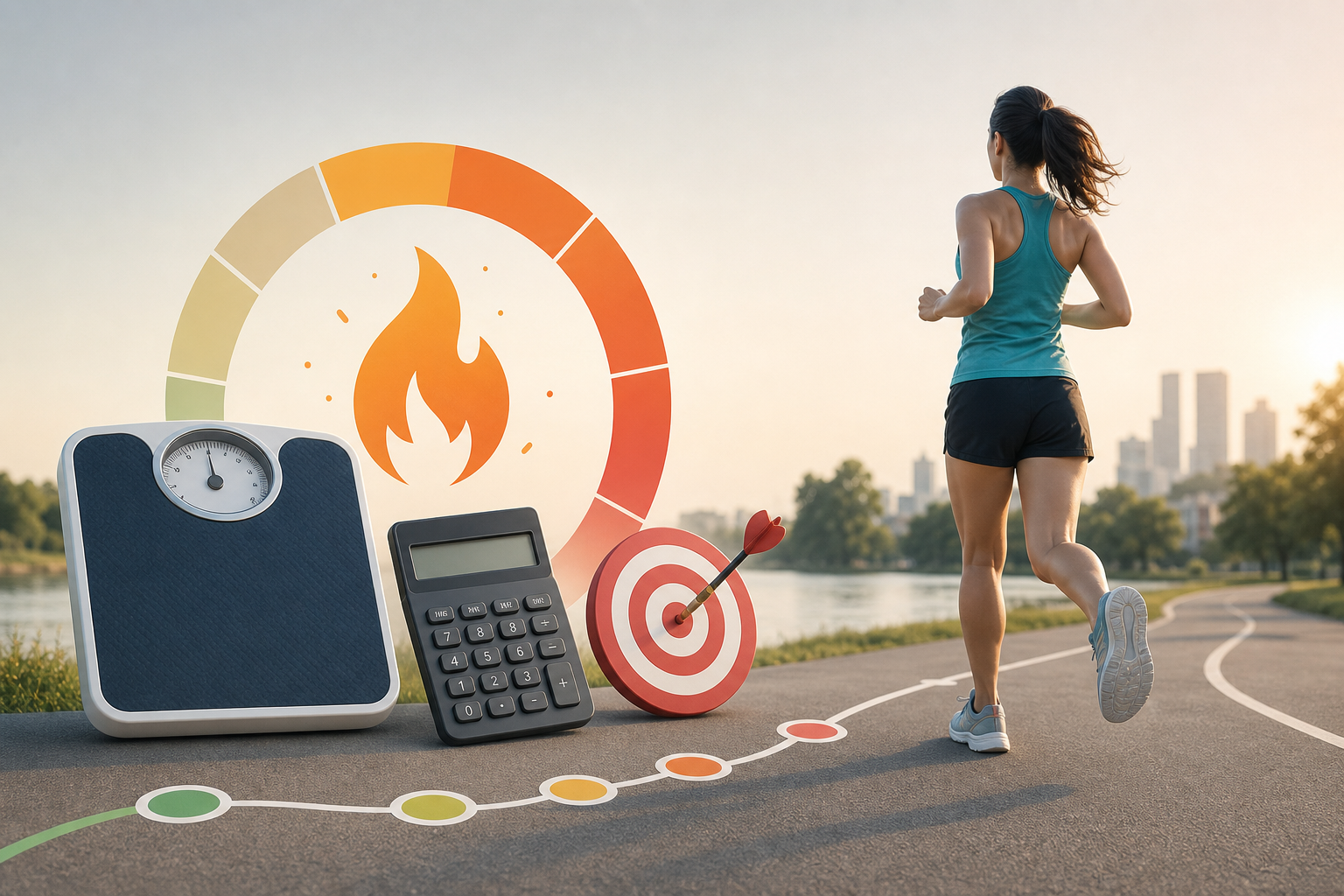
How many calories does running burn? There is no single number: the estimate depends mainly on body weight, running intensity and duration. For example, an 80 kg person running for 30 minutes at an intensity of 8.3 MET uses an estimated 349 kilocalories (kcal). This is a planning estimate rather than a measured result because terrain, wind, fitness and individual running efficiency can change actual energy expenditure.
How many calories does running burn at different intensities?
Running calorie burn generally increases when a person runs for longer, has a higher body weight or runs at a higher intensity. A short, easy run therefore produces a different estimate from a longer or more demanding session.
Running intensity is commonly represented by a metabolic equivalent of task, or MET. A higher MET value indicates a greater estimated energy cost per minute. The 2024 Adult Compendium of Physical Activities provides standardized MET values for different activities and intensities, including running.
MET values make it possible to compare activities consistently, but they are population averages. Two people of the same weight, running at the same pace for the same time, may not use exactly the same amount of energy.
The MET-based formula
A standard equation for estimating calories burned running is:
Estimated kcal = MET × 3.5 × body weight (kg) ÷ 200 × minutes
In this equation, “calories” refers to kilocalories, the unit normally shown on food labels and exercise tools. The calculation scales directly with the MET value, body weight and duration.
What affects running calorie burn?
Body weight
At the same MET value and duration, the equation gives a higher calorie estimate for a person with a higher body weight. This is a mathematical effect of weight being included directly in the formula, not a judgement about fitness or health.
Body composition is not directly included in a basic MET calculation. The calculator uses total body weight because that is the measurement required by the standard equation.
Running intensity
Intensity has a substantial effect on estimated expenditure. Faster or more demanding running is generally assigned a higher MET value than easier running. However, pace is not the only influence: hills, uneven surfaces, wind and running form can make a particular pace feel and function differently.
A pace-based MET selection should therefore be viewed as a practical category. It does not measure the runner’s individual effort or oxygen use.
Duration
Within the equation, calorie expenditure rises in direct proportion to time. If weight and MET intensity stay the same, a 40-minute run produces twice the estimate of a 20-minute run.
This does not mean every minute of a real session has identical intensity. Warm-ups, walking breaks, traffic stops and changes in gradient may reduce or increase the average intensity.
Terrain and environmental conditions
Running uphill may require more effort than running on level ground at the same speed. Wind resistance, soft surfaces and trails can also affect the energy required. A calculator may not capture these differences unless it specifically asks about terrain or gradient.
Treadmill and outdoor estimates can differ because conditions are not identical. Treadmill calibration, incline settings, air resistance and pace variation all introduce uncertainty.
Running economy and fitness
Running economy describes how efficiently a person moves at a given pace. Individual technique, training background and movement patterns can influence actual energy use, even when body weight and speed appear similar.
A standard MET estimate cannot account fully for these personal differences. Measuring energy expenditure more directly requires specialized assessment rather than a general online calculator.
Example running calorie calculation
Consider a person who weighs 80 kg and runs for 30 minutes at an intensity of 8.3 MET.
- Multiply the MET value by 3.5: 8.3 × 3.5 = 29.05.
- Multiply by body weight: 29.05 × 80 = 2,324.
- Divide by 200: 2,324 ÷ 200 = 11.62 kcal per minute.
- Multiply by 30 minutes: 11.62 × 30 = 348.6 kcal.
The resulting estimate is approximately 349 kcal.
The table shows how duration changes the result when body weight and intensity remain fixed:
| Body weight | Intensity | Duration | Estimated expenditure |
|---|---|---|---|
| 80 kg | 8.3 MET | 20 minutes | About 232 kcal |
| 80 kg | 8.3 MET | 30 minutes | About 349 kcal |
| 80 kg | 8.3 MET | 45 minutes | About 523 kcal |
These figures illustrate the formula rather than predict an exact measured result. If the runner changes pace, encounters hills or takes breaks, the session’s average intensity may differ from 8.3 MET.
What the running calories calculator can and cannot tell you
The running calories calculator applies a standardized MET equation to body weight, selected intensity and duration. It is useful for producing a consistent estimate without completing the calculation manually.
What it can estimate
- Approximate calories used during a selected running period.
- How the estimate changes when body weight, intensity or duration changes.
- Differences between running scenarios calculated with the same method.
- A practical figure for activity logs or general exercise planning.
What it cannot measure
- Your exact individual energy expenditure.
- Changes caused by wind, hills, surface conditions or running economy unless those factors are included.
- The precise intensity of a session with frequent pace changes or walking breaks.
- Changes in body weight that may or may not follow from the estimated expenditure.
To use the tool, select the requested unit system, enter body weight and duration, and choose the running intensity that best matches the session. The displayed result should be read as an estimate based on the selected inputs.
Input accuracy matters. Entering elapsed time when the tool expects active running time, or choosing an intensity that does not match the session, can make the result less representative.
How to interpret calories burned running
A calorie estimate is most useful as a comparison tool. For example, it can show how changing a planned run from 20 to 30 minutes affects the result when the other inputs remain constant.
It is less reliable as an exact allowance for food intake. MET estimates do not capture every individual and environmental factor, so treating every estimated exercise calorie as a precisely measured amount can give a false sense of accuracy.
Fitness watches, treadmills and online tools may display different results for the same run. They can use different activity classifications, personal data, heart-rate information or proprietary equations. Some may report total energy used during the period, while others emphasize “active” calories above resting expenditure.
Consistency helps when comparing sessions. Using the same method and similar input choices makes changes in the estimate easier to interpret, even though the absolute number remains approximate.
Frequently asked questions
Does running faster always burn more calories?
A higher running intensity usually has a higher MET value and therefore produces a higher estimate per minute. However, a faster run may be shorter, so total expenditure still depends on both intensity and duration.
Why does body weight change the estimate?
Body weight is a direct part of the MET formula. At the same MET intensity and duration, increasing the entered weight increases the calculated result proportionally. The equation does not separately assess body composition or movement efficiency.
Should walking breaks be included in running time?
If a session contains substantial walking, using one running MET value for the entire elapsed time may overstate the average intensity. A more representative approach is to calculate running and walking periods separately when suitable activity options are available.
Why is my treadmill or watch result different?
Devices and calculators may use different formulas and data. A watch might include heart rate and personal profile information, while a treadmill may rely mainly on speed, incline and entered weight. None of these methods should automatically be treated as an exact laboratory measurement.
Can running calorie estimates predict weight change?
Not by themselves. A running estimate describes one component of energy expenditure, while body weight can be influenced by overall energy intake and expenditure, fluid balance and other individual factors. The result is better used as an activity estimate than as a prediction of a specific weight outcome.
Putting the estimate in context
When asking how many calories does running burn, the most accurate general answer is that it varies with body weight, intensity, duration and the conditions of the run. MET-based calculations provide a standardized way to estimate the amount, but they do not directly measure an individual runner’s energy use.
Use the result as an approximate comparison between sessions or planning scenarios. Changes in terrain, pace, wind, running economy and fitness mean actual running calorie burn may be higher or lower than the calculated figure.