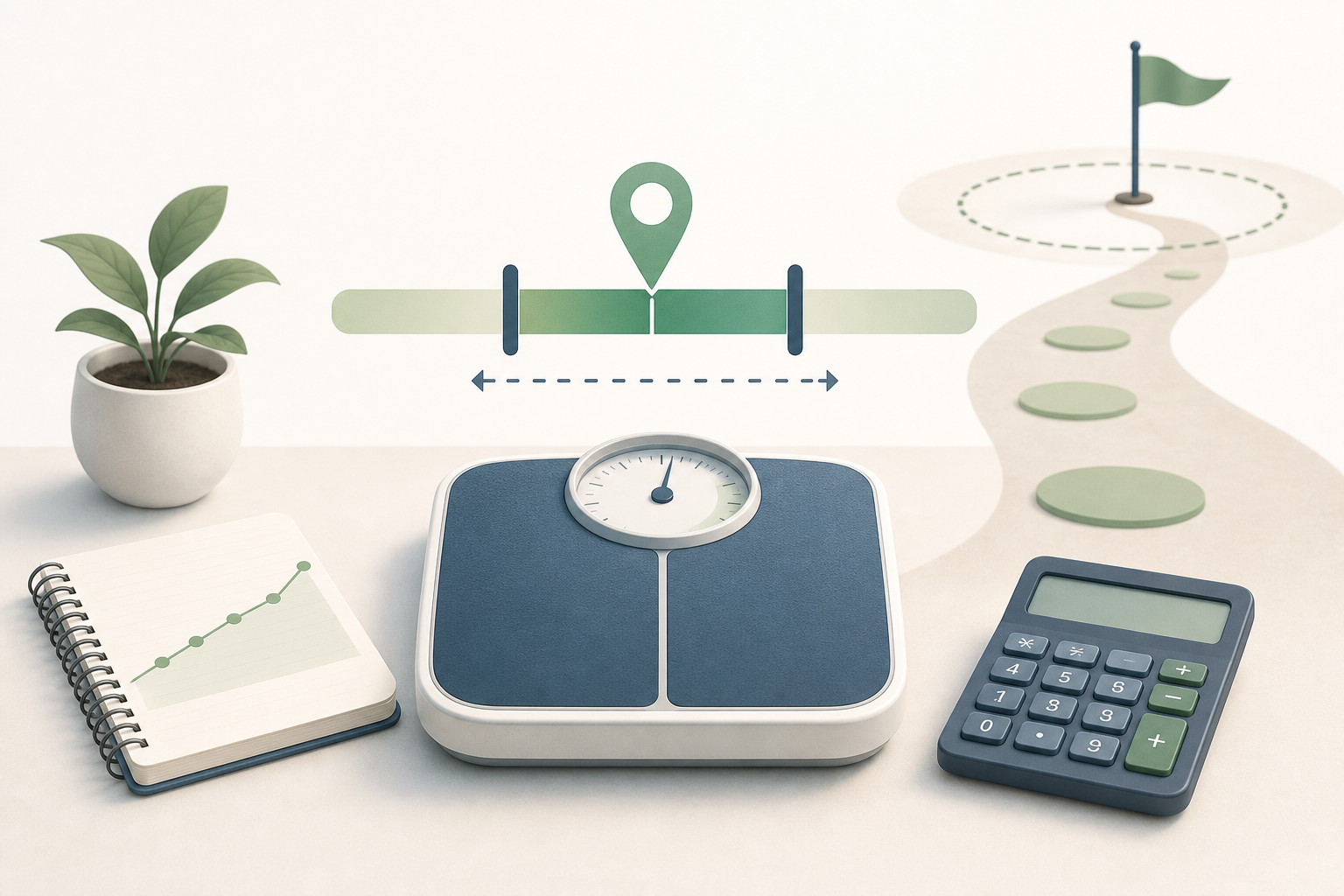
For many people, a goal weight range is more practical than one exact number. A range allows for ordinary changes in body weight while still giving you a clear direction. A single target weight can also be useful, especially as a planning reference, but it does not need to become a rigid pass-or-fail threshold.
- Why a goal weight range can be more useful than one number
- When a single target weight may still help
- How to create a flexible goal weight range
- Choose a reference method
- Decide whether the estimate is a midpoint or a boundary
- Set boundaries that match your purpose
- Review the range when circumstances change
- Staged goals can make a distant target easier to evaluate
- What the goal weight calculator can and cannot tell you
- A practical way to combine a target, range and stages
- Frequently asked questions
- Is a goal weight range always better than a single target?
- How wide should my range be?
- Does reaching a calculated target mean it is the right weight for me?
- Can I use two BMI values to estimate a healthy weight range?
- Should I change my target if my circumstances change?
- Should I track daily weight or only my range?
- Choosing the format that fits your plan
The best format depends on how you prefer to plan, what you want to track and whether body weight is the most relevant measure for your priorities. You can also combine both approaches: use one estimated target weight as a midpoint and a flexible range for ongoing tracking.
Why a goal weight range can be more useful than one number
Body weight is not perfectly stable. Measurements can vary with hydration, food and drink intake, clothing, time of day and other short-term factors. As a result, reaching an exact number on one occasion may be less informative than seeing whether your general pattern sits within a range you have chosen.
A range may offer several practical advantages:
- It accommodates normal variation. Small changes do not automatically mean that your overall direction has changed.
- It reduces false precision. A calculated target may look exact, but it remains an estimate based on the information and method used.
- It supports longer-term tracking. A range can be easier to use when your aim is to maintain a broadly stable pattern.
- It can reflect different priorities. Comfort, strength, mobility, health considerations and daily routines may matter alongside scale weight.
A range should still be deliberate rather than arbitrary. Its boundaries can be based on a chosen planning method, previous experience and, where relevant, guidance from a qualified health professional.
When a single target weight may still help
One target weight provides a simple reference point. It may be useful when comparing estimates, setting an initial planning marker or working with a calculator that returns one result.
The main limitation is that a single value can appear more precise than it really is. For example, a calculated result of 68.9 kg does not establish that 68.9 kg is uniquely appropriate or meaningfully different from a nearby measurement.
A single target may work well if you treat it as:
- a planning estimate rather than a required outcome;
- the midpoint of a broader range;
- one milestone within a staged plan; or
- one measure to consider alongside non-weight indicators.
If an exact number creates unhelpful pressure, a range or staged approach may provide clearer context. Conversely, if one number makes planning easier, you can use it without assuming that every short-term measurement must match it.
How to create a flexible goal weight range
There is no universal range width that suits everyone. Rather than applying an unsupported standard margin, start by deciding what the range is meant to represent.
Choose a reference method
You might begin with a target weight estimated from height and a selected BMI, a weight previously discussed with a healthcare professional, or another personally relevant planning value. Record how you selected it so that you can interpret it later.
Decide whether the estimate is a midpoint or a boundary
A calculator result can serve as the centre of your range, but it does not have to. Depending on your purpose, it could instead be an upper boundary, a lower boundary or simply a comparison point.
Set boundaries that match your purpose
A range intended for initial planning may differ from one used for longer-term weight maintenance. The boundaries should be wide enough to recognise ordinary variability but specific enough to remain useful for you.
Review the range when circumstances change
A target selected months or years earlier may no longer fit your priorities, routines or health context. Revising a range is not the same as abandoning a plan; it is an opportunity to check whether the original assumptions remain relevant.
Staged goals can make a distant target easier to evaluate
A staged goal divides the space between your current measured weight and a longer-term target into smaller planning checkpoints. These checkpoints do not have to follow fixed intervals or deadlines.
At each stage, you can review more than the scale. Depending on your priorities, useful observations might include how sustainable your routine feels, whether clothing fits differently, how consistently you can follow your plan, or whether the original target remains appropriate.
For example, suppose someone records a current weight and has a lower long-term target in mind. Instead of treating that final value as the only successful result, they could identify an initial checkpoint and reassess after reaching or approaching it. They might continue, maintain the new level for a period, or revise the longer-term plan based on current circumstances.
This approach avoids assuming that a target selected at the beginning must remain unchanged. It also separates progress tracking from the idea that only the final number counts.
What the goal weight calculator can and cannot tell you
The goal weight calculator converts a BMI value that you choose into a corresponding weight for your height. It uses the following relationship:
Goal weight = target BMI × height² in metres
For example, at a height of 1.75 m and a selected target BMI of 22.5, the corresponding estimated weight is about 68.9 kg. This is a mathematical conversion, not a personalised recommendation that the individual should weigh 68.9 kg.
The calculator can help you:
- translate a selected target BMI into a weight estimate;
- compare the weights associated with different chosen BMI values;
- create a reference point for a target weight or range; and
- document the assumptions behind a planning estimate.
It cannot determine your medically appropriate target, assess your body composition or account for your health history, muscle mass and personal priorities. BMI is a screening measure based on height and weight; it is not a direct measurement of body fat or an individual diagnosis. The CDC advises that adult BMI should be considered alongside other health information.
The result is calculated, while the weight shown on your scale is measured. Both can still involve limitations: a calculation depends on its formula and chosen inputs, while a scale reading can be affected by measurement conditions.
A practical way to combine a target, range and stages
Consider an adult who wants a structured plan but does not want progress to depend on one exact scale reading. They use the calculator to convert a chosen BMI into an estimated target weight and keep a record of the height and BMI entered.
Rather than treating the result as a required endpoint, they use it as a reference near the centre of a broader range. They then select an earlier checkpoint between their current measured weight and that reference.
The planning process might look like this:
- Record current weight under reasonably consistent measurement conditions.
- Choose a BMI value for calculation, understanding that the choice is not medical advice.
- Calculate the corresponding weight and label it as an estimate.
- Decide whether that estimate will be a midpoint, boundary or comparison point.
- Create one initial stage rather than focusing only on the longer-term target.
- Review the plan using weight trends, personal priorities and relevant professional guidance.
This structure preserves the clarity of a numerical target without giving one measurement more significance than it can support. It also allows the plan to change when new information becomes available.
Frequently asked questions
Is a goal weight range always better than a single target?
No. A range offers flexibility, while one number offers simplicity. Some people use a single value for calculations and a range for everyday tracking, allowing both formats to serve different purposes.
How wide should my range be?
There is no single width that is appropriate for everyone. Consider why you are creating the range, the amount of short-term variation you commonly observe and whether your target has been discussed with a qualified health professional.
Does reaching a calculated target mean it is the right weight for me?
Not necessarily. A calculated target reflects the formula and inputs used. It does not evaluate body composition, medical history, symptoms, lifestyle or personal priorities.
Can I use two BMI values to estimate a healthy weight range?
You can convert two selected BMI values into two corresponding weights and use them as reference boundaries. However, the resulting interval remains BMI-based and should not be treated as an individual medical assessment. CDC BMI categories are screening categories rather than personalised targets.
Should I change my target if my circumstances change?
You can review it. Changes in health, activity, priorities or professional advice may alter how useful an earlier target is. A target is a planning tool, not an obligation to preserve a decision indefinitely.
Should I track daily weight or only my range?
The preferred tracking frequency varies. If you weigh regularly, looking at the pattern over time may provide more context than reacting to each individual measurement. Use reasonably consistent measurement conditions when possible.
Choosing the format that fits your plan
One target weight can provide a clear calculation point, while a goal weight range can better reflect ordinary variation and uncertainty. Staged goals add another layer by creating opportunities to review the plan before reaching a distant endpoint.
Whichever format you choose, keep calculated estimates separate from measured values and record the assumptions behind them. A target is most useful when it supports informed planning rather than acting as a rigid test of success.