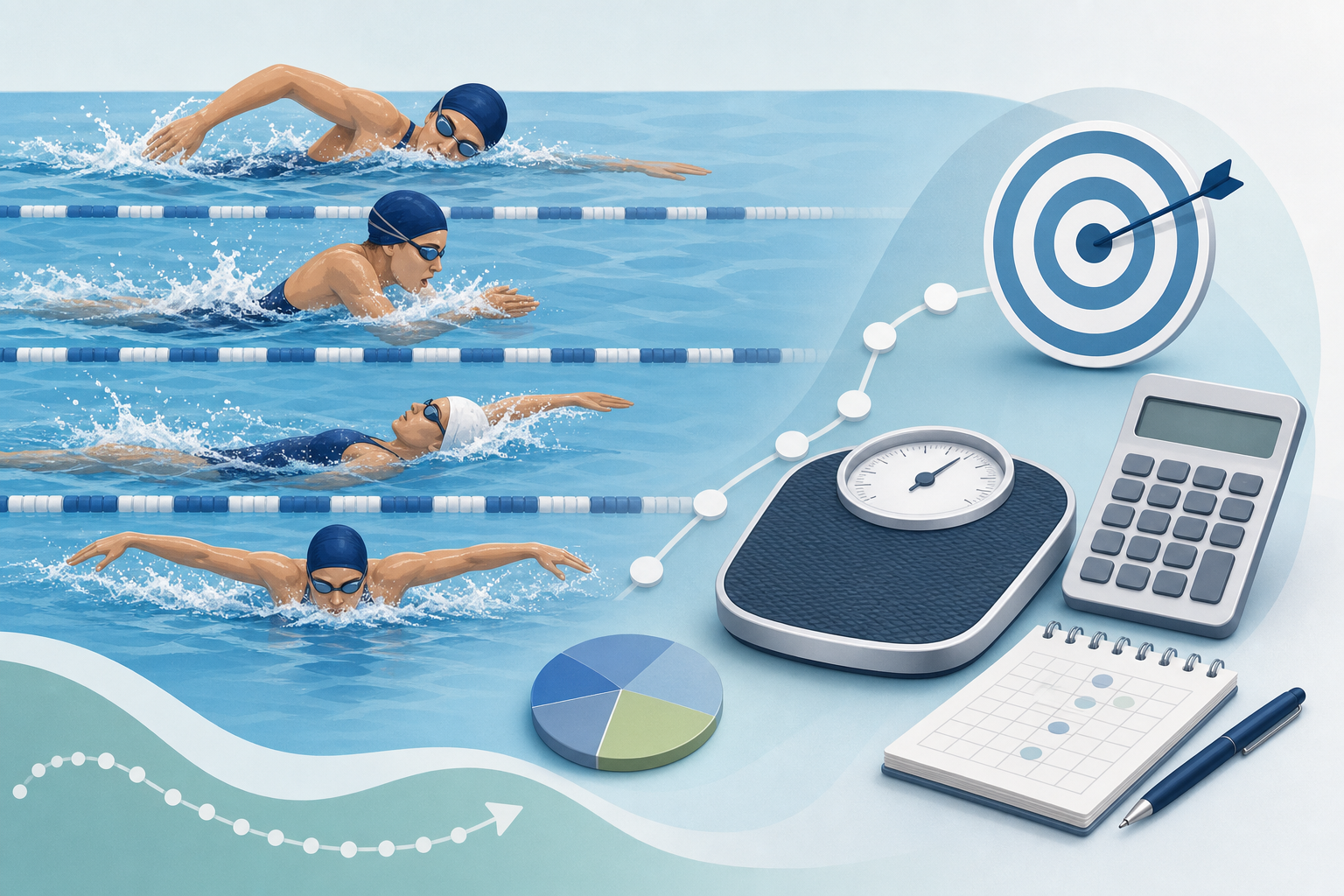
The short answer to “do different swimming strokes burn different calories?” is yes. Stroke style can change the amount of muscular work, body position, drag and breathing pattern involved, while pace and technique influence how demanding the swim is. As a result, swimming activities may be assigned different metabolic equivalent (MET) values and produce different calorie estimates.
- Why do different swimming strokes burn different calories?
- Effort level may matter as much as stroke style
- How MET values produce swimming calorie estimates
- A practical swimming calorie calculation
- Mixed-stroke session example
- What a swimming calories calculator can and cannot tell you
- What the calculator can show
- What the calculator cannot measure
- Other factors that influence calories burned swimming
- Frequently asked questions
- Which swimming stroke uses the most calories?
- Does swimming faster always increase the calorie estimate?
- Should rest time be included in swimming duration?
- Can I calculate a session that uses several strokes?
- Why does my wearable show a different result?
- Are swimming calorie estimates suitable for comparing workouts?
However, the stroke name alone does not determine energy use. A relaxed front crawl with frequent rests may use less energy than a continuous, forceful breaststroke session. Body weight, duration, swimming efficiency and water conditions also affect estimated calories burned swimming.
Why do different swimming strokes burn different calories?
Each stroke creates a different movement pattern. Front crawl, breaststroke, backstroke and butterfly use the arms, legs and trunk in different ways, and each presents distinct technical demands.
Several features can affect the energy required:
- Propulsion: The amount and timing of force generated by the arms and legs vary by stroke.
- Water resistance: Body position and technique affect drag. More drag generally means more work is needed to maintain a given speed.
- Coordination: Some strokes require complex timing between the kick, pull and breathing cycle.
- Breathing pattern: Restricted or timed breathing can influence perceived effort and pacing.
- Continuous movement: Some swimmers glide or pause more during one stroke than another.
These differences help explain why activity references such as the 2024 Adult Compendium of Physical Activities distinguish swimming by factors including stroke and intensity. The listed MET values are standardised estimates for categories of activity, not measurements of what every individual swimmer uses.
Effort level may matter as much as stroke style
A stroke can be performed at an easy, moderate or vigorous effort. Increasing speed usually requires more force and may raise the MET value used for an estimate. This means there is no single calorie figure that applies to every session of front crawl, breaststroke or another stroke.
Consider two people using the same stroke for 30 minutes. One swims continuously at a demanding pace, while the other alternates easy lengths with long rests. Their session duration is the same, but their active effort and average energy expenditure may be quite different.
Technique also complicates comparisons. An experienced swimmer may travel faster while using smooth, economical movements. A less efficient swimmer might expend substantial effort at a slower speed because poor alignment or timing creates additional resistance.
This does not mean inefficient technique is a useful way to increase swimming calorie burn. It simply means pace does not reveal the full energy cost, especially when comparing swimmers with different skill levels.
How MET values produce swimming calorie estimates
A MET is a standard way to express the energy cost of an activity relative to resting energy expenditure. In calculator-based estimates, a higher MET value produces a higher calorie result when body weight and duration remain unchanged.
A commonly used calculation is:
Estimated kcal = MET × 3.5 × body weight (kg) ÷ 200 × minutes
The calculation has three main inputs:
- MET value: Represents the selected swimming activity and effort category.
- Body weight: A higher body weight produces a higher estimate within this formula.
- Duration: More minutes produce a proportionally larger estimate when the MET remains constant.
The formula treats the selected MET as if it applies across the stated duration. In practice, a swimming session may include easy lengths, harder intervals, time at the wall and changes of stroke. The result should therefore be read as an estimate based on the option selected, not as a directly measured value.
A practical swimming calorie calculation
Suppose a person weighs 70 kg and swims for 30 minutes at an activity level represented by 6 MET. The estimate is calculated as follows:
6 × 3.5 × 70 ÷ 200 × 30 = approximately 221 kcal
This example does not mean that every 30-minute swim uses 221 kcal. It applies only to the stated body weight, duration and assumed 6-MET intensity. Selecting a different stroke or effort category may change the MET value and therefore the estimate.
For an illustrative comparison, if two sessions have different MET values but the same body weight and duration, the session with the higher MET will produce the higher calculator result. That mathematical difference reflects the activity categories chosen; it does not prove that an individual’s measured energy use differed by exactly the same amount.
Mixed-stroke session example
A swimmer might spend 10 minutes warming up gently, 15 minutes completing harder front-crawl intervals and 5 minutes swimming easy backstroke. Entering the entire 30 minutes as vigorous front crawl would likely overstate the session’s average demand because it ignores the easier periods.
A more representative approach is to estimate each segment separately when the calculator provides suitable options, then add the results. If that is not practical, selecting the category that most closely reflects the average effort is reasonable, provided the final number is treated cautiously.
What a swimming calories calculator can and cannot tell you
A swimming calories calculator estimates energy use from body weight, selected effort or swimming category, and duration. It is useful for comparing similar planned sessions and seeing how changes in time or intensity affect the formula.
What the calculator can show
- An estimated calorie total for the entered body weight and duration.
- How the estimate changes when a different stroke or effort option has a different MET value.
- The effect of extending or shortening a session within the same activity category.
- A consistent method for comparing planned swimming sessions.
What the calculator cannot measure
- Your individual stroke efficiency or technical skill.
- The exact proportion of active swimming and rest time unless entered separately.
- Changes in pace from one length or interval to another.
- The effects of current, waves, water temperature or additional equipment unless the tool specifically includes them.
- Your directly measured energy expenditure.
The displayed result is not equivalent to a laboratory measurement. Even wearable devices provide estimates and may interpret swimming movement differently. A calculator is best viewed as a structured planning tool rather than a precise account of energy used.
Other factors that influence calories burned swimming
Stroke and pace are important, but several other details can widen the difference between a standard MET estimate and actual expenditure.
- Rest intervals: A 45-minute pool visit is not necessarily 45 minutes of continuous swimming. Time spent resting at the wall lowers the session’s average demand.
- Pool versus open water: Currents, waves, navigation and changing conditions can alter effort in open water.
- Push-offs and turns: Strong wall push-offs may increase speed without requiring the same continuous stroking effort as swimming the entire distance without walls.
- Training equipment: Fins, paddles, kickboards and pull buoys change propulsion, resistance and the muscles emphasised.
- Swimming skill: Streamlined body position and coordinated movements can reduce unnecessary drag.
- Session structure: Intervals, drills, recovery lengths and technique work may have very different intensities within one workout.
- Body size: Body weight is part of the standard formula, but the formula cannot fully represent individual body composition or movement economy.
Because these factors interact, swimming calorie burn should not be inferred from distance alone. Two people may cover the same distance in the same time while using different techniques, rest patterns and levels of effort.
Frequently asked questions
Which swimming stroke uses the most calories?
There is no universal answer for every swimmer. A demanding stroke performed continuously may receive a higher MET value than an easy activity category, but actual expenditure depends on effort, technique, body weight, duration and rest. Comparing clearly defined stroke-and-intensity categories is more useful than ranking stroke names by themselves.
Does swimming faster always increase the calorie estimate?
A faster category will generally have a higher MET value in a MET-based model, which raises the estimate. Individual results may not follow the calculator perfectly because speed, efficiency, water conditions and rest periods vary.
Should rest time be included in swimming duration?
Use active swimming time when the selected MET describes continuous swimming. If the session contains substantial rest, either exclude that time or estimate active and resting segments separately. Counting long breaks as vigorous swimming can overstate the result.
Can I calculate a session that uses several strokes?
Yes. If possible, divide the session by stroke or effort level, calculate each segment and add the estimates. Otherwise, choose the option that best represents the overall average intensity and recognise that the result will be less specific.
Why does my wearable show a different result?
A wearable may use motion sensors, heart-rate information and its own proprietary calculation, while a swimming calories calculator generally applies a standard MET formula. Neither figure should automatically be treated as an exact measurement, and differences are expected when the methods and inputs are not the same.
Are swimming calorie estimates suitable for comparing workouts?
They can support broad comparisons when the same method and consistent inputs are used. For example, they can show the formula-based difference between 20 and 40 minutes at the same selected intensity. Comparisons become less reliable when stroke, effort, rest patterns or water conditions change substantially.
In summary, the answer to “do different swimming strokes burn different calories?” is generally yes because stroke and effort categories can carry different MET values. The most useful estimate considers not only the named stroke, but also active duration, pace, rest intervals, body weight and how closely the selected category matches the actual session.