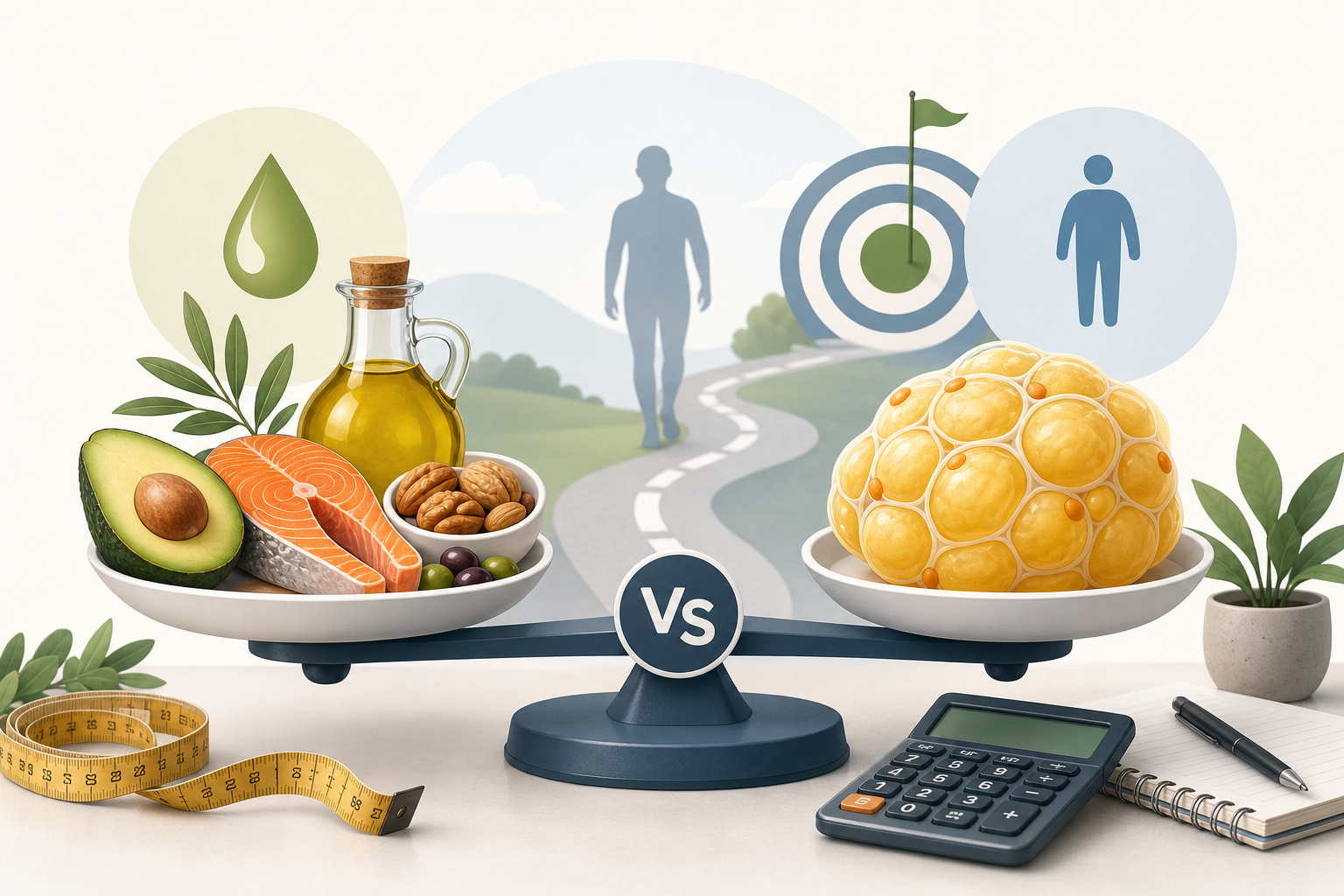
Understanding dietary fat vs body fat starts with a simple distinction: dietary fat is a nutrient found in food, while body fat is tissue in which the body stores energy. Eating fat does not automatically cause an equivalent amount of fat to appear on the body. Changes in stored body fat reflect energy intake, energy use and biological factors over time—not the presence of one nutrient in a single meal.
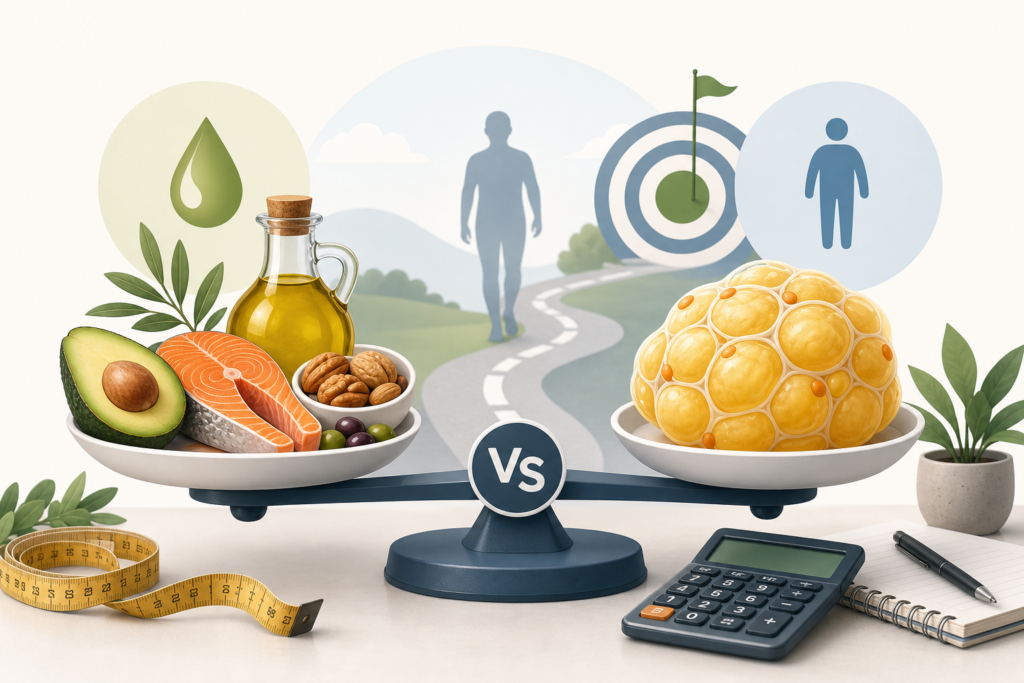
Dietary fat vs body fat: the essential difference
Dietary fat is one of the three main energy-providing macronutrients, alongside carbohydrate and protein. It supplies fatty acids, helps with the absorption of fat-soluble vitamins and contributes to the structure and function of cells. The National Academies includes fat within its Dietary Reference Intake framework for macronutrients.
Body fat, also called adipose tissue, is part of the body. It stores energy and has other physiological roles. The amount and distribution of body fat vary among people and can change over time.
- Dietary fat is measured as part of food intake, usually in grams.
- Body fat is stored tissue, often discussed as body-fat mass or body-fat percentage.
- Dietary fat can contribute energy that is used immediately or stored.
- Body-fat change depends on overall energy balance over time, not dietary fat alone.
The shared word “fat” can make these concepts sound interchangeable, but they describe different things. One is a nutrient entering the body through food; the other is tissue already present in the body.
What happens to dietary fat after you eat it?
During digestion, dietary fat is broken down into components that can be absorbed. The body can then use these components for energy and for essential structural and physiological functions.
If the body does not need all available energy at that time, some energy may be stored for later use. Dietary fat can be stored in adipose tissue, but that does not mean every gram eaten becomes a gram of body fat. Food is digested and metabolised, while the body is continually using and storing energy throughout the day.
Carbohydrate and protein also provide energy. Their metabolic pathways differ, but total energy intake from all macronutrients can affect longer-term energy storage. For this reason, focusing only on dietary fat may give an incomplete picture of body-fat change.
Why eating fat does not directly determine body-fat gain
Dietary fat provides 9 kilocalories per gram, making it more energy-dense than carbohydrate or protein. This matters when estimating the energy supplied by a meal or planning fat grams per day, but energy density alone does not determine how an individual’s body weight or body composition will change.
Over time, stored energy may increase when total energy intake consistently exceeds total energy use. Stored energy may decrease when the body uses more energy than it receives. These are simplified descriptions: real-world changes can also be influenced by appetite, activity, food availability, digestion, health, medication, sleep and individual biology.
A high-fat food can fit within a person’s calorie target, just as a low-fat food can contribute to an energy intake above that target. Portion size, eating pattern and the rest of the diet all matter.
A practical meal example
Consider two meals that each provide 600 kcal. One obtains a larger share of its calories from fat, while the other obtains more from carbohydrate. Their macronutrient profiles differ, but their stated energy content is the same.
The higher-fat meal does not automatically produce more body fat from that single eating occasion. Its longer-term relevance depends on how it fits into total intake, energy use and the broader dietary pattern. It may also differ from the other meal in fibre, protein, vitamins, minerals, food volume and types of fat—details that a calorie total alone cannot show.
How a fat intake calculator estimates fat grams per day
A fat intake calculator converts a calorie target and a selected percentage of calories from fat into an estimated daily gram amount. It uses the fact that each gram of dietary fat provides approximately 9 kcal.
The calculation is:
Fat grams = calories × fat percentage ÷ 9
For example, suppose a person is planning around 2,000 kcal per day and chooses to obtain 30% of those calories from fat:
- Convert 30% to 0.30.
- Multiply 2,000 kcal by 0.30 to get 600 kcal from fat.
- Divide 600 by 9 to get approximately 66.7 grams.
The resulting estimate is about 67 grams of fat per day. This is a mathematical allocation, not a measured biological requirement and not a prediction of body-fat change.
What the calculator can tell you
- The number of fat grams corresponding to a chosen calorie level and fat percentage.
- How changing the selected percentage changes the estimated gram target.
- A practical number for meal planning or reviewing a food log.
What the calculator cannot tell you
- Whether the calorie target is appropriate for a particular person.
- How much body fat a person has or how it may change.
- Whether the overall diet provides enough fibre, protein, vitamins or minerals.
- What proportion of intake comes from saturated, monounsaturated, polyunsaturated or trans fat.
- Whether particular foods or dietary patterns suit an individual’s health needs.
The result is only as relevant as the values entered. If the calorie target or chosen percentage is not suitable, the calculated fat amount will not correct that underlying assumption.
Dietary fat quality matters as well as quantity
A gram target describes quantity, but foods containing the same number of fat grams are not necessarily nutritionally equivalent. They may contain different fatty acids and differ substantially in protein, fibre, sodium, vitamins, minerals and degree of processing.
Dietary fat occurs in foods such as nuts, seeds, vegetable oils, fish, dairy products, eggs, meat and many prepared foods. These foods make different contributions to the overall diet. Reviewing dietary fat therefore involves more than staying below or reaching a single gram number.
The National Academies’ macronutrient reference framework recognises dietary fat as part of an overall dietary pattern rather than treating it as an isolated substance. A calculator can support numerical planning, but it cannot assess food quality or the balance of the complete diet.
Frequently asked questions
Does eating dietary fat immediately turn into body fat?
No. Dietary fat must first be digested, absorbed and metabolised. Some may be used for energy or physiological functions, and some may be stored. Net changes in body fat reflect energy storage and use over time rather than an automatic one-for-one conversion after a meal.
Can body fat increase on a low-fat diet?
It can. A low-fat label describes only one aspect of a diet or food. If overall energy intake repeatedly exceeds energy use, the body can store excess energy even when the proportion of calories from fat is relatively low.
Can someone eat dietary fat while trying to manage weight?
Yes. Dietary fat is a normal macronutrient and can be included in many eating patterns. The amount that fits depends on the person’s total calorie plan, preferred macronutrient distribution, food choices and individual needs.
Is the fat intake calculator measuring how much fat my body needs?
No. It performs a conversion based on the calorie target and percentage entered. It does not directly measure a person’s nutritional requirements, absorption, metabolism or body composition.
Are fat grams on a food label the same as body-fat grams?
No. A food label reports the amount of dietary fat in a serving. Body-fat mass is tissue in the body and is not calculated by adding together the fat grams shown on food labels.
Will a specific number of fat grams per day change body-fat percentage?
A fat-gram estimate cannot predict that outcome. Body-fat percentage may be affected by changes in both fat mass and lean mass, while estimates from scales and other devices can also vary with the measurement method and conditions.
The practical takeaway
The key distinction in dietary fat vs body fat is that dietary fat is a macronutrient, whereas body fat is stored tissue. Dietary fat supplies energy and supports essential functions, but eating it does not by itself determine how much body fat a person has.
A fat intake calculator is useful for converting a chosen calorie percentage into fat grams per day. Its result should be understood as a planning estimate, not a body-composition measurement, diet-quality assessment or forecast of weight change.