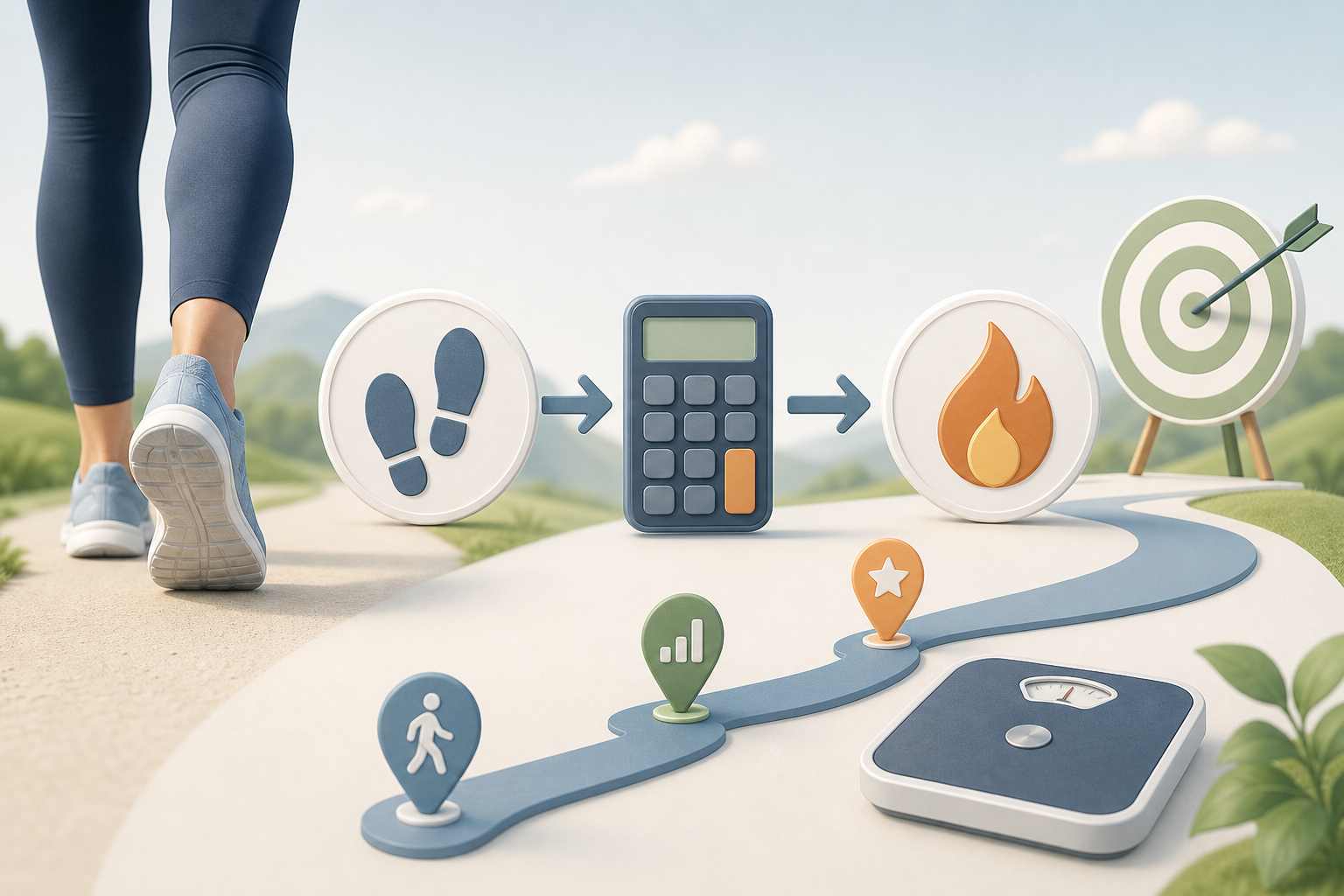
To convert steps to calories, first estimate how far those steps covered, use walking pace to estimate duration, and then combine duration with body weight and a suitable walking MET value. The result is an approximation rather than a direct measurement because step length, pace and step-count accuracy vary. A steps to calories calculator performs this sequence automatically.
How to convert steps to calories step by step
A step count does not have one fixed calorie value. Two people can record the same number of steps but cover different distances, walk at different speeds and use different estimated amounts of energy.
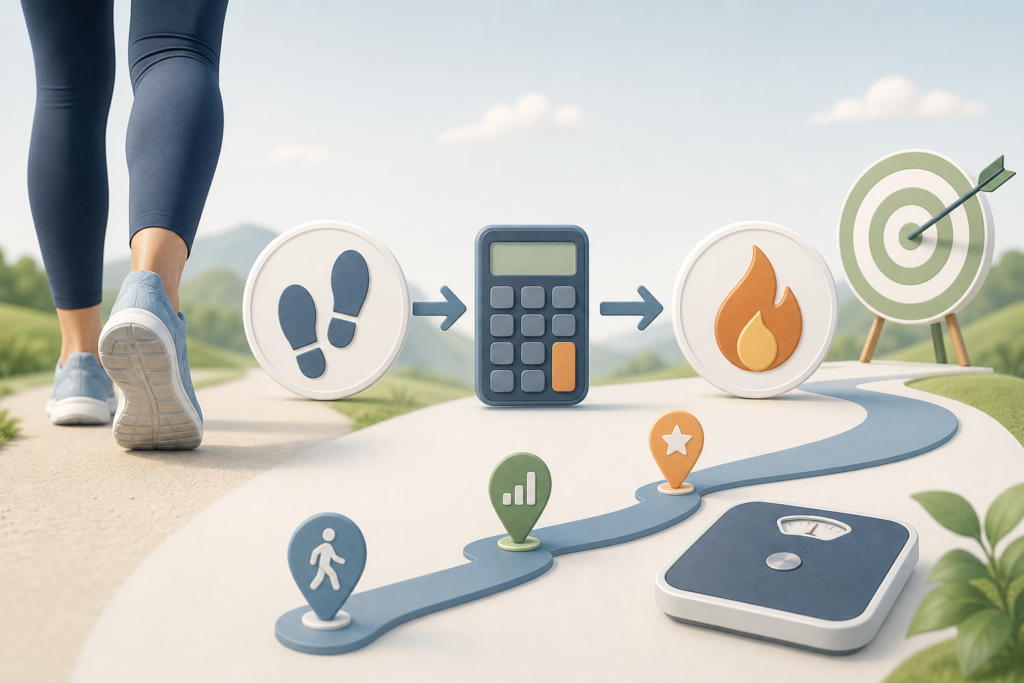
The calculation usually follows this sequence:
- Estimate step length from height or another available body measurement.
- Multiply step count by estimated step length to calculate distance.
- Use distance and walking pace to estimate how long the walk lasted.
- Select a walking MET value that corresponds to the pace.
- Combine the MET value, duration and body weight to estimate calories burned.
This approach is more informative than multiplying every step by a universal calorie factor. However, it remains less precise than using a measured distance and duration because each stage introduces some uncertainty.
The formulas behind a steps-to-calories estimate
1. Estimate walking distance
The first stage converts step count into distance:
Distance = number of steps × estimated step length
For example, if the estimated step length is 0.75 metres, 10,000 steps would correspond to 7,500 metres, or 7.5 kilometres. This does not mean every person taking 10,000 steps walks 7.5 kilometres; it is the result of the assumed step length.
Step length may be estimated from height, but actual step length is also affected by walking speed, terrain, mobility and individual gait. Measured distance from a known route or a well-calibrated device may therefore differ from a height-based estimate.
2. Estimate walking duration
If pace is entered as speed, estimated duration can be calculated as:
Duration = distance ÷ speed
A distance of 7.5 kilometres at 5 kilometres per hour would take approximately 1.5 hours, or 90 minutes. If pace is expressed as minutes per kilometre or minutes per mile, duration can instead be found by multiplying distance by that pace.
3. Apply a walking MET value
A metabolic equivalent, or MET, is a standard way to express the energy cost of an activity relative to rest. Different walking speeds and conditions are assigned different MET values in the Compendium of Physical Activities.
A commonly used MET-based calorie equation is:
Estimated calories = MET × 3.5 × body weight in kilograms ÷ 200 × minutes
This equation generally estimates gross energy expenditure during the activity, meaning that it includes energy the body would have used at rest during the same period. A result labelled “active” or “net” calories may use a different method that subtracts resting expenditure.
Example: estimating 10000 steps calories
Consider an illustrative example with the following assumptions:
- Steps: 10,000
- Estimated step length: 0.75 metres
- Body weight: 70 kilograms
- Walking speed: 5 kilometres per hour
- Illustrative MET value: 3.5
First, calculate distance:
10,000 × 0.75 metres = 7,500 metres, or 7.5 kilometres
Next, estimate duration:
7.5 kilometres ÷ 5 kilometres per hour = 1.5 hours, or 90 minutes
Finally, apply the illustrative MET equation:
3.5 × 3.5 × 70 ÷ 200 × 90 = approximately 386 Calories
This is a worked example, not a standard answer for 10,000 steps. A different body weight, step length, pace or MET selection would change the result. The actual calculator may also use a more specific walking MET value for the selected pace.
Why walking calories vary for the same step count
Body weight
Body weight is included in the MET calorie equation, so the same activity duration and MET value produce different estimates at different weights. This is a calculation effect and does not indicate that one person’s walk is more valuable than another’s.
Step length and distance
A longer step length means that a fixed number of steps represents a greater estimated distance. Height can help estimate step length, but it cannot capture every difference in gait or walking conditions.
Walking pace
Pace affects both duration and activity intensity. Walking faster usually corresponds to a higher energy-expenditure rate, but it also means completing the same distance in less time. A sound estimate accounts for both effects rather than assuming that calories increase in direct proportion to speed.
Terrain and walking conditions
Inclines, uneven ground, stairs and carrying a load can change the effort required. A basic calculation based only on steps, estimated distance and ordinary walking pace may not capture these conditions.
Step-count accuracy
Phones and wearables use their own sensors and algorithms to identify steps. Device placement, arm movement, walking speed and activities involving repeated motion can affect the count. Two devices may therefore report different totals for the same day.
Continuous walking versus daily steps
Ten thousand steps completed in one continuous walk may not be equivalent to the same count accumulated through short periods of movement at different speeds. If a calculator applies one selected pace to every step, its result assumes that the full step count occurred under roughly similar conditions.
What the steps to calories calculator can and cannot tell you
The calculator is designed to estimate walking calories from step count, body size and pace. It can organise the calculation consistently and show how the inputs relate to estimated distance, duration and calorie expenditure.
It can help estimate:
- Step length based on the measurements requested by the tool
- Approximate distance represented by the step count
- Walking duration at the selected pace
- Calories based on body weight, duration and a walking MET value
It cannot directly measure:
- Your actual step length throughout the walk
- The accuracy of the phone or wearable that counted the steps
- Changes in speed during the day
- Terrain, wind, incline or carried loads unless specifically included
- Your individual physiological response to the activity
The displayed calorie number should therefore be read as an estimate. Entering a measured distance and duration, when available, can reduce the uncertainty introduced by estimating them from steps.
Frequently asked questions
Can steps be converted into calories exactly?
No. Steps do not directly measure distance, duration or energy expenditure. The conversion requires assumptions about step length and pace, followed by a MET-based calculation using body weight.
How many calories do 10,000 steps burn?
There is no single value for 10000 steps calories. The result depends on the distance those steps represent, how long the walking took, body weight, pace and walking conditions. A calculator can provide a personalised estimate from those inputs, but it cannot turn the step count into a measured calorie value.
Is step count or walking time more useful for estimating calories?
Walking time is important because the MET equation uses activity duration. Step count can help estimate distance, but a recorded duration reduces one stage of estimation. Measured distance, duration and body weight generally provide a stronger basis than step count alone.
Why does my wearable show a different calorie result?
A wearable may use heart-rate data, its own step-length estimate, movement patterns or a proprietary energy model. It may also report active calories rather than gross calories. These methodological differences can produce results that do not match a general walking-calorie equation.
Does faster walking always burn more calories for the same number of steps?
Not necessarily in a simple proportional way. A faster pace may raise the MET value but reduce the time needed to complete the estimated distance. The final estimate depends on the combination of intensity and duration.
Can the calculation include hills or stairs?
Only if the tool provides an input or activity option for those conditions. A basic walking calculation usually assumes ordinary walking at the selected pace, so it may understate or otherwise misrepresent the effort of routes with substantial climbing or stairs.
Using the estimate in context
The most useful way to convert steps to calories is to keep the calculation sequence visible: steps become estimated distance, distance and pace become estimated duration, and duration is combined with body weight and a walking MET value. Each conversion adds uncertainty, so the final number should not be treated as a precise measurement.
For comparisons over time, consistent inputs and device placement may be more informative than focusing on small differences between daily calorie estimates. Changes in the assumed pace, step length or reporting method can alter the result even when the underlying activity is similar.