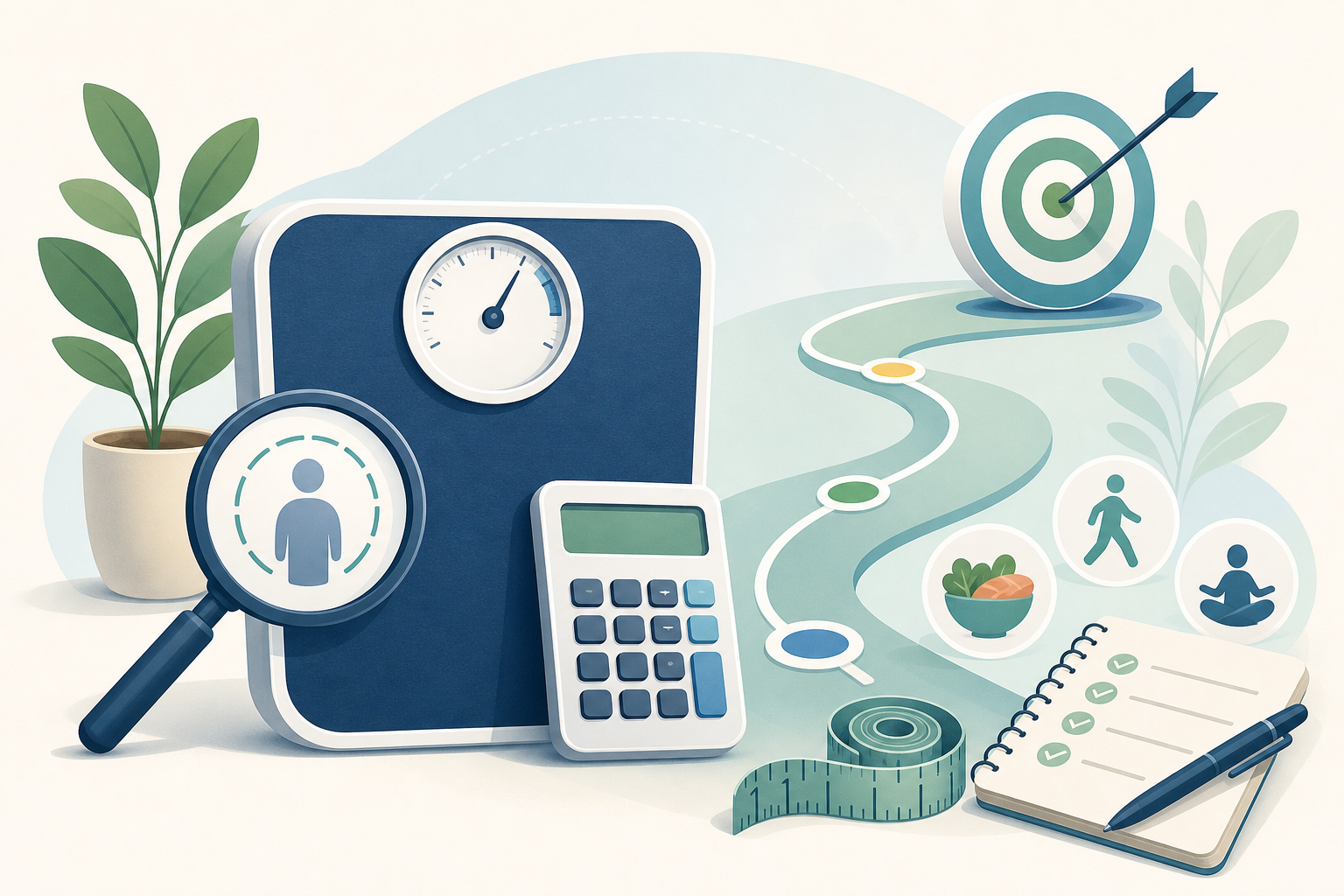
A bmi screening tool uses height and weight to identify a weight category that may warrant further discussion or assessment. It is not a diagnosis because body mass index does not directly measure body fat, muscle mass, fat distribution, fitness, or overall health.
BMI can be useful as a quick, consistent starting point. Its result is best interpreted alongside body measurements, health history, physical function, and other relevant clinical information.
Why a bmi screening tool cannot provide a diagnosis
Screening tools are designed to flag patterns or possible areas of concern. They do not establish whether a person has a health condition, and they do not explain why a result falls within a particular range.
BMI reduces two measurements—height and weight—to one number. Two people with the same BMI may have different amounts of muscle and body fat, different fat distribution, and different health profiles.
A diagnosis generally requires more specific information. Depending on the situation, a healthcare professional may consider symptoms, medical and family history, physical measurements, blood pressure, laboratory results, medicines, and changes over time.
How body mass index is calculated
Body mass index is calculated by dividing weight in kilograms by height in metres squared:
BMI = weight (kg) ÷ height² (m²)
For example, a person who weighs 80 kg and is 1.75 m tall has an estimated BMI of:
80 ÷ (1.75 × 1.75) = approximately 26.1
For adults, the US Centers for Disease Control and Prevention lists the following common BMI categories:
| BMI | Adult weight-status category |
|---|---|
| Below 18.5 | Underweight |
| 18.5 to 24.9 | Healthy weight |
| 25.0 to 29.9 | Overweight |
| 30.0 or above | Obesity |
These categories provide standard screening ranges, not individual conclusions about health. A value within the commonly described healthy BMI range does not confirm that someone is healthy, just as a value outside that range does not diagnose a disease. The categories and their use as screening measures are explained by the CDC’s adult BMI guidance.
What a BMI calculator can and cannot tell you
What it can estimate
A BMI calculator applies the standard formula to entered height and weight. If US units are entered, the measurements are converted internally before the calculation.
The tool can provide:
- An estimated BMI based on the entered measurements
- The common adult weight-status category associated with that number
- A repeatable way to compare results when measurements change
The result is only as accurate as the information entered. Measured height and weight usually provide a more dependable estimate than recalled or guessed values.
What it cannot determine
A BMI calculator cannot directly measure:
- Body-fat percentage
- Muscle mass
- Bone mass
- Where fat is carried on the body
- Physical fitness or strength
- Metabolic or cardiovascular health
- The cause of a change in body weight
It also cannot decide whether weight change would be appropriate for a particular person. That question may depend on health history, current symptoms, medicines, nutrition, physical function, and other individual factors.
Practical examples of BMI’s limitations
A muscular person
Consider an adult who regularly performs resistance training and has substantial muscle mass. Because muscle contributes to body weight, the person’s BMI may fall in the overweight range even if their body-fat level is not high.
The calculation itself is not incorrect. It has accurately compared weight with height, but it cannot identify what makes up that weight.
Two people with the same BMI
Two adults of the same height and weight will have the same BMI. However, one may have more muscle, while the other may have more body fat or carry more of their weight around the waist.
The shared BMI does not make their body composition or health circumstances identical. This is why the number should prompt context rather than an automatic conclusion.
A result within the healthy range
A person can have a BMI in the healthy weight category while still having health concerns that BMI does not detect. Conversely, someone outside that category may have favourable results on other assessments.
In both cases, BMI contributes one piece of information. It does not override measured clinical findings or an individual assessment.
Measures that can complement BMI
No single measurement gives a complete picture of health. Depending on the purpose of the assessment, BMI may be considered with other information.
- Waist measurement: This provides information about body size and fat distribution that BMI does not capture. Measurement technique should be consistent when comparing results over time.
- Body-composition estimates: Devices and methods may estimate body fat and lean mass, although results can vary by method, equipment, hydration, and testing conditions.
- Weight history: A stable BMI and a rapidly changing BMI may require different interpretations, even when the current values are identical.
- Blood pressure and laboratory results: These are measured health indicators rather than conclusions inferred from body size.
- Physical function: Strength, mobility, endurance, and the ability to carry out daily activities add context that BMI cannot provide.
- Personal and medical context: Symptoms, medicines, health conditions, pregnancy, and individual history may affect how height and weight information is interpreted.
These measures do not need to agree with BMI. A difference between them often reflects the fact that they assess different aspects of the body or health.
How to interpret a BMI result responsibly
Begin by treating the result as an estimate based on two measurements. Check that the height, weight, and selected units were entered correctly, especially if the result seems unexpected.
Next, look at context rather than focusing only on the category label. Consider whether weight has changed, whether muscle mass may influence the result, and whether other measured health information is available.
A result close to a category boundary should not be treated as fundamentally different from a result just across that boundary. For example, BMI values of 24.9 and 25.0 are numerically very similar even though standard category labels differ.
Finally, avoid using BMI as a personal health grade or as a comparison of worth, effort, or behaviour. Properly used, the bmi screening tool is a starting point for understanding weight relative to height—not a diagnosis or complete assessment.
Frequently asked questions
Is BMI a direct measure of body fat?
No. BMI is calculated from height and weight. It does not separate fat, muscle, bone, or other components of body weight.
Does a healthy BMI mean that I am healthy?
Not necessarily. A BMI in the healthy weight category is one screening result, but it does not assess blood pressure, laboratory markers, fitness, nutrition, symptoms, or medical history.
Can BMI overestimate body fat in muscular people?
BMI may place a muscular person in a higher weight category because it does not distinguish muscle from fat. This does not mean the calculation is mathematically wrong; it means the result has limited information about body composition.
Why did my BMI change only slightly after a weight change?
BMI reflects weight relative to height, so a modest change in weight usually produces a modest change in BMI. Rounding by a calculator can also make small differences less visible.
Should I focus on reaching a particular BMI number?
BMI alone cannot determine an appropriate personal target. Any target should account for broader health information, weight history, physical function, and individual circumstances rather than relying only on a category boundary.