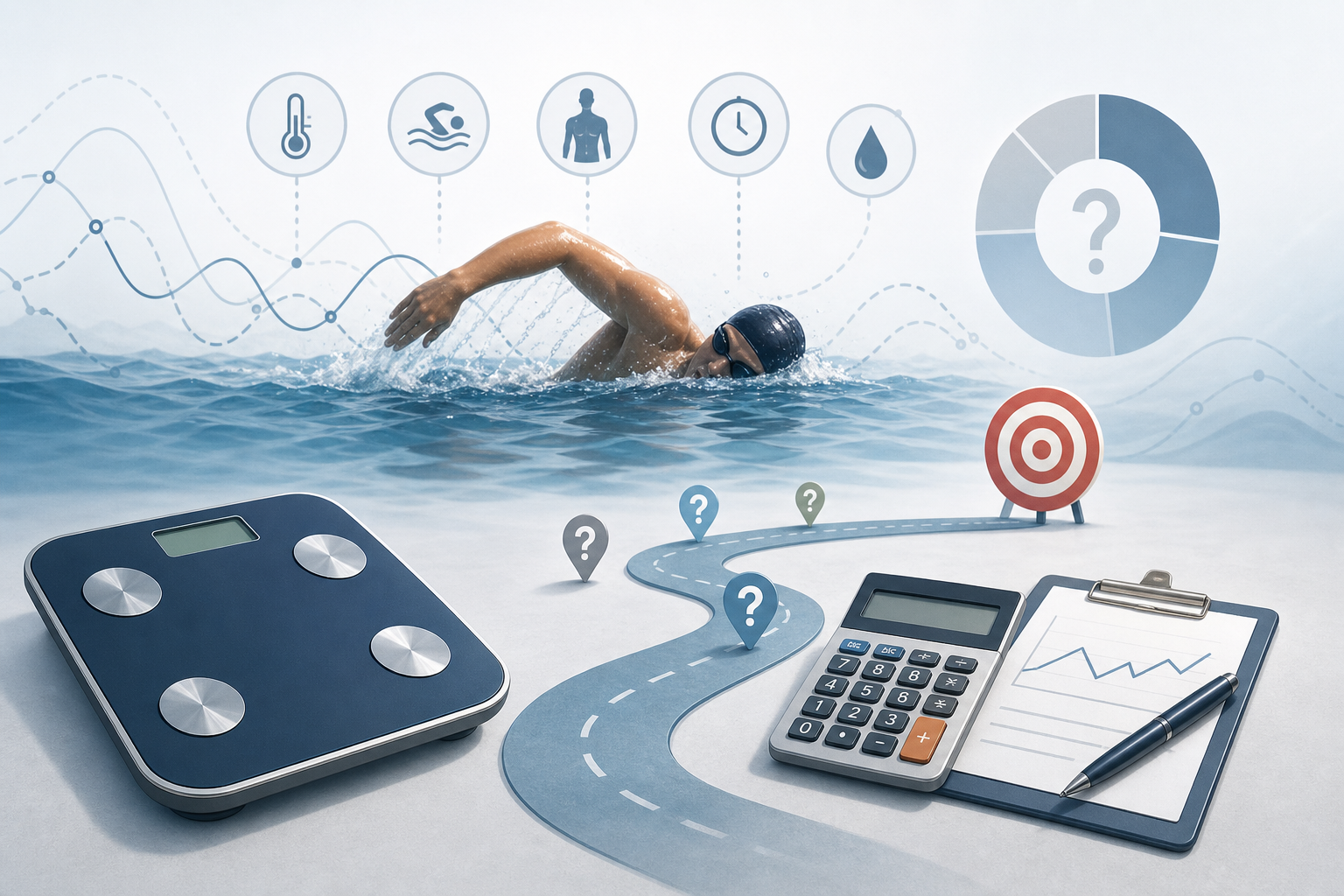
Understanding why swimming calorie estimates are hard to measure precisely starts with a simple fact: pool time does not reveal how much work a swimmer actually performed. Stroke efficiency, pace changes, rest periods, technique, body size and water conditions can all alter energy use. A swimming calories calculator therefore provides a planning estimate, not a direct measurement of calories burned.
- The main reasons why swimming calorie estimates are hard to measure precisely
- Stroke efficiency changes the work required
- Swimming technique is difficult to represent with one intensity label
- Rest periods can change the result substantially
- Stroke, pace and workout structure all matter
- Average pace can hide repeated changes in intensity
- Distance does not fully describe exertion
- How MET-based swimming estimates work
- Why a MET category cannot represent every swimmer
- Water and pool conditions introduce more uncertainty
- Limitations of watches and other swimming wearables
- What a swimming calories calculator can and cannot tell you
- What it can help with
- What it cannot determine
- A practical interval-session example
- Frequently asked questions
- Should rest time be included in swimming duration?
- Does a faster pace always mean more calories burned?
- Is a smartwatch more accurate than a MET calculator?
- Can two swimming strokes have the same calorie estimate?
- Why does the estimate change with body weight?
- How should a swimming calorie estimate be interpreted?
Even two people completing the same stroke, distance and session duration may use different amounts of energy. One may glide efficiently with few pauses, while the other uses more effort, takes longer rests or struggles to maintain position in the water.
The main reasons why swimming calorie estimates are hard to measure precisely
Most swimming estimates are based on body weight, time and an assigned intensity level. These inputs are useful, but they do not capture every movement or change in effort during a session.
Stroke efficiency changes the work required
Efficient swimmers generally travel farther with each stroke and lose less speed through unnecessary movement. Less efficient swimmers may use extra kicks, shorter strokes or more force to cover the same distance.
This does not mean efficiency always produces a lower total expenditure. A skilled swimmer may move much faster or train at a higher intensity. The key limitation is that distance or pace alone cannot show how economically the swimmer moved.
Swimming technique is difficult to represent with one intensity label
Body position, breathing pattern, kick timing, turns and push-offs all affect the work performed. Technique may also deteriorate as fatigue develops, increasing effort even when lap times remain similar.
A calculator cannot observe these details. It must group a wide range of swimming styles into broad categories such as easy, moderate or vigorous effort.
Rest periods can change the result substantially
A 45-minute pool visit is not necessarily 45 minutes of continuous swimming. The session may include instruction, conversations, equipment adjustments or recovery at the wall.
If the full session is entered as active swimming time, estimated swimming calorie burn may be too high. Entering only moving time can better represent the active portion, although it excludes energy used while resting between lengths.
Stroke, pace and workout structure all matter
Different strokes involve different movement patterns and muscle demands. The effort required for relaxed backstroke is not equivalent to fast butterfly, even when the duration is identical.
Stroke labels are still imperfect. Slow, technically demanding freestyle for one person may feel harder than faster freestyle for an experienced swimmer. Kickboard work, drills, fins, paddles and pull buoys can also change effort without fitting neatly into a standard stroke category.
Average pace can hide repeated changes in intensity
Many sessions alternate between hard intervals and easy recovery lengths. An average speed may make the workout appear steady even though the swimmer moved between very different effort levels.
The same issue applies to sets such as 10 fast lengths with rests between them. Total distance and elapsed time do not show how much of the session was spent swimming hard, swimming easily or remaining stationary.
Distance does not fully describe exertion
Distance is useful for tracking training volume, but calories burned swimming cannot be calculated reliably from distance alone. A swimmer may cover a distance slowly and continuously, complete it rapidly with long rests, or use drills that increase resistance and reduce speed.
Duration and effort provide important context, but effort itself is subjective unless measured under controlled conditions.
How MET-based swimming estimates work
A common approach assigns a metabolic equivalent, or MET, to an activity category. The 2024 Adult Compendium of Physical Activities provides standardised MET values for many activities, including swimming categories.
A typical calculation is:
Estimated kcal = MET × 3.5 × body weight in kilograms ÷ 200 × minutes
For example, a 70 kg person swimming for 30 minutes at an assigned value of 6 MET would have an estimated expenditure of:
6 × 3.5 × 70 ÷ 200 × 30 = 220.5 kcal, rounded to about 221 kcal.
This result comes from a standard model. It is not a measurement of that individual’s metabolism during the swim. The estimate is only as suitable as the selected MET value, duration and body-weight input.
Why a MET category cannot represent every swimmer
A MET value describes a general activity intensity rather than a personalised response. It does not directly account for stroke mechanics, swimming experience, buoyancy, fatigue or the proportion of time spent resting.
Broad categories are useful for comparison and planning, but the difference between “moderate” and “vigorous” swimming may not be obvious. A pace that is comfortable for one swimmer can be demanding for another.
Water and pool conditions introduce more uncertainty
Swimming takes place in an environment that affects resistance, body position and comfort. Pool length, water movement and available wall push-offs can alter the nature of a session.
A short pool involves more frequent turns and push-offs than a long pool or open water. Strong push-offs may increase speed without requiring continuous stroking, while poor turns may require extra effort to regain pace.
Open-water swimming adds other variables, including currents, waves, sighting and a lack of wall rests. Swimming with a current may reduce the effort needed to cover a recorded distance, while swimming against it may increase effort and slow progress.
Water temperature can also influence comfort, pacing and movement. However, temperature alone is not enough to calculate a dependable calorie adjustment. Its effect depends on the swimmer, exposure, clothing and how the session changes in response to the conditions.
Limitations of watches and other swimming wearables
Wearable devices may use heart rate, motion sensors, personal details and proprietary algorithms to estimate expenditure. These devices can be helpful for recording trends, but the displayed calorie number remains an estimate.
Stroke detection may be affected by drills, unusual technique, missed turns or periods when the swimmer stops. A device that misidentifies active time, distance or stroke type may pass those errors into its calorie calculation.
Heart-rate readings in water can also be less consistent than expected, depending on device fit, sensor contact and swimming movement. Even when heart rate is recorded accurately, the algorithm still has to translate that response into estimated energy use.
Different brands may produce different results from the same session because their calculation methods and intensity assumptions differ. Agreement between a wearable and a MET calculator does not prove that either value is a direct measurement.
What a swimming calories calculator can and cannot tell you
A swimming calories calculator combines body weight, effort and duration to estimate energy expenditure. It is most useful when inputs are entered consistently across similar sessions.
What it can help with
- Estimating the approximate energy cost of a planned or completed swim.
- Comparing longer and shorter sessions using the same assumptions.
- Exploring how body weight, duration or selected effort changes the result.
- Keeping a consistent planning record when direct measurement is unavailable.
What it cannot determine
- Your exact calories burned swimming.
- How efficient your stroke was during each length.
- How much your effort changed across intervals.
- Whether all entered minutes were spent actively swimming.
- The precise effect of currents, waves, water temperature or equipment.
- Whether a wearable’s result is more accurate than the calculator’s estimate.
For the most meaningful comparison, use active swimming time where practical and select the effort category that best represents most of the session. If a workout contains clearly different sets, separate calculations for easy and hard portions may better reflect its structure than one average category.
A practical interval-session example
Consider a 70 kg swimmer who spends 30 minutes at the pool. If all 30 minutes are entered at 6 MET, the result is about 221 kcal.
Suppose the swimmer was actively moving for only 20 minutes and spent 10 minutes recovering at the wall. Applying 6 MET to the 20 active minutes gives about 147 kcal for the swimming portion:
6 × 3.5 × 70 ÷ 200 × 20 = 147 kcal.
The swimmer still used energy during the rest periods, so 147 kcal is not a complete measurement of the entire pool visit. However, treating all 30 minutes as swimming at 6 MET assumes that the active intensity continued during those rests. The two results answer different questions, illustrating why clearly defined duration matters.
The same swimmer could repeat the session with better technique, harder intervals or shorter rests and receive the same calculator result if the inputs remain unchanged. This is why estimates are generally more suitable as ranges or consistent planning figures than as exact totals.
Frequently asked questions
Should rest time be included in swimming duration?
Use active swimming time if the calculator’s intensity category represents continuous swimming. If rests are brief and included, recognise that the result applies the selected swimming intensity to those minutes and may overstate the active portion.
Does a faster pace always mean more calories burned?
Not necessarily. Faster swimming often requires greater effort, but technique, drafting, currents, push-offs and workout duration also matter. An efficient swimmer may move quickly without the same relative effort experienced by a less efficient swimmer.
Is a smartwatch more accurate than a MET calculator?
Not automatically. A watch may use individual heart-rate and movement data, while a MET calculator uses standard activity values. Both depend on assumptions and can be affected by incomplete or inaccurate inputs.
Can two swimming strokes have the same calorie estimate?
Yes, particularly when they are assigned the same broad intensity or MET value. In practice, the swimmer’s pace, skill and technique may make the actual effort different even when the calculated result is identical.
Why does the estimate change with body weight?
The standard MET formula includes body weight, so a higher entered weight produces a higher estimate when MET and duration stay the same. This mathematical relationship does not account for all individual differences in swimming economy or body composition.
How should a swimming calorie estimate be interpreted?
Treat it as an approximate value produced by a model, not as a precise measurement or a guaranteed basis for food or weight-management decisions. Understanding why swimming calorie estimates are hard to measure precisely makes it easier to compare results consistently without giving the number more certainty than it has.