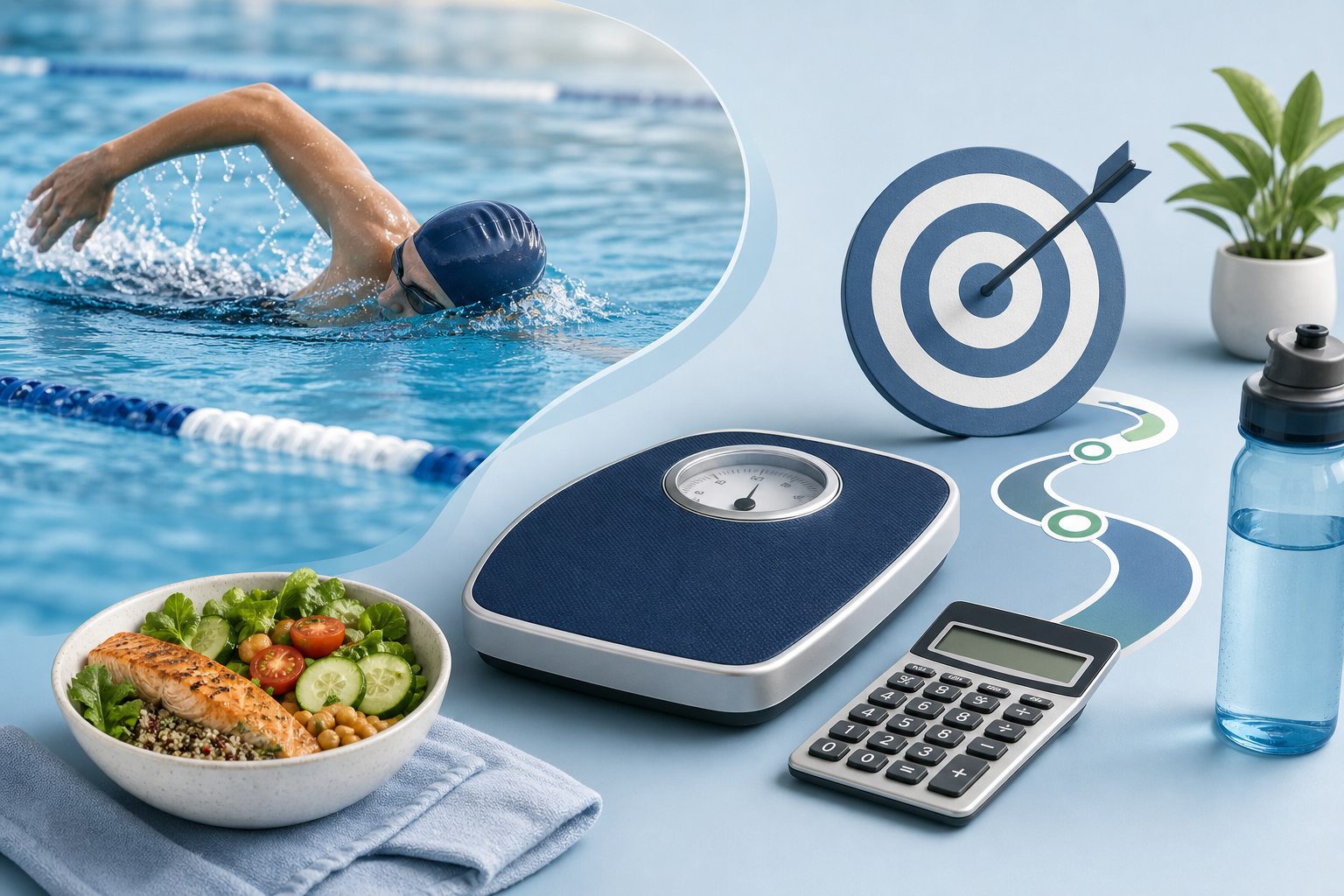
So, how many calories does swimming burn? There is no single number. Estimated energy use depends mainly on body weight, swimming duration and the intensity or stroke selected. For example, a 70 kg person swimming for 30 minutes at an intensity rated at 6 METs would use an estimated 221 kilocalories (kcal).
- How many calories does swimming burn at different effort levels?
- What determines calories burned swimming?
- Body weight
- Stroke and intensity
- Swimming duration
- Rest intervals and session structure
- Technique and water conditions
- How the swimming calorie calculation works
- Example swimming calorie burn calculation
- What the swimming calories calculator can and cannot tell you
- What it can tell you
- What it cannot tell you
- How to interpret a swimming calorie estimate
- Frequently asked questions
- Does swimming faster always burn more calories?
- Should rest time be included in swimming duration?
- Which swimming stroke burns the most calories?
- Can I calculate calories from swimming distance alone?
- Why does a wearable give a different result?
- How many calories does swimming burn in 30 minutes?
This figure is an estimate rather than a direct measurement. Technique, pace, rest periods, water conditions and individual swimming efficiency can all change actual energy expenditure.
How many calories does swimming burn at different effort levels?
Swimming calorie burn generally increases as effort and time increase. A relaxed session with frequent rests will usually use less energy than continuous swimming at a demanding pace for the same duration.
Activity calculators often represent effort with a metabolic equivalent of task, or MET. One MET is a standard reference for resting energy expenditure, while a higher MET value represents greater estimated energy demand. The 2024 Adult Compendium of Physical Activities provides MET values for many activities, including different forms of swimming.
A MET value describes an activity category, not an exact measurement of one person’s effort. Two people completing what appears to be the same swim may use different amounts of energy because their technique, fitness, body composition and pace differ.
What determines calories burned swimming?
Body weight
In the standard MET calculation, estimated calorie expenditure rises in direct proportion to body weight. At the same MET level and duration, the formula will therefore produce a higher estimate for a heavier person than for a lighter person.
This does not mean body weight is the only factor that matters. It is one input in a population-based equation and does not capture every individual difference.
Stroke and intensity
Different strokes and effort levels can have different MET values. A leisurely swim, steady lap swimming and vigorous training should not be treated as equivalent activities.
Stroke choice alone does not determine intensity. A technically skilled swimmer may move efficiently at a given pace, while a less efficient swimmer may expend more effort. Conversely, a swimmer taking long breaks may have a lower average expenditure across the full session than the selected activity category suggests.
Swimming duration
The calculation increases with the number of active minutes. If body weight and MET level remain unchanged, 40 minutes produces twice the estimate of 20 minutes.
Duration should reflect how the calculator defines the session. If it asks for swimming time, counting only active minutes may be more appropriate than including time spent changing, standing at the pool edge or having extended conversations.
Rest intervals and session structure
A 45-minute pool visit is not necessarily 45 minutes of continuous swimming. Rest between lengths, instruction time and drill recovery can reduce the session’s average intensity.
For interval sessions, the most useful estimate may come from separating harder swimming, easier recovery swimming and complete rest when the available calculator options allow it. Otherwise, choose the effort level that best represents the session as a whole.
Technique and water conditions
Efficient technique can reduce the effort required to cover a given distance. Water resistance may also vary with speed, body position and conditions such as currents or waves.
These details are difficult to represent in a simple swimming calories calculator. They help explain why an estimate may differ from a swimmer’s actual energy expenditure.
How the swimming calorie calculation works
A common MET-based equation is:
Estimated kcal = MET × 3.5 × body weight (kg) ÷ 200 × minutes
In this formula, “calories” refers to kilocalories, the unit commonly shown as Calories on food and activity records. The three main inputs affect the result in predictable ways:
- MET: Represents the estimated intensity of the selected swimming activity.
- Body weight: Is entered in kilograms or converted from another unit by the tool.
- Minutes: Represents the duration assigned to that intensity.
The calculation is linear. Doubling the duration doubles the estimate if all other inputs stay the same. Selecting a higher MET value also raises the estimate, although the selected category may not perfectly match the swimmer’s actual effort.
MET equations are useful for comparing activities and planning scenarios, but they are not the same as measuring an individual’s energy expenditure in a laboratory.
Example swimming calorie burn calculation
Consider a person who weighs 70 kg and swims for 30 minutes at an activity level assigned 6 METs. The calculation is:
6 × 3.5 × 70 ÷ 200 × 30 = 220.5 kcal
Rounded to the nearest whole number, the estimated expenditure is 221 kcal.
If the same person swam at the same assumed intensity for 60 minutes, the equation would produce about 441 kcal. That comparison assumes the swimmer maintains the selected effort for the full duration. If pace falls or rest time increases, the actual difference may not be exactly proportional.
As another planning scenario, suppose a session contains 15 minutes of steady swimming, 10 minutes of harder intervals and 10 minutes of easy recovery. Treating all 35 minutes as vigorous swimming could overstate the result. Treating the entire session as easy swimming could understate it. Estimating the segments separately may better represent a mixed session.
What the swimming calories calculator can and cannot tell you
The swimming calories calculator estimates energy expenditure from the body weight, effort and duration entered. It applies a standard equation consistently, which is useful for exploring how changes in these inputs affect the result.
What it can tell you
- An estimated number of kilocalories used during the entered swimming duration.
- How the estimate changes when body weight, duration or selected intensity changes.
- A consistent basis for comparing possible swimming sessions.
- An approximate activity value for general planning or record-keeping.
What it cannot tell you
- Your directly measured energy expenditure.
- Exactly how efficient your stroke technique is.
- Whether the chosen effort category accurately reflects every part of the session.
- The precise effect of currents, waves, water temperature or pool congestion.
- How much of the session was active swimming unless the entered time accounts for rests.
To use the result sensibly, select the option that most closely describes the actual swim and enter a realistic duration. Keep the same approach when comparing sessions. Consistent inputs often make trends more useful, even though each individual result remains an estimate.
How to interpret a swimming calorie estimate
A calorie estimate is best treated as an approximate range indicator rather than an exact amount. Rounding the result and avoiding assumptions of precision can better reflect the uncertainty in the calculation.
It is also important not to compare swimming sessions by duration alone. Thirty minutes of continuous lap swimming is different from 30 minutes in the pool that includes instruction, rests or social time. Distance alone can also be misleading because swimmers may cover the same distance at different speeds and with different levels of efficiency.
For repeated tracking, use similar definitions of active time and effort. For example, do not record rest time as active swimming in one session but exclude it in the next. This improves consistency without turning the estimate into a measured value.
Calorie expenditure is only one way to describe a swimming session. The calculator does not assess swimming skill, training quality, recovery needs or the overall suitability of an exercise plan.
Frequently asked questions
Does swimming faster always burn more calories?
A faster pace usually corresponds to greater energy demand, but pace is not the only consideration. Stroke efficiency, rest intervals and water conditions can affect the relationship between speed and actual expenditure. The calculator represents these differences through broad effort or activity categories.
Should rest time be included in swimming duration?
Use the type of duration requested by the calculator. If it is intended to represent active swimming, exclude extended rests. For short interval recoveries that are part of a continuous workout, selecting an average session intensity may be a practical alternative.
Which swimming stroke burns the most calories?
There is no universal answer for every swimmer. Activity references assign different MET values to particular strokes and effort levels, but technique and pace can substantially influence an individual session. The most demanding category on paper may not accurately describe how a particular person swims.
Can I calculate calories from swimming distance alone?
Distance does not provide enough information for a standard MET calculation. Body weight, duration and an appropriate intensity category are also needed. Two swimmers can complete the same distance in different amounts of time and at different effort levels.
Why does a wearable give a different result?
Wearables and online tools may use different equations, activity categories and personal inputs. A wearable may also incorporate movement or heart-rate data, while a MET calculator uses standardized activity values. Neither difference proves that one result is an exact measurement.
How many calories does swimming burn in 30 minutes?
The answer depends on body weight and the selected MET value. At 70 kg and 6 METs, 30 minutes gives an estimate of about 221 kcal. A different weight, stroke category or effort level will produce a different result.