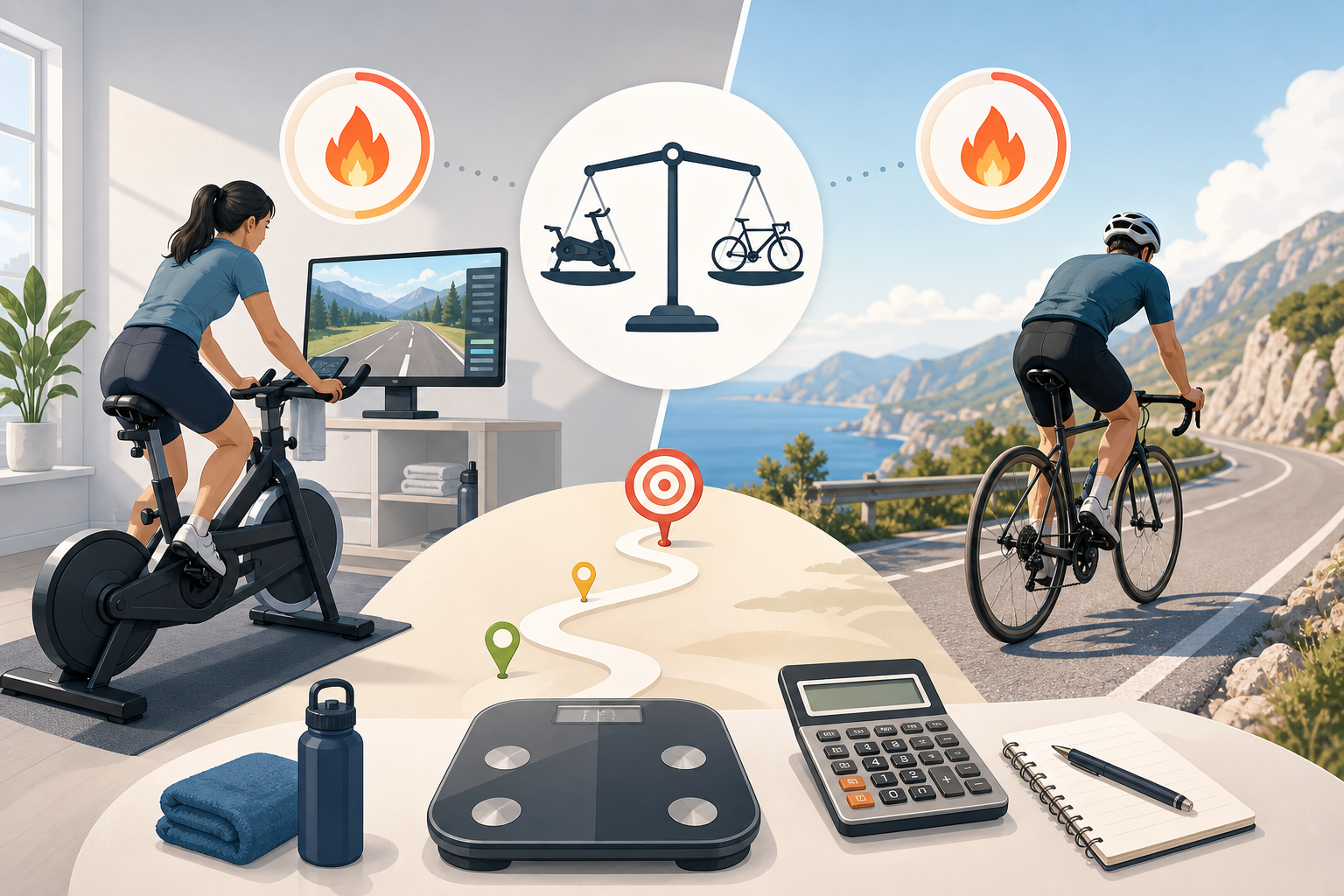
Understanding indoor vs outdoor cycling calories why the numbers may differ begins with a simple point: the same ride duration or average speed does not always represent the same physical effort. A stationary bike may provide continuous resistance, while an outdoor route can include hills, wind, coasting, stops and changing surfaces. Calorie figures from either setting are estimates unless energy expenditure is measured under controlled conditions.
- Indoor vs outdoor cycling calories why the numbers may differ: the main reasons
- How cycling calorie estimates are calculated
- Resistance, terrain and coasting change the workload
- Stationary-bike resistance
- Outdoor terrain and wind
- Coasting, braking and stops
- A practical indoor and outdoor comparison
- Environmental and measurement factors
- What the cycling calories calculator can and cannot tell you
- Frequently asked questions
- Does indoor cycling always burn more calories than outdoor cycling?
- Why does my stationary bike show a different result from a calculator?
- Should I use average speed to select cycling intensity?
- Should rest periods count in an indoor cycling workout?
- Is a power meter more accurate for bike calorie burn?
- Which number should I use when my devices disagree?
Indoor vs outdoor cycling calories why the numbers may differ: the main reasons
Indoor and outdoor cycling use similar pedalling movements, but the riding conditions are not equivalent. Indoors, resistance is set by the bike, rider or programmed workout. Outdoors, the required effort changes with terrain, weather, traffic and riding position.
These differences can make either type of cycling more demanding:
- Indoor cycling may require steadier work. There are usually no traffic lights or downhill sections unless the rider deliberately reduces effort.
- Outdoor cycling may involve greater resistance. Climbing, headwinds, rough surfaces and repeated acceleration can increase the workload.
- Outdoor rides can also include low-effort periods. Descents, coasting, drafting and waiting at junctions may reduce the average effort.
- Indoor sessions vary by bike and settings. A displayed resistance level is not necessarily comparable between different stationary-bike models.
As a result, a 45-minute stationary-bike session and a 45-minute outdoor ride should not automatically receive the same calorie estimate.
How cycling calorie estimates are calculated
A cycling calories calculator commonly estimates energy expenditure using body weight, duration and an intensity category. The intensity may be represented by a metabolic equivalent of task, or MET.
MET values provide a standardized estimate of the energy cost of an activity. The 2024 Adult Compendium of Physical Activities lists MET values for a range of cycling activities, including stationary and outdoor options at different intensities.
A commonly used calculation is:
Estimated kcal = MET × 3.5 × body weight in kilograms ÷ 200 × minutes
For example, an 80 kg person cycling for 45 minutes at an assigned intensity of 6.8 MET would have an estimated expenditure of:
6.8 × 3.5 × 80 ÷ 200 × 45 = approximately 428 kcal
This is a population-based estimate rather than a measurement of that individual’s metabolism. Two people with the same body weight can produce different bike calorie burn figures in real life because of differences in workload, movement efficiency, fitness, riding position and bicycle setup.
Calculators and devices may also report different types of calories. Some show total energy expenditure during the activity, while others attempt to show “active” calories above resting needs. That distinction can create a difference even when both tools use the same ride data.
Resistance, terrain and coasting change the workload
Stationary-bike resistance
On an indoor bike, resistance determines how much force is required to turn the pedals. However, a resistance setting of 10 on one bike may not equal level 10 on another. Bikes may use different flywheels, braking systems, calibration methods and resistance scales.
Cadence also matters. Pedalling quickly at light resistance is not necessarily equivalent to pedalling more slowly against heavy resistance. Heart rate, perceived effort or measured power can add context, although each has limitations.
Outdoor terrain and wind
Outdoor effort can change from one minute to the next. Riding uphill generally requires more work than travelling at the same speed on level ground. A headwind can raise the effort needed to maintain speed, while a tailwind may reduce it.
Road surface, tyre pressure, bicycle type, carried luggage and riding posture can also affect resistance. A rider on a heavy utility bicycle over a rough surface may work harder than someone travelling at the same speed on a road bike over smooth pavement.
Coasting, braking and stops
Average outdoor speed does not reveal how much of the ride involved active pedalling. A route may include a demanding climb followed by a long descent with little or no pedalling. Traffic lights and junctions can add stationary time, while repeated acceleration after each stop can briefly increase effort.
Some apps calculate calories from total elapsed time, while others use moving time. If stops are included as though the rider were continuously cycling, the estimate may be too high.
A practical indoor and outdoor comparison
Consider an 80 kg rider completing two sessions that each last 45 minutes.
| Ride | What happens | Why the estimate may differ |
|---|---|---|
| Indoor session | The rider pedals continuously at a moderate setting, with two short recovery periods. | The workload is relatively steady, but the result depends on how accurately the bike represents resistance or power. |
| Outdoor route | The rider encounters a hill, several traffic lights, a downhill section and a light headwind. | The hill and wind raise effort, while stops and coasting lower the amount of continuous work. |
If both sessions are entered simply as “45 minutes of moderate cycling,” a calculator may return the same number. The rider’s actual energy use could nevertheless differ because the intensity pattern was not the same.
Average speed alone would not settle the comparison. A slower ride into a headwind may require more effort than a faster ride with a tailwind, and indoor speed is often a bike-generated value that does not correspond directly to outdoor travel speed.
Environmental and measurement factors
Outdoor temperature and weather may affect comfort, pacing and clothing choices, but they should not be converted into a precise calorie adjustment without suitable measurement. The clearer influences for most estimates are duration, body weight and the intensity category selected.
Indoor conditions can also affect performance. Limited airflow may make a session feel harder, particularly as the rider warms up. Feeling hotter, however, does not by itself provide a reliable measure of calories burned cycling.
Different tracking methods can produce different results:
- MET-based calculators assign an average energy cost to an activity category.
- Fitness watches may combine movement, heart rate and personal profile information using proprietary equations.
- Stationary bikes may estimate calories from speed, cadence, resistance or calculated power.
- Power meters measure cycling work more directly at the pedals, crank or hub, but converting mechanical work into calories still requires assumptions about human efficiency.
None of these methods should be treated as a direct laboratory measurement of energy expenditure. Even apparently precise device figures can reflect model assumptions, sensor accuracy and the quality of the personal data entered.
What the cycling calories calculator can and cannot tell you
The calculator can provide a consistent estimate from body weight, selected cycling intensity and duration. It is useful for comparing sessions when the same method and similar inputs are used each time.
It can help answer questions such as:
- How does the estimate change when ride duration increases?
- How do light, moderate and vigorous intensity selections compare?
- How does body weight affect a MET-based estimate?
- What approximate result does a standardized activity value produce?
The calculator cannot determine the exact resistance of a stationary bike, the gradient of every hill or how long an outdoor rider coasted. It also cannot know the effects of wind, drafting, road surface, bicycle efficiency or individual movement efficiency unless those factors are specifically measured and incorporated.
Select the intensity description that most closely matches the actual session rather than choosing a category from speed alone. For an outdoor ride with substantial stops, moving time may better represent cycling duration than total time. For interval workouts, one overall intensity category is necessarily a simplification.
Frequently asked questions
Does indoor cycling always burn more calories than outdoor cycling?
No. Indoor cycling can involve more continuous pedalling, but an outdoor ride with hills, wind or frequent acceleration may require more work. Duration alone cannot determine which session used more energy.
Why does my stationary bike show a different result from a calculator?
The bike and calculator may use different formulas or inputs. The bike may use resistance, cadence or estimated power, while a calculator may use a MET category, body weight and time. They may also differ in whether they report total or active calories.
Should I use average speed to select cycling intensity?
Speed can provide context, but it does not fully describe effort. Terrain, wind, bicycle type, drafting and stops can make the same outdoor speed represent very different workloads. Indoor speed is even less directly comparable because it is generated by the bike.
Should rest periods count in an indoor cycling workout?
Brief low-resistance recovery periods are part of many workouts, but they reduce the session’s average intensity. If a calculator applies one intensity to the full duration, choose a category that represents the overall session rather than only its hardest intervals.
Is a power meter more accurate for bike calorie burn?
A properly functioning power meter provides more individualized information about mechanical work than speed or a broad activity category. However, calorie conversion still depends on assumptions, so the result remains an estimate rather than a direct measurement.
Which number should I use when my devices disagree?
Use one consistent method for comparisons instead of switching between the highest or lowest figures. Record the source, whether it uses moving or elapsed time, and whether the result represents active or total calories. This makes trends easier to interpret.
In summary, indoor vs outdoor cycling calories why the numbers may differ is mainly explained by changes in resistance, terrain, wind, coasting, stops and estimation methods. Treat each result as an informed approximation, and compare like with like whenever possible.