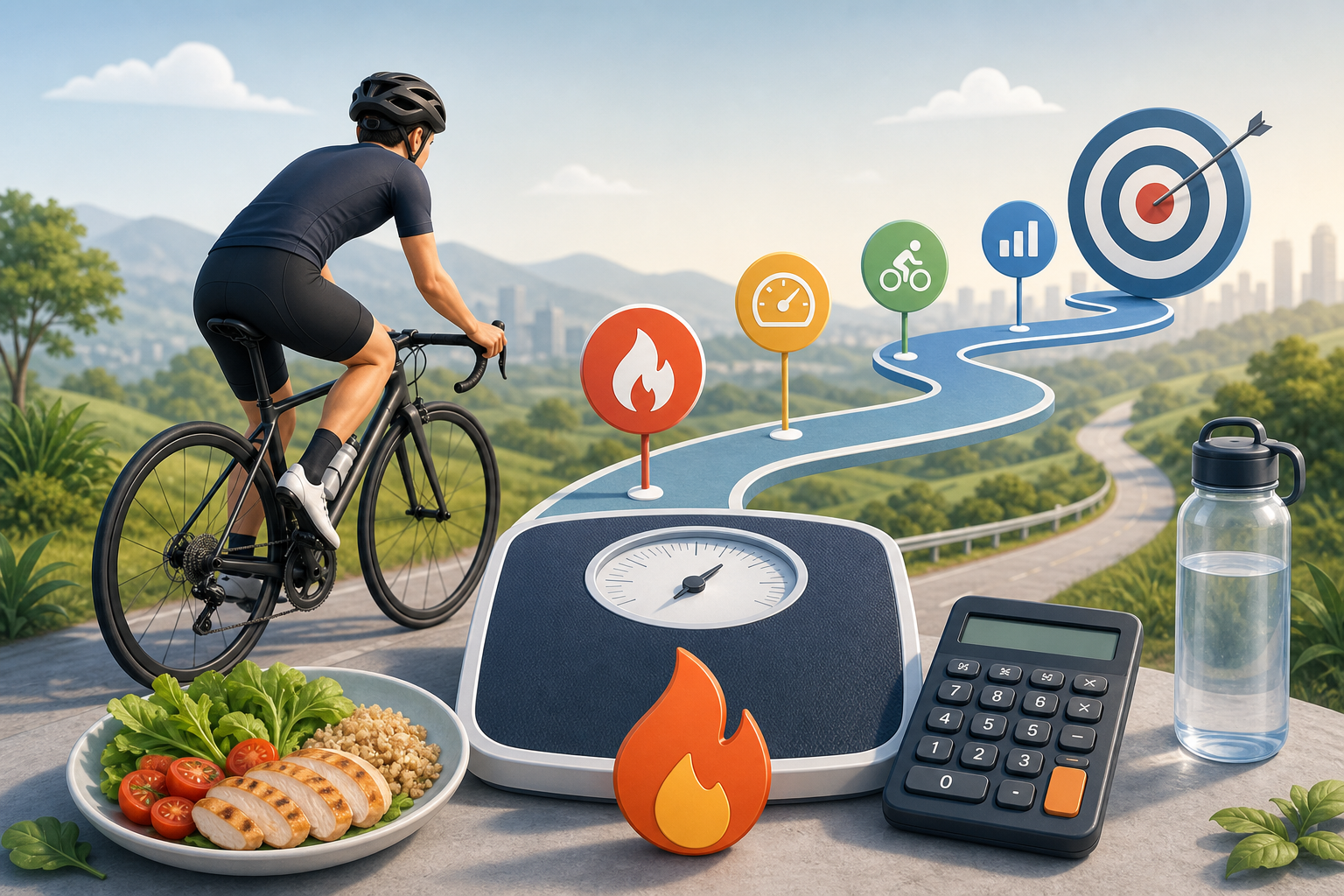
How many calories does cycling burn? There is no single number: the estimate depends mainly on body weight, cycling intensity and duration. As an illustration, an 80 kg person cycling for 45 minutes at an intensity rated at 6.8 METs would use an estimated 428 kcal. Terrain, wind, bicycle type and individual efficiency can make actual energy expenditure different.
How many calories does cycling burn at different durations?
When body weight and intensity stay the same, estimated calories burned cycling increase in direct proportion to time. Doubling the cycling duration doubles the formula-based estimate.
The following example uses a body weight of 80 kg and an intensity of 6.8 METs. These figures are illustrative estimates, not measured calorie expenditure.
| Cycling duration | Estimated energy expenditure |
|---|---|
| 15 minutes | About 143 kcal |
| 30 minutes | About 286 kcal |
| 45 minutes | About 428 kcal |
| 60 minutes | About 571 kcal |
A lighter person would generally receive a lower estimate at the same MET level and duration, while a heavier person would receive a higher estimate. However, two people with the same body weight can still use different amounts of energy because the calculation does not measure their individual cycling efficiency.
How cycling calorie expenditure is estimated
A cycling calories calculator commonly uses metabolic equivalent of task, or MET, values. A MET value represents the estimated energy cost of an activity relative to rest and provides a standardized way to classify different activities and effort levels.
The calculation is:
Estimated kcal = MET × 3.5 × body weight in kilograms ÷ 200 × minutes
The MET value represents the selected cycling intensity. Body weight scales the estimate for the person, and minutes account for how long the activity continues. This method is based on standardized activity classifications such as those reported in the 2024 Adult Compendium of Physical Activities.
Because this is a model rather than a direct measurement, the result should be read as an approximation. The formula cannot detect changing effort, coasting, stops, drafting or individual differences in movement efficiency.
What affects bike calorie burn?
Body weight
At a fixed MET value and duration, estimated calorie expenditure is proportional to body weight. For example, the formula gives a person weighing 80 kg a higher estimate than a person weighing 60 kg when both entries use the same intensity and time.
This mathematical relationship does not mean body weight is the only factor affecting real energy use. The MET method applies a population-based activity value rather than measuring each rider’s metabolism.
Cycling intensity
Intensity has a major effect on the estimate. Easy recreational riding, a steady moderate session and vigorous cycling use different MET values. Choosing an intensity that reasonably reflects the whole ride is therefore important.
Speed can help describe intensity, but it is not a complete measure of effort. The same speed may feel easy on flat ground with a tailwind and demanding on an incline or into a headwind. Indoor resistance also changes effort even when there is no outdoor speed to record.
Duration
The formula treats duration linearly. A 45-minute ride produces one and a half times the estimate of a 30-minute ride when body weight and MET value are unchanged.
Use active cycling time when possible. Including a long café stop, traffic delay or other period without cycling may overstate the estimate unless the tool specifically accounts for breaks.
Terrain and wind
Climbing, rough surfaces and headwinds can increase the work needed to maintain a given speed. Descending, smooth surfaces, tailwinds and riding in another cyclist’s slipstream may reduce the required effort.
A calculator usually handles these conditions indirectly through the selected intensity. It does not normally analyse every hill or wind change unless it receives more detailed ride data.
Bicycle type and riding position
Road, mountain, hybrid, electric and stationary bicycles can involve different resistance and riding conditions. Tyres, bicycle weight, surface, posture and mechanical efficiency can also influence the work performed.
For an electric bicycle, motor assistance may reduce the rider’s contribution. A general cycling estimate may therefore be less suitable unless its intensity option specifically represents assisted cycling.
A practical cycling calorie calculation
Consider a rider who weighs 80 kg, cycles for 45 minutes and selects an intensity of 6.8 METs. Entering those values into the formula gives:
6.8 × 3.5 × 80 ÷ 200 × 45 = 428.4 kcal
The rounded result is about 428 kcal. This is an estimated energy cost for the entered body weight, intensity and duration; it is not a direct reading of energy used by that particular rider.
If the same rider cycled for 30 minutes at the same assigned intensity, the estimate would be about 286 kcal. If the actual session included repeated stops or substantial changes in effort, using one MET value for the entire ride would simplify those variations.
What the cycling calories calculator can and cannot tell you
What it can estimate
- Approximate energy expenditure based on body weight, selected cycling intensity and duration.
- How the estimate changes when ride time, body weight or intensity changes.
- A consistent way to compare possible cycling sessions using the same calculation method.
- A planning figure when direct measurements are unavailable.
To use the cycling calories calculator, choose the requested unit system, enter body weight and duration, select the intensity that best represents the ride, and calculate the result. Review the selected values before interpreting the estimate.
What it cannot measure
- Your exact individual calorie expenditure.
- Every change in gradient, wind, resistance, speed or riding position.
- The amount of time spent coasting or stopped unless that is reflected in the duration.
- Individual cycling efficiency, fitness or physiological differences.
- Precise energy output from body weight, time and a general intensity category alone.
Indoor and outdoor cycling estimates can differ substantially. A stationary bicycle may report resistance, cadence or power, while an outdoor ride includes hills, wind, road surfaces and periods of coasting.
A properly calibrated power meter can provide more individualized information about mechanical work performed during cycling. Even then, converting work into human calorie expenditure requires assumptions about efficiency, so a displayed calorie number remains an estimate rather than a laboratory measurement.
How to interpret calories burned cycling
Use the result as an approximate range or planning value rather than an exact allowance. Small changes in the selected MET level can meaningfully change the result, especially during a long ride.
Different calculators, exercise bicycles and wearable devices may produce different figures because they use different intensity categories, sensor inputs and calculation methods. Some displays may also distinguish between total energy used during the activity and energy above resting needs, while others may not make that distinction clear.
For more useful comparisons, use the same calculator and similar input choices across sessions. Record duration consistently and select intensity according to the actual ride rather than the result you expect to see.
Calorie expenditure is only one way to describe cycling. Duration, distance, perceived effort, cadence and power may provide additional context, depending on the type of riding and the available equipment.
Frequently asked questions
Does cycling faster always burn more calories?
Higher effort usually receives a higher MET value and therefore a higher estimate for the same body weight and duration. However, speed alone does not define effort because gradient, wind, road surface, drafting and bicycle type also affect how hard the rider works.
Is indoor bike calorie burn the same as outdoor cycling?
Not necessarily. Indoor cycling depends heavily on resistance settings and the accuracy of the bicycle’s sensors, while outdoor cycling is affected by terrain, weather, stops and coasting. Two sessions of equal duration can therefore have different energy demands.
Why does my fitness watch show a different result?
A watch may use heart rate, movement, age and other profile information, while a basic calculator uses body weight, time and a standardized MET value. Differences do not necessarily mean one result is correct and the other is wrong; they may reflect different inputs and assumptions.
Can cycling calories be calculated from distance alone?
Distance alone is usually insufficient because completing the same route in different conditions can require different effort and time. Duration combined with a reasonable intensity classification provides a clearer basis for a general estimate.
Should breaks be included in cycling duration?
Use active riding time if the goal is to estimate the cycling portion of the session. Including periods when you were stopped can overestimate expenditure if the calculation treats every minute as active cycling.
How many calories does cycling burn for an individual rider?
A calculator can provide an estimate after body weight, intensity and duration are entered, but it cannot determine an exact individual value. Actual expenditure may differ because of terrain, wind, cycling efficiency, bicycle setup and changes in effort throughout the ride.