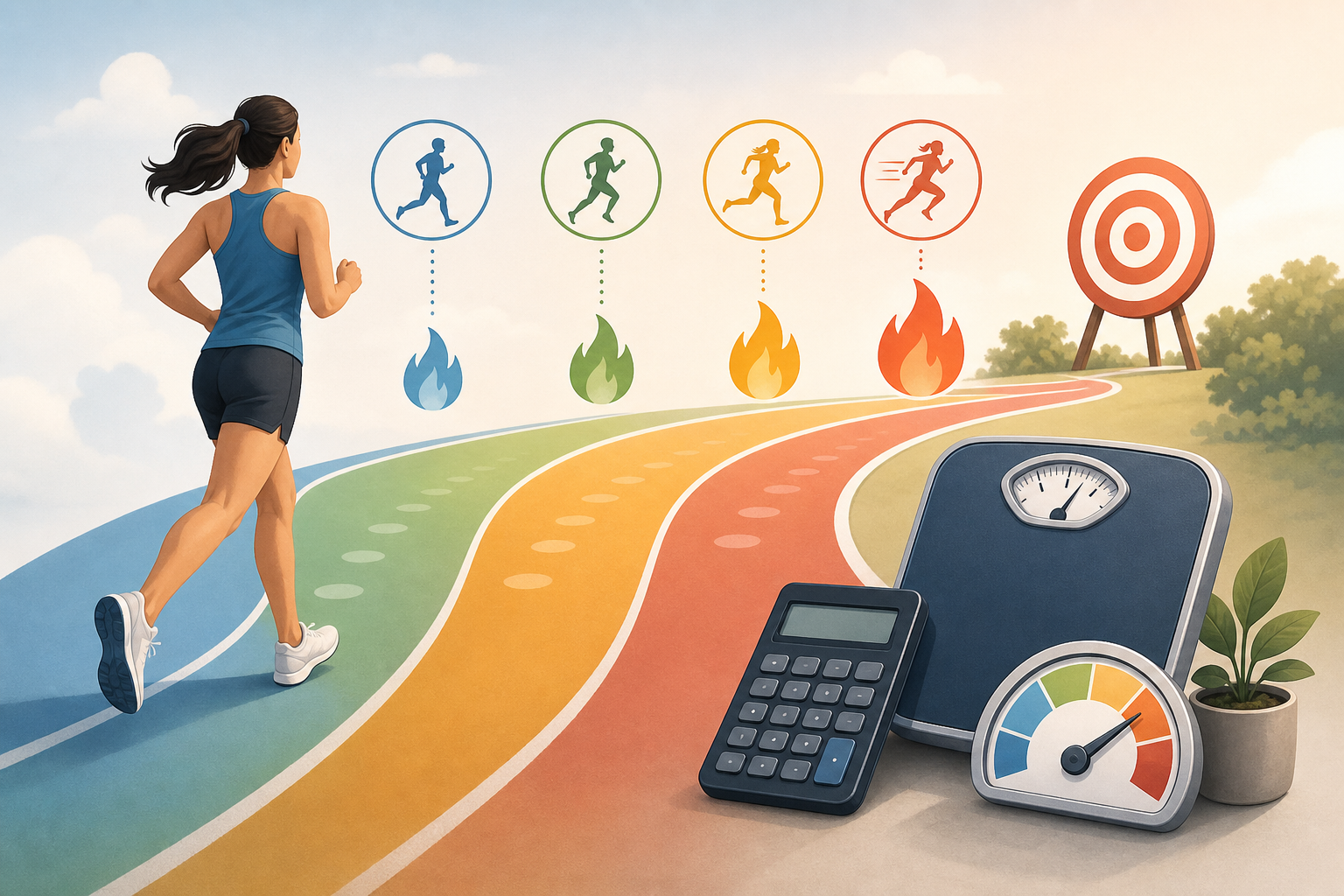
If you are asking, “does running pace change how many calories you burn,” the short answer is yes. A faster pace generally increases exercise intensity and calories burned per minute. However, the total for a run also depends on how long you continue, your body weight, the terrain and how efficiently you run.
This means a short, fast run does not automatically use more energy than a longer, slower run. Both intensity and duration need to be considered when estimating running calorie burn.
How does running pace change how many calories you burn?
Running faster usually requires the body to produce energy at a higher rate. In calorie estimates, this higher intensity is commonly represented by a larger metabolic equivalent, or MET, value.
MET values provide a standard way to compare the energy demands of different activities and intensities. The 2024 Adult Compendium of Physical Activities includes MET values for running at different speeds and under different conditions.
When body weight and duration remain the same, a higher MET value produces a higher calorie estimate. Therefore, increasing pace will generally raise calories burned per minute.
Pace is not the only influence, however. Running uphill, running into the wind or moving on a difficult surface can increase effort without a major change in your recorded pace. Conversely, a trained runner may move at a particular speed more efficiently than someone less accustomed to running.
Why intensity and duration both affect calories burned running
Total calories burned running are estimated from both the rate of energy use and the amount of time spent running. Pace mainly changes the rate, while duration determines how long that rate is maintained.
A faster runner might use more calories each minute but finish a set distance sooner. A slower runner may use fewer calories per minute but remain active for longer. Depending on the pace and duration, either session could have the larger total estimate.
This distinction is important when comparing runs:
- For the same duration, the faster or more demanding run will generally have the higher estimate.
- For the same distance, a faster pace raises intensity but reduces the time spent running.
- For different distances and durations, neither pace nor time alone can determine the result.
- For routes with hills or difficult surfaces, recorded pace may not fully represent effort.
For this reason, “calories per minute” and “total calories for the session” answer different questions. A higher calorie rate does not necessarily mean a higher session total.
How running calorie estimates are calculated
A practical running calories calculator can estimate energy expenditure using body weight, activity intensity and duration. A commonly used MET-based formula is:
Estimated kcal = MET × 3.5 × body weight in kilograms ÷ 200 × minutes
The MET value represents the estimated intensity of the run. Body weight is included because moving a larger body generally requires more energy under otherwise similar conditions. Minutes convert the estimated rate into a total for the session.
The formula produces an estimate rather than a direct measurement. MET values are population averages, so they cannot account fully for individual running economy, fitness, technique, environmental conditions or physiological differences.
A practical calculation example
Consider a runner who weighs 80 kilograms and runs for 30 minutes at an intensity represented by 8.3 MET:
8.3 × 3.5 × 80 ÷ 200 × 30 = approximately 349 kcal
If that person continued for 45 minutes at the same estimated intensity, the result would be approximately 523 kcal. The longer run produces a higher total because the same estimated calorie rate is maintained for an additional 15 minutes.
If the runner increased pace, the relevant MET value would generally rise. The calories-per-minute estimate would then increase, but the final session total would still depend on how many minutes the faster pace was sustained.
What else can change running calorie burn?
Pace is useful, but it does not describe every source of effort. Two runs completed at the same average pace can have different energy demands.
- Body weight: The MET formula produces a higher estimate for a higher body weight when intensity and time are unchanged.
- Hills: Uphill running generally requires more effort than running at the same pace on level ground.
- Wind: A headwind can increase effort even if pace remains steady.
- Surface: Sand, trails, mud and uneven ground may change the energy demand compared with a firm, level surface.
- Running economy: Technique, training background and familiarity with a pace can affect how efficiently someone runs.
- Pace variation: Intervals, stops and changes in speed may not be represented well by one average pace.
Weather, clothing, footwear and carrying equipment may also affect how demanding a run feels. A simple calculator will not usually capture all these details, so small differences between estimated sessions should not be treated as precise.
What a running calories calculator can and cannot tell you
The running calories calculator estimates calories used while running from body weight, intensity and duration. It is useful for comparing possible sessions using one consistent calculation method.
For example, it can help you explore how the estimate changes when you keep duration fixed but select a higher intensity. It can also show how extending the duration affects the result when body weight and intensity remain unchanged.
What the calculator can estimate
- Approximate calories used during a specified running session.
- The effect of changing body weight, intensity or duration within the formula.
- Differences between sessions when the same method and inputs are used.
- A standardized result based on an assigned MET value.
What the calculator cannot measure
- Your exact energy expenditure.
- Individual running economy or metabolic response.
- Every effect of hills, wind, temperature or surface conditions.
- The accuracy of a pace, duration or body-weight value entered incorrectly.
- Whether an estimated calorie amount will lead to a particular change in body weight.
Calculator results should therefore be read as planning estimates, not measured physiological values. Even a wearable device provides an estimate unless energy expenditure is assessed with specialised measurement methods.
How to compare running sessions sensibly
Start by deciding what you are comparing. If the question is which pace has the higher energy demand per minute, the faster pace will generally have the higher estimate. If the question is which complete session uses more calories, compare both intensity and total time.
Use the same input method when comparing sessions. For example, avoid comparing one result based on average pace with another based on a brief peak pace. For an interval session, an average intensity may be more representative than the fastest segment, although it still simplifies the workout.
It is also helpful to avoid attaching too much significance to small estimated differences. MET categories and calculator inputs are not precise enough to establish that two similar runs differed by an exact number of calories.
The practical answer to “does running pace change how many calories you burn” is that pace changes the rate of energy use, while duration helps determine the final total. Body weight, route and running efficiency add further variation.
Frequently asked questions
Does running twice as fast burn twice as many calories?
Not necessarily. The relationship between pace and estimated energy use is not a simple one-to-one rule. A much faster pace may have a higher MET value, but running twice as fast also changes how long it takes to cover a set distance.
Does a faster 30-minute run burn more than a slower 30-minute run?
Generally, yes. When body weight and duration are the same, the faster run will usually be assigned a higher intensity and therefore a higher calorie estimate.
Can a slow, long run burn more than a short, fast run?
Yes. Although the faster run may use more calories per minute, a sufficiently longer session can produce a higher total. The result depends on the combination of intensity and minutes.
Should I use pace or heart rate to estimate running calories?
Both are indirect indicators. Pace-based estimates can miss the effects of terrain, weather and individual efficiency, while heart-rate estimates also rely on device algorithms and personal assumptions. Neither should be treated as an exact measurement.
Why does my running calories calculator result differ from my watch?
The calculator and watch may use different formulas, intensity categories and personal data. A watch may also incorporate heart rate, movement data or its own proprietary assumptions, so matching results should not be expected.