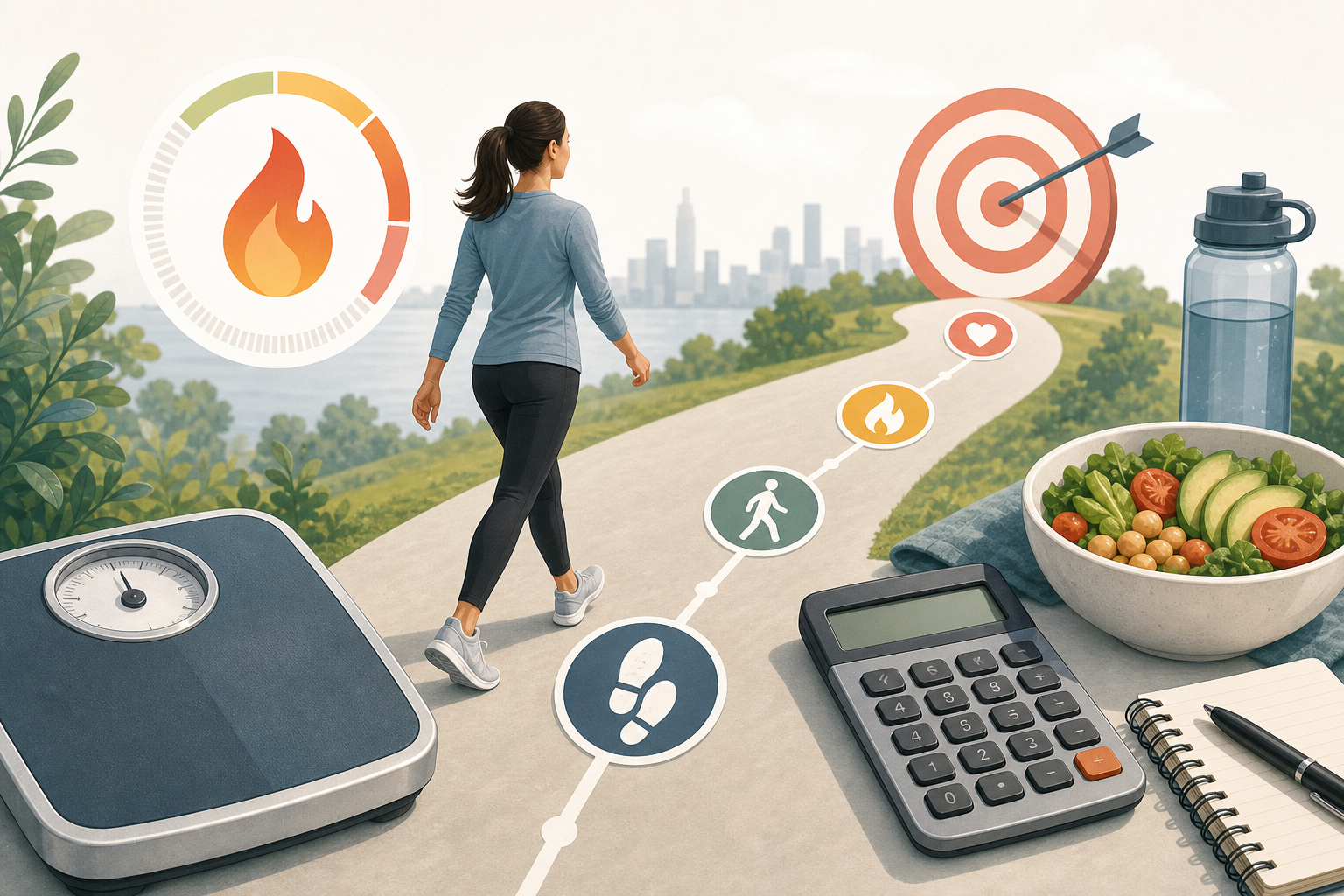
When people search for “10000 steps calories burned,” they often expect one fixed number. In practice, 10,000 steps do not burn the same number of calories for everyone. The estimate depends mainly on body weight, estimated step length, walking distance, pace and time spent walking.
For a typical adult, 10,000 steps may represent several kilometres or miles. A personalised estimate is therefore more useful than a universal calorie figure, especially when step length and walking pace are taken into account.
10000 steps calories burned: why there is no single answer
Steps measure movement count, not distance or energy expenditure directly. Two people can each record 10,000 steps while covering different distances and walking for different lengths of time.
Calorie estimates also depend on body weight. In standard activity calculations, a person with a higher body weight will generally have a higher estimated energy cost for the same activity duration and intensity.
Pace adds another variable. Faster walking usually has a higher energy cost per minute, but it also reduces the time needed to cover a given distance. This is why pace should be included in the calculation rather than treated as a simple multiplier.
What affects walking calories from 10,000 steps?
Body weight
Body weight is an important input in equations that estimate activity energy expenditure. If two people walk for the same amount of time at the same intensity, the equation will usually produce a higher calorie estimate for the person with the higher body weight.
This does not mean that body weight alone determines the result. Distance, duration and pace still matter.
Height and estimated step length
Height is often used to estimate step length when the actual stride has not been measured. A longer estimated step length converts the same 10,000 steps into a longer walking distance.
However, height-based step length is only an approximation. Leg proportions, walking style, mobility, surface and pace can all affect a person’s actual step length.
Walking pace
Pace helps determine both walking duration and activity intensity. A relaxed walk, a purposeful walk and a brisk walk may have different energy costs even when the step totals are identical.
The 2024 Adult Compendium of Physical Activities provides standard metabolic equivalent, or MET, values for activities at different intensities. These values support activity estimates, but they do not measure an individual’s calorie use directly.
Distance and duration
Ten thousand short steps may cover less distance than 10,000 long steps. If two people walk at the same speed, the person covering the longer distance will also spend more time walking.
Duration is important because calorie equations apply an estimated energy cost over time. An inaccurate step-length estimate can therefore affect both estimated distance and estimated duration.
Terrain and walking conditions
Hills, uneven ground, wind, carrying a load and frequent changes in speed can alter the real effort required. A basic steps calculation may not account for these conditions unless the tool specifically asks about them.
Indoor steps, outdoor walking and steps accumulated during everyday tasks may also involve different movement patterns. The same total does not necessarily represent one continuous walk.
How a steps-to-calories estimate is calculated
A steps-based calculator must first translate the step count into information that can be used in an energy equation. A typical method follows these stages:
- Estimate step length from height or another body measurement.
- Multiply step length by the number of steps to estimate distance.
- Use the selected pace to estimate how long the distance would take.
- Assign a walking MET value appropriate to the selected pace.
- Combine MET level, body weight and estimated duration to calculate calories.
In this context, Calories usually means kilocalories, the unit commonly used on food labels and activity trackers. The result is a modelled estimate rather than a direct measurement of energy expenditure.
Small differences at each stage can affect the final number. For example, an overestimated step length produces a longer estimated distance, while an inaccurate pace selection changes both duration and the MET value used.
Different calculators and wearables may also report different results. Their algorithms may use different stride assumptions, intensity categories or definitions of activity calories. Some estimates represent total energy used during the activity, while others attempt to show only energy above resting needs.
A practical 10,000-step example
Consider two adults who each record 10,000 steps in a day. One is taller and takes longer steps, while the other takes shorter steps. Even with the same step count, the taller person’s estimated distance may be greater if step length is derived from height.
Now suppose the first person walks at a steady moderate pace and the second accumulates steps more slowly through short periods of everyday movement. Their total walking time and assigned intensity may differ, so their estimated walking calories will not match.
Body weight can widen the difference further. If the two people have different body weights, the MET-based equation will produce different calorie estimates even if their calculated distance and pace are similar.
This example shows why “10,000 steps” is not a complete calorie calculation. The step count is only the starting input.
What the steps to calories calculator can and cannot tell you
The steps to calories calculator estimates walking calories from step count, body size and pace. It is useful for comparing similar walking days or seeing how changes in the inputs affect the estimate.
What it can estimate
- Approximate step length based on the body information entered.
- Estimated distance represented by the step count.
- Approximate walking duration at the selected pace.
- Estimated calorie expenditure using body weight, duration and a walking MET value.
What it cannot measure
- Your exact step length throughout the day.
- The accuracy of steps counted by a phone, watch or pedometer.
- Individual differences in movement efficiency or physiology.
- Every change in gradient, terrain, speed, load or walking surface.
- Calories measured directly in a laboratory setting.
The result should therefore be treated as an activity estimate, not a measured value. It is most useful when the inputs are realistic and the same method is used consistently.
How to interpret your 10000 steps calories burned estimate
A calorie result should not be read as an exact amount that must be replaced with food or deducted from a daily intake target. Both activity expenditure and total daily energy needs are estimates unless assessed with specialised measurement methods.
For more consistent comparisons, enter current body measurements, choose the pace that best reflects the walking performed and use the same device for step counting. If actual walking distance or duration is available, it may provide a stronger basis for an estimate than steps alone.
Daily differences are normal. A day of brisk outdoor walking may not be comparable with a day when 10,000 steps were accumulated gradually indoors, even if a tracker displays the same total.
The most useful answer to 10000 steps calories burned is therefore a personalised range or calculator estimate based on body weight, height and pace—not one universal number.
Frequently asked questions
Is 10,000 steps always the same distance?
No. Distance depends on step length, which varies with height, body proportions, pace and walking style. A calculator usually estimates step length when a measured value is unavailable.
Does walking faster always burn more calories for 10,000 steps?
Faster walking generally uses more energy per minute, but the same distance is completed in less time. A suitable calculation accounts for both intensity and duration, so the result does not increase in simple proportion to speed.
Why does body weight change the calorie estimate?
MET-based calorie equations include body weight. As a result, two people completing the same estimated walk can receive different calorie values when their body weights differ.
Why does my wearable show a different result?
Wearables may use measured movement, heart-rate data, personal settings and proprietary algorithms. They can also differ in step detection and in whether they report total or above-resting activity calories.
Are 10,000 steps taken throughout the day equivalent to one walk?
Not necessarily. Steps accumulated during household tasks, work and short walks may involve different speeds and movement patterns from a continuous walk. A calculator must simplify these variations by applying the pace selected by the user.
Can step count alone provide an accurate calorie figure?
Step count alone is not enough for a personalised estimate. Body weight, estimated step length and pace provide important context, but the final result remains approximate.