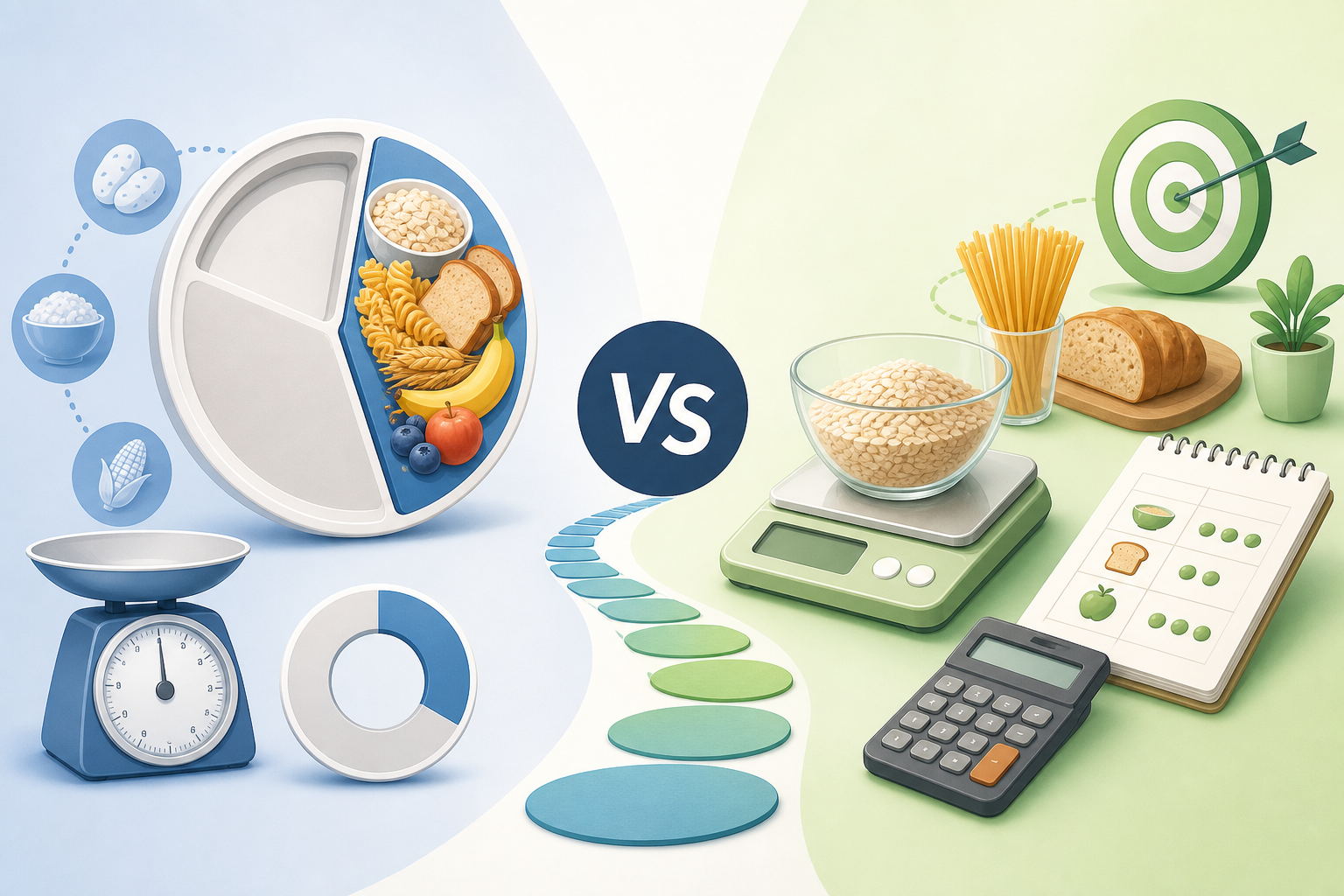
Carbohydrate percentage vs grams describes two ways of expressing the same planned carbohydrate intake. Percentage shows the share of total calories allocated to carbohydrate, while grams show the absolute quantity to eat over a day. A percentage only becomes a gram target when it is combined with a calorie target.
For example, 50% carbohydrate at 2,000 kcal equals 250 grams per day. At 1,600 kcal, the same 50% allocation equals 200 grams. This is why both the percentage and the calorie figure matter.
Carbohydrate percentage vs grams: the key difference
A carbohydrate percentage is a relative value. It describes how much of a person’s planned energy intake comes from carbohydrate compared with protein and fat.
Carbohydrate grams are an absolute value. They give a quantity that can be compared with nutrition labels, food records or meal-planning amounts.
- Percentage of calories: useful for viewing the overall macronutrient balance of an eating pattern.
- Grams per day: useful for translating that balance into a practical daily amount.
A carbohydrate percentage does not mean the percentage of food by weight. A diet providing 50% of calories from carbohydrate is not necessarily made up of 50% carbohydrate-containing food by weight, because foods also contain water, fibre, protein, fat and other components.
How to convert a carbohydrate percentage into grams
Carbohydrate is assigned 4 kilocalories per gram for this type of macronutrient calculation. The conversion therefore uses the calorie target, the selected carbohydrate percentage and the energy value per gram.
Carbohydrate grams per day = total calories × carbohydrate percentage ÷ 4
The percentage must be entered as a decimal in a manual calculation. For example, 50% becomes 0.50 and 45% becomes 0.45.
Example at 2,000 kcal
- Multiply 2,000 kcal by 0.50: 2,000 × 0.50 = 1,000 kcal from carbohydrate.
- Divide the carbohydrate calories by 4: 1,000 ÷ 4 = 250 grams.
The result is an estimated allocation of 250 grams of carbohydrate per day. It is not a measured intake unless actual food consumption is recorded and calculated separately.
Converting grams back into a percentage
The calculation can also be reversed:
Carbohydrate percentage = carbohydrate grams × 4 ÷ total calories × 100
If a person plans to consume 225 grams of carbohydrate within a 1,800 kcal target, those grams provide an estimated 900 kcal. Dividing 900 by 1,800 shows that carbohydrate accounts for 50% of the calorie target.
How calorie intake changes the gram result
The same carbohydrate percentage can produce substantially different gram amounts because the total calorie target changes. A percentage should therefore not be interpreted as a fixed quantity.
| Calorie target | Carbohydrate percentage | Calories from carbohydrate | Carbohydrate grams |
|---|---|---|---|
| 1,600 kcal | 40% | 640 kcal | 160 g |
| 1,600 kcal | 50% | 800 kcal | 200 g |
| 2,000 kcal | 50% | 1,000 kcal | 250 g |
| 2,400 kcal | 50% | 1,200 kcal | 300 g |
| 2,400 kcal | 55% | 1,320 kcal | 330 g |
The table also shows why comparing percentages without knowing calorie intake can be misleading. Two people could both allocate 50% of calories to carbohydrate while having different gram targets.
The reverse is also true. A fixed intake of 250 grams supplies an estimated 1,000 kcal from carbohydrate. That represents about 56% of a 1,800 kcal target, 50% of a 2,000 kcal target or 40% of a 2,500 kcal target.
Why percentages and grams are both useful
Percentage shows the overall dietary pattern
A percentage helps place carbohydrate within the full calorie allocation. If carbohydrate provides 50% of calories, the remaining 50% is available for protein and fat. The three macronutrient percentages should account for the overall energy allocation when the plan is internally consistent.
The National Academies describes an Acceptable Macronutrient Distribution Range for carbohydrate of 45% to 65% of energy for adults. This is a population-level reference range, not an individual prescription, and it does not determine which specific foods supply the carbohydrate.
Grams support practical planning
Food labels and tracking tools generally display carbohydrate in grams rather than as a percentage of a person’s calorie target. A daily gram estimate can therefore be divided across meals and snacks or compared with a food record.
For example, someone with a calculated allocation of 240 grams per day might use the figure as a daily planning total. The amount does not need to be divided equally, and the mathematical result alone does not determine meal timing or food choices.
Neither view measures carbohydrate quality
Percentage and grams only describe quantity and energy allocation. They do not show whether the carbohydrate comes from particular grains, legumes, fruit, vegetables, dairy products, drinks, sweets or a combination of foods.
They also do not summarise the overall nutritional characteristics of the diet. Two eating patterns can contain the same carbohydrate grams and percentage while being made up of very different foods.
What a carbohydrate calculator can and cannot tell you
A carbohydrate calculator automates the conversion between a calorie target, a carbohydrate percentage and grams per day. It uses the same formula: calories multiplied by the selected percentage, divided by 4.
A carb calculator can tell you:
- how many calories are allocated to carbohydrate;
- the corresponding estimated carbohydrate grams per day;
- how changing the calorie target changes the gram result;
- how changing the percentage affects carbs per day; and
- how a selected percentage compares with a commonly used adult reference range, when the tool provides that context.
It cannot tell you:
- whether the entered calorie target matches your measured energy needs;
- which carbohydrate percentage is personally appropriate;
- which foods should provide the calculated grams;
- whether a particular eating pattern meets all nutritional needs; or
- how a health condition, medication, pregnancy, athletic training or other individual factor should affect intake.
The output is a mathematical planning estimate rather than a medical nutrition prescription. Its accuracy depends on the calorie target and percentage entered. If the calorie target is only an estimate, the resulting gram amount is also an estimate.
Common questions about carbohydrate percentages and grams
Is 50% carbohydrate the same as 50 grams?
No. A percentage describes a share of total calories, while grams describe an absolute amount. At 2,000 kcal, 50% carbohydrate equals 250 grams; 50 grams would provide an estimated 200 kcal, or 10% of a 2,000 kcal target.
Do I need a calorie target before calculating carbs per day?
Yes, if the starting point is a carbohydrate percentage. The gram result cannot be calculated from the percentage alone because 50% of 1,600 kcal is different from 50% of 2,400 kcal.
Why does a carb calculator divide by 4?
The calculation assigns 4 kcal to each gram of carbohydrate. After determining how many calories are allocated to carbohydrate, dividing by 4 converts those calories into estimated grams.
Should the carbohydrate, protein and fat percentages equal 100%?
For a simplified macronutrient calorie allocation, the percentages are generally intended to total 100%. If they do not, some calories may be unallocated or counted inconsistently. Actual food records can also involve rounding and other components, so displayed figures may not always add up perfectly.
Does a lower carbohydrate percentage always mean fewer grams?
Not when comparing different calorie targets. A lower percentage applied to a higher calorie target can produce more grams than a higher percentage applied to a lower target. Both values must be considered together.
Can I compare my gram result with an adult percentage range?
Only after converting the grams into a share of total calories. A gram figure by itself cannot be compared directly with a percentage range. The relevant calculation requires both the carbohydrate grams and the total calorie intake.
Using both views together
The clearest approach is to use percentage for context and grams for practical planning. Percentage answers, “What share of calories comes from carbohydrate?” Grams answer, “What absolute daily quantity does that share represent?”
Understanding carbohydrate percentage vs grams also helps prevent comparisons that leave out calorie intake. Neither figure is inherently more accurate; each expresses a different aspect of the same allocation, and both depend on the assumptions entered.