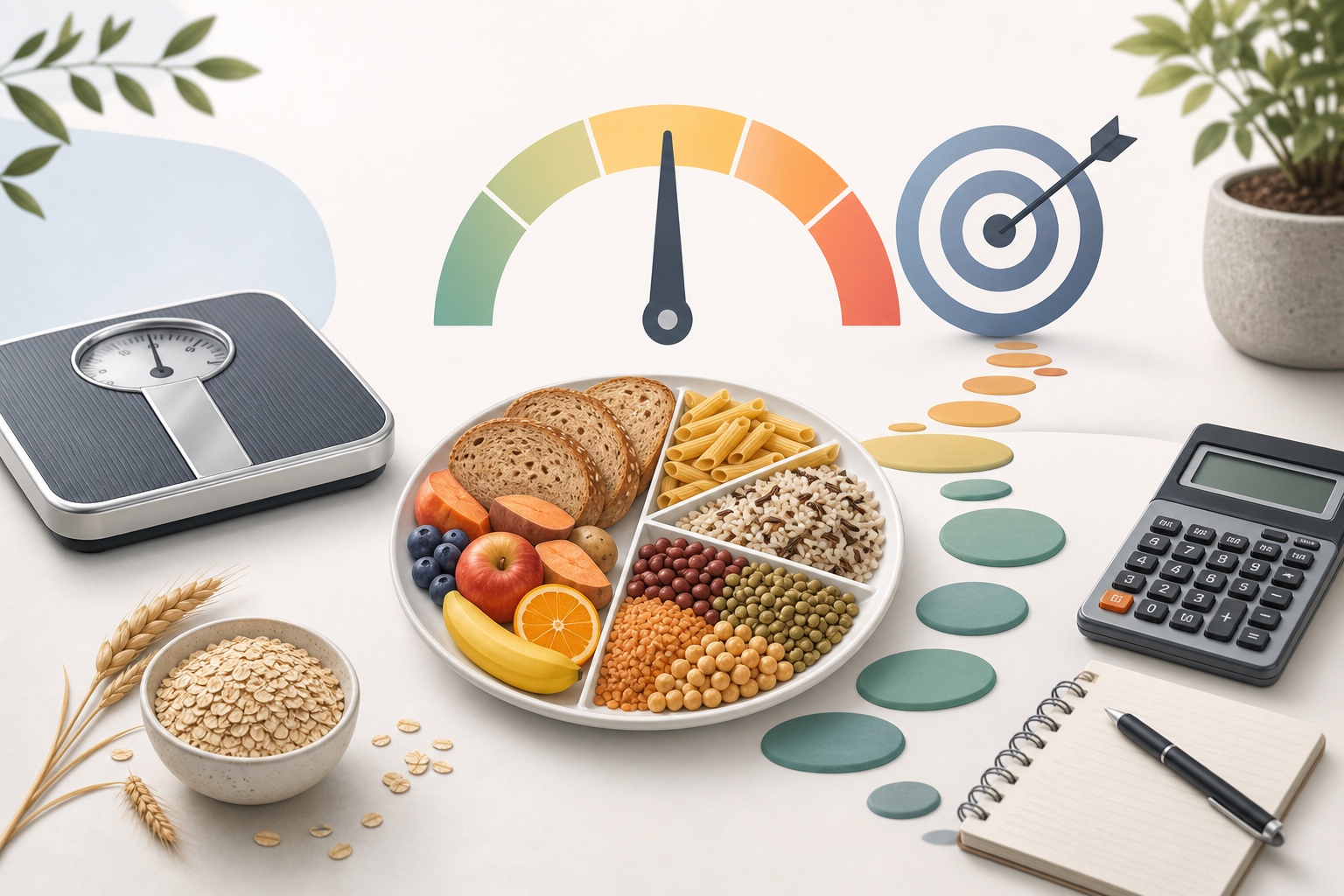
There is no single answer to how many carbs per day everyone should eat. For general comparison, the National Academies describes an adult carbohydrate range of 45% to 65% of total energy intake. On a 2,000-kcal diet, that equals approximately 225 to 325 grams per day. Your suitable amount may differ according to your calorie needs, dietary pattern, activity, food preferences and health considerations.
How many carbs per day is a useful starting point?
A practical starting point is to choose a percentage of your daily calories and convert it into grams. The 45% to 65% adult reference range allows for substantial variation rather than identifying one ideal carbohydrate target.
Here is what that range looks like at several calorie levels:
| Daily calorie target | 45% from carbohydrate | 65% from carbohydrate |
|---|---|---|
| 1,600 kcal | 180 g | 260 g |
| 1,800 kcal | 203 g | 293 g |
| 2,000 kcal | 225 g | 325 g |
| 2,400 kcal | 270 g | 390 g |
These are mathematical comparisons, not personalised recommendations. A percentage that works well for one person may not match another person’s energy needs, meal pattern or preferred foods.
How to convert a carbohydrate percentage into grams
Carbohydrate provides approximately 4 kilocalories per gram. To convert a calorie percentage into grams, first calculate the calories allocated to carbohydrate and then divide that number by 4.
Carbohydrate grams = daily calories × carbohydrate percentage as a decimal ÷ 4
For example, write 50% as 0.50. If you prefer to use the whole percentage number, divide by 100 before dividing by 4:
Carbohydrate grams = daily calories × percentage ÷ 100 ÷ 4
Example: 2,000 kcal with 50% from carbohydrate
- Multiply 2,000 kcal by 0.50: 2,000 × 0.50 = 1,000 kcal from carbohydrate.
- Divide carbohydrate calories by 4: 1,000 ÷ 4 = 250 grams.
The resulting target is 250 grams of carbohydrate per day. It is an estimated allocation based on the chosen calorie target and percentage; it is not a measured intake or a medical nutrition prescription.
Example: adjusting the percentage
Suppose someone has a planning target of 1,800 kcal and wants 45% of those calories to come from carbohydrate. The calculation is 1,800 × 0.45 ÷ 4, which gives approximately 203 grams per day.
If the same person chose 55%, the estimate would be approximately 248 grams. Changing the percentage changes the result even though the calorie target remains the same.
Why carbohydrate needs vary between people
Carbohydrate intake can vary substantially across eating patterns. Two people with similar body sizes may choose different amounts because their total energy needs, activity, meal preferences and macronutrient distributions are not identical.
Factors that may influence a planning target include:
- Total calorie intake: The same carbohydrate percentage produces more grams at a higher calorie level.
- Physical activity: The type, duration and intensity of activity can affect how a person organises meals and energy intake.
- Dietary pattern: Some eating patterns allocate a larger share of calories to carbohydrate, while others allocate more to fat or protein.
- Food preferences and culture: Staple grains, legumes, fruit and other carbohydrate-containing foods differ across cuisines.
- Appetite and meal structure: People vary in the combinations of foods and macronutrients they find practical and satisfying.
- Health circumstances: Individual medical or nutrition needs can make a general percentage unsuitable without personalised guidance.
Percentages also interact. If carbohydrate takes up a larger percentage of a fixed calorie target, the percentages assigned to protein or fat must decrease. A daily plan should therefore be considered as a whole rather than treating carbohydrate in isolation.
Carbohydrate quantity does not describe diet quality
A gram target tells you how much carbohydrate a plan contains, but not where that carbohydrate comes from. The same total could be assembled from very different combinations of foods.
Carbohydrate-containing foods include grains, legumes, fruit, starchy vegetables, milk and yoghurt, as well as foods and drinks containing added sugars. Their overall nutritional profiles are not interchangeable. Foods may differ in fibre, protein, fats, vitamins, minerals, preparation and portion size.
For that reason, reaching a calculated number should not be the only objective. It is useful to consider the pattern behind the total, including:
- the balance between minimally processed and highly processed choices;
- the inclusion of fibre-containing foods;
- the variety of grains, legumes, fruit and vegetables where suitable;
- the amount of added sugar in the overall eating pattern;
- how carbohydrate foods are combined with sources of protein and fat; and
- whether meals are practical, affordable and culturally appropriate.
A lower carbohydrate total is not automatically higher quality, and a higher total is not automatically lower quality. The source and context of the carbohydrate matter alongside the number of grams.
Using a carbohydrate calculator correctly
A carbohydrate calculator performs the percentage-to-grams conversion automatically. You enter a calorie target and select the percentage of calories to allocate to carbohydrate. The result is an estimated number of grams per day.
A carb calculator can help with:
- converting a chosen calorie percentage into grams;
- comparing different percentage options;
- seeing how a change in calorie intake affects carbohydrate grams;
- checking the arithmetic used in a meal-planning estimate; and
- viewing a commonly used adult reference range for context.
However, the calculator cannot determine your measured energy requirements, assess the nutritional quality of your carbohydrate sources or identify the best macronutrient split for your circumstances. It also cannot account fully for health conditions, medicines, symptoms, pregnancy, breastfeeding or sport-specific nutrition needs.
The output is only as useful as the inputs. If the calorie target is an estimate, the carbohydrate result is also an estimate. Selecting 50% does not establish that 50% is personally appropriate; it only calculates what that choice represents in grams.
Practical ways to apply a daily carbohydrate estimate
A daily total can be used as a planning framework rather than a requirement to hit an exact number every day. Food intake naturally varies, and nutrition labels, serving sizes and home-prepared recipes all introduce some uncertainty.
One approach is to distribute the estimated total across meals and snacks. For example, a 250-gram daily plan might allocate different amounts to breakfast, lunch, dinner and snacks according to the person’s routine. It does not have to be divided equally.
When reviewing a plan, consider both quantity and food selection:
- Confirm that the calorie target is a planning estimate rather than a measured value.
- Choose a carbohydrate percentage that fits the wider macronutrient plan.
- Convert that percentage into grams.
- Review which foods contribute those grams.
- Adjust meal distribution for appetite, activity and schedule.
- Reassess the plan if the inputs or circumstances change.
There is usually little value in treating a calculated target as perfectly precise. The calculation is exact for the numbers entered, but the real-world calorie target, portions and food composition may not be exact.
Frequently asked questions
Is 250 grams of carbohydrate per day too much?
Not necessarily. At 2,000 kcal, 250 grams supplies 1,000 kcal, or 50% of total energy. That falls within the National Academies’ adult reference range, but whether it suits an individual depends on the wider diet and personal circumstances.
Should I count total carbohydrates or only sugars?
The percentage-to-grams formula refers to total carbohydrate, not sugars alone. If you use food labels to compare your intake with a calculated target, use the total carbohydrate value unless your nutrition plan specifically uses another measure.
Does fibre count towards carbohydrate grams?
Food-labelling rules and the way fibre is presented can differ between countries. Use the total carbohydrate figure provided under your local labelling system consistently, and avoid mixing values calculated under different conventions.
Can I calculate carbohydrate grams without a calculator?
Yes. Multiply daily calories by the chosen percentage written as a decimal, then divide by 4. For 1,800 kcal at 50%, the calculation is 1,800 × 0.50 ÷ 4 = 225 grams.
Do I need to eat the same number of carbs every day?
Not everyone plans intake that precisely. Daily amounts may vary with meals, schedules and activity. A calculated target can be treated as a general planning estimate unless there is a specific reason to follow a more structured plan.
Ultimately, the answer to how many carbs per day depends on both the calorie target and the percentage selected. The calculation provides a useful quantity estimate, while food quality, overall dietary balance and individual needs provide the necessary context.